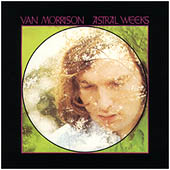
1. Astral Weeks
2. Beside You
3. Sweet Thing
4. Cyprus Avenue
5. The Way Young Lovers Do
6. Madame George
7. Ballerina
8. Slim Slow Slider
Rolling stone
He didn't use the phrase for a song title until a year later, but "Astral Weeks" was the album on which Van Morrison fully descended "into the mystic." Morrison's first full-fledged solo album sounded like nothing else in the pop-music world of 1968: soft, reflective, hypnotic, haunted by the ghosts of old blues singers and ancient Celts and performed by a group of extraordinary jazz musicians, it sounds like the work of a singer and songwriter who is, as Morrison sings in the title track, "nothing but a stranger in this world."
It also sounds like the work of a group of musicians who had become finely attuned to one another through years of working together - but, in fact, Morrison had made his name with rock songs like "Gloria" and "Here Comes the Night," and he sang "Astral Weeks," sitting by himself in a glass-enclosed booth, scarcely communicating with the session musicians, who barely knew who he was.
"Some people are real disillusioned when I tell them about making the record," says Richard Davis, who supplied what may be the most acclaimed bass lines ever to grace a pop record. "People say, 'He must have talked to you about the record and created the magic feeling that had to be there . . .' To tell you the truth, I don't remember any conversations with him. He pretty much kept to himself. He didn't make any suggestions about what to play, how to play, how to stylize what we were doing."
"I asked him what he wanted me to play, and he said to play whatever I felt like playing," adds Connie Kay, the Modern Jazz Quartet drummer, who was also in the group assembled for the session. "We more or less sat there and jammed, that's all."
Kay was hired because Davis had suggested him; Davis got the nod because he had often worked with Lewis Merenstein, who produced the record and rounded up the musicians. Other musicians on the album include guitarist Jay Berliner, percussionist Warren Smith and horn player John Payne - all of them New York jazzmen and session players who knew nothing about Morrison and who rarely appeared on pop records.
At the time, Morrison's solo career was just getting under way; earlier he had let the rough rock and R&B band Them. Until he signed with Warner Bros., to make "Astral Weeks," the mercurial Irishman didn't even have a deal with a major American label, though he had made a few solo recordings, including the sunny pop hit "Brown Eyed Girl" and the scarifying "T.B. Sheets," a ten-minute dirge about a friend's death from tuberculosis.
The songs he brought into New York's Century Sound Studios were a far cry from those earlier tunes. They were long, most of them, and meandering, suffused with the pain of the blues and the lilt of traditional Irish melodies. Morrison depicted the streets of Belfast in a dim, hallucinatory light, peopled with characters who danced like young lovers and spun like ballerinas but who mostly struggled to reach out to each other and find the peace and clam that otherwise eluded them. The crowning touch is "Madame George," a cryptic character study that may or may not be about an aging transvestite but that is certainly as heartbreaking a reverie as you will find in pop music.
A straight rock & roll band probably wouldn't have know what to do with these songs, but the musicians Merenstein assembled moved with the lightness and freedom that the tunes demanded. And the arrangements, invented on the spot by those players, were as singular as the world they illustrated: a soothing acoustic guitar, gently brushed drums, the caressing warmth of Davis's bass.
Not that the musicians were trying to interpret Morrison's words. "I can't remember ever really paying attention to the lyrics," says Davis. "We listened to him because you have to play along with the singer, but mostly we were playing with each other. We were into what we were doing, and he was into what he was doing, and it just coagulated."
They worked from seven to ten at night, running through songs they had never heard before; both Davis and Kay remember that the basic tracks were finished in a single three-hour session (the liner notes of the compact disc say it took "less than two days"). By seven o'clock some of the musicians had already played on two earlier sessions and Davis, for one, credits the relatively late hour with the way "Astral Weeks" sounds. "You know how it is at dusk, when the day has ended but it hasn't?" Davis asks. "There's a certain feeling about the seven-to-ten-o'clock session. You've just come back from a dinner break, some guys have had a drink or two, it's this dusky part of the day, and everybody's relaxed. Sometimes that can be a problem - but with this record, I remember that the ambiance of that time of day was all through everything we played."
The album wasn't a hit, the way "Moondance" would be in 1970, but it was instantly recognized as one of the rare albums for which the word "timeless" is not only appropriate but inescapable. And songs from the LP have continued to show up in Morrison's live performances since then. "Cyprus Avenue" was often his set closer, and as recently as last year he performed a "Ballerina/Madame George" medley.
As for the "Astral Weeks" musicians, they don't know much more about Morrison than they did back in 1968. "He didn't seem to be the kind of guy who hung out with musicians, so I never got to know him," says Davis, who now teaches music in Wisconsin, in addition to doing session work and playing live dates. "But I'll tell 5/5
Amazon.com
Never mind that Van Morrison is one of the most indelible songwriters of the 20th century--take each album on its own terms. On 1968's seminal Astral Weeks, a twentysomething Van Morrison can be found belting his gospelly, bluesy vocals in just as fine a form as he would be 20 years hence. In the sociopolitical context of the times, the album cried out about such ubiquitous '60s themes as cultural oppression and social upheaval. But it is Morrison's vocal dexterity and passion that maintains such timeless appeal. Take tracks like "Madame George" or "Cyprus Avenue" and you'll find such beautiful mourning, it'll be clear why modern songwriter Sinéad O'Connor once publicly exclaimed: "Van Morrison should be friggin' canonized." --Nick Heil
Ohyeah.com
"The whole European philosophical tradition since Plato has attempted to account for our sense that we do not belong in the world, that we are pilgrims and strangers here, homesick for another place where one day we shall truly be ourselves."
- AN Wilson, 'CS Lewis: A Biography'
"Ain't nothin' but a stranger in this world."
- Van Morrison 'Astral Weeks'
'Astral Weeks' is a trip - maybe the greatest that's ever been committed to record. It's brimful of memories, illuminations, crazy scenes and ciphres, some of which may may never be solved. For 30 years, now it's been adored by stoners, acid-eaters, apprentice mystics, musicologists and homesick Irish kids. It's the foundation of the Van Morrison myth - the album about a guy that ventures into some otherworldly area, finding strange connections in time and place, having his mind utterly blown.
It's a difficult record to describe. It's certainly not rock and roll. There's a bit of jazz in there - maybe the spirit of John Coltrane, and some of the session guys who played on it were associates of Charles Mingus, Miles Davis and the Modern Jazz Quartet. But there are folksy touches and a Latin brass arrangement too.
However, the most remarkable thing in there is Van's voice. He's excelled himself since, on tracks such as 'Listen To The Lion', or 'Into The Mystic', on 'Vanlose Stairway' and 'Crazy Love'. But this is an album's worth of feverish, uncharted art. He's wailing and wowing, picking up little phrases and running them over in his mouth, forming amazing word-whirls. Listen to the famous lines in 'Madame George', the ones that unfurl as:
"And the love that loves the love that loves love that loves. The love that loves to love the love the loves to love the love that loves."
On paper, it looks strange. Yet when Van takes each word and sends it spinning into the next, it's like gazing into one of those psychedelic illustrations from the Book of Kells. Not many singers have such a linguistic capacity. You're thinking of fellow starsailors such as Tim Buckley or Terry Callier, or about the trance-inducing power of Nusrat Fateh Ali Khan.
Morrison's action flits from Belfast to Dublin, from West London to Massachusetts. There are a bunch of recogniseable characters, such as young Rosie, who lives in the avenue of trees, and the unspeakably lovely ballerina from the Boston area. And at the centre of the trip is a strange, amorphous character called George who has to leave town due to some mysterious incident.
Van allows his subconscious to do much of the work, patching images together, dropping in lines from old pop songs, Biblical phrases and gospel hymns, occasionally leaving the listener (and perhaps himself) in a richly confused state.
One theory is that 'Astral Weeks' was intended as a film soundtrack, which may explain the quick fades and unusual edits, the way one scene gives way to something altogether different. Van called the scheme "multiple visual sketches". There's even talk of a 'lost' track, which allowed Van to improvise for 15 minutes, gloriously lost in music.
The album was apparently recorded in two short sessions in New York, with musicians that he barely knew. There are times when you can hear the players busking it. Bassist Richard Davis, an experienced hand, plays the very minimum on the title track. You can imagine him watching Van's performance for clues, underlining the mood as it rises and falls. But that unexpected feeling gives the music an extra edge.
Compare this to the prototype versions of 'Beside You' and 'Madame George' which appeared on the 'Bang Masters' sessions of 1967, and realise how the conventional rock sound blunted the magic. But a year later, at Century Sound, on 52nd Street, the 'Astral Weeks' session, bottled the genie. The results have regularly been hailed in the Greatest Albums Ever polls across the decades.
Recorded just before 'The Troubles' flared in Northern Ireland, the LP is a tantalising glimpse into a world that's long gone. In 'Astral Weeks', people and relationships tend to disintegrate over time. There's an echo of this sentiment in the titles for the two sides of vinyl as it originally appeared. These were: 'In The Beginning' and 'Afterwards'.
You can take the inference back even further and compare these songs to William Blake's 'Songs Of Innocence and Experience'. The joyful, loved-up numbers such as 'Sweet Thing' are ace. But when the story turns rotten as in 'Slim Slow Slider', the sadness is all the more upsetting because we know just how blissful things once were. Certainly much of the record finds Van looking back, pained and disconsolate, thinking that he'll never be so happy again in this world.
The misty quality of Van's lyrics allows him to be interpreted in many ways. Over the years, I've met dozens of people who carry completely different versions of 'Astral Weeks' in their imagination. This is my version and it's served me well; penetrating my dreams and sending me down beautiful avenues of thought. Maybe you'll recognise some of it too.
|