- Black Dog
- Rock And Roll
- Battle Of Evermore
- Stairway To Heaven
- Misty Mountain Hop
- Four Sticks
- Going To California
- When The levee Breaks
About.com
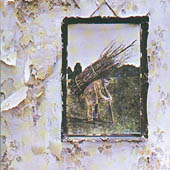
Led Zeppelin IV - a.k.a. Zoso, Runes, Four Symbols, Untitled or whatever the hell the album with the strange cover sporting a photograph on a war-torn wall of an old man seemingly stooped over, loaded down with a batch of straw on his back (?) is called - is a crowning achievement from one of rock's most enduring legends. Taking elements of the hard rock, blues-based format the band had mastered on their first two albums; merging the suave acoustic/folk musings from the third album; and blending it all with an exotic mix of Indian/Mediterranean stylings and mythological lyrics, Led Zeppelin's fourth album confirmed the inevitable - they were on their way to becoming the biggest musical act on the planet.
Guitarist Jimmy Page, unveiling a flurry of complex overdubs and drop dead dripping textures, was the chief architect, maneuvering his vision to fruition on this record. As a producer, Page skillfully manipulated and molded the band's natural thunder into an intoxicating wall of sound. Robert Plant's wailing voice was a vital part of that sound, effectively becoming a fourth and unique instrument unto itself. This is obvious on "Black Dog," the album's opening track with a stop-and-go arrangement that relies completely on the singer's well-paced and screeching delivery. The energy shifts into overdrive with "Rock and Roll," another signature tune that would eventually be mutilated by every garage band in existence. And then in one grand swoop, a mystical mood settles in, mandolins and acoustic guitars howl at the moon, and Plant and Sandy Denny - a member of the seminal English folk group, Fairport Convention - exchange verses in the dramatic, "The Battle Of Evermore." As if everything for this band climaxes during the fourth round, the first three songs meticulously set the stage for the album's magnum opus, "Stairway To Heaven."
Despite the fact that "Stairway To Heaven" would go on to be the most overplayed song in the history of FM radio, it was never released as a single. This undoubtedly helped push the fourth album up the charts, peaking at number two in the U.S. Beyond the first four cuts, there's a bountiful helping of prime-cut Zep to maintain the momentum. The invincible keyboard work of John Paul Jones, weaving in and out of Page's smooth guitar lines, tastefully eases "Misty Mountain Hop" forward; four drumsticks and the powerful foot of John Bonham drives "Four Sticks;" the folksy meanderings of Page and Plant reveal yet another side on "Going To California." The record closes out - suitably enough - with the epic, "When The Levee Breaks." And while Led Zeppelin would go on to produce other classics of this caliber, nothing would ever capture the band's pure essence and strength as well as the notorious fourth album - no matter what you want to call it.
- Review by Shawn Perry
Amazon
Amazon.com essential recording
Also known as the "rune" album because of the medieval symbols adorning its cover, Led Zeppelin's fourth album, released in 1971, turned them from mere superstars into giant behemoths of the rock world. On tracks like "Black Dog," "Misty Mountain Hop," and "Rock and Roll," the combination of Robert Plant's banshee wails and Jimmy Page's frenetic guitar playing forever altered the stylistic bent of hard rock music. And the foreboding "When the Levee Breaks" demonstrated that Zeppelin could indeed play the blues fairly straight if they so desired. Still, everything here ultimately took a back seat to the album's (and, ultimately, the band's) magnum opus--the expertly constructed and deftly executed classic, "Stairway to Heaven." --Billy Altman
Jimmy Page was a top London studio guitarist before he got rich and famous as the musical leader of Led Zeppelin. The group's fourth--and arguably their finest--album is as much a tribute to his technique as a monument to his versatility. Page produced the album, co-wrote all eight songs, and played mandolin as well as all the guitars. Musically, this 1971 disc ranges from acoustic English folke ("Goin' to California" and "The Battle of Evermore," the latter featuring the... read more
CD Universe
Led Zeppelin: Robert Plant (vocals, harmonica); Jimmy Page (electric, acoustic & 12-string guitar, mandolin); John Paul Jones (bass, keyboards); John Bonham (drums, percussion).
Additional personnel: Sandy Denny (vocals); Ian Stewart (piano).
Recorded at Headley, Grange, Hampshire, Island Studios, London, England; Sunset Sound, Los Angeles, California.
All tracks have been digitally remastered.
LED ZEPPELIN IV is the definitive Led Zeppelin recording. It was on LED ZEPPELIN IV that the band's sound and concept, Plant's vocals, and Page's arranging skills finally crystallized into something completely distinct and original. The earthy hedonism of their earlier work was deepened and extended on rockers like "Black Dog," "Rock And Roll" and "Misty Mountain Hop." Their interest in traditional folk music (and a more tender form of sentiment) found fresh expression on "Going To California" and "The Battle Of Evermore" (with Sandy Denny of Fairport Convention). And "When The Levee Breaks" was yet another powerhouse blues.
LED ZEPPELIN IV was also the recording which produced Led Zeppelin's most celebrated composition, "Stairway To Heaven". From its familiar opening chord progression, the song steadily grows in intensity, reflecting Led Zeppelin's growing interest in metaphysical imagery, gradually transforming itself from a folkish ballad into a rocking anthem.
NME
This much they evidently did, as you could tell from the opening bars of 'Black Dog' and 'Rock And Roll' on 'Led Zeppelin IV'. Fantastic electrified riffs, and the world was Led once more. Then, of course, came 'Stairway To Heaven'. OK, mystical hippy bollocks on the one hand, but, hey!, great guitar 'work', and extensive air guitar duties were expected of every teenage boy during the last fast bit. And finally, of course, there was 'When The Levee Breaks', and the drumbeat that ate a continent. They just don't write them as big as that any more.
7/10
Q
You bought Remasters. You bought Boxed Set-2 to mop up. You went mad, bought The Complete Studio Recordings. And now you can buy each album, digitally reupholstered, separately. Who are you, exactly? Not Tony Blair, surely. Anyway - note III's release is delayed due to sleeve restoration - the first one (1969) is the rites of passage, Marquee-style bluesbreaker album, recorded in just 30 hours (no record contract, no cash), its peak Dazed And Confused, wherein half-inched blues explodes into riffology. II (1969) streaks ahead, recorded en route in America, swollen rock excursions Whole Lotta Love and The Lemon Song its keystones, Bonham's Moby Dick a happy indulgence. IV or Four Symbols (1971) abides the unbeaten classic, its Headley Grange big-room ambience still best described by When The Levee Breaks - Bonzo in excelsis. Survive Stairway To Heaven and you'll know why it's the best seller of the lot. Houses Of The Holy (1973) is the sound of a band whose cup overfloweth - Plant and Jones couldn't get the individual stuff down fast enough. Disparate and less earthy, the latter's No Quarter is an involving mantra and The Ocean is funky, but it is a sickly whole when you know what came next . . . Reviewed by Andrew Collins
Rolling Stone
It might seem a bit incongruous to say that Led Zeppelin-a band never particularly known for its tendency to understate matters-has produced an album which is remarkable for its low-keyed and tasteful subtlety, but that's just the case here. The march of the dinosaurs that broke the ground for their first epic release has apparently vanished, taking along with it the splattering electronics of their second effort and the leaden acoustic moves that seemed to weigh down their third. What's been saved is the pumping adrenaline drive that held the key to such classics as "Communication Breakdown" and "Whole Lotta Love," the incredibly sharp and precise vocal dynamism of Robert Plant, and some of the tightest arranging and producing Jimmy Page has yet seen his way toward doing. If this thing with the semi-metaphysical title isn't quite their best to date, since the very chances that the others took meant they would visit some outrageous highs as well as some overbearing lows, it certainly comes off as their most consistently good.
One of the ways in which this is demonstrated is the sheer variety of the album: out of eight cuts, there isn't one that steps on another's toes, that tries to do too much all at once. There are Olde Englishe ballads ("The Battle of Evermore" with a lovely performance by Sandy Denny), a kind of pseudo-blues just to keep in touch ("Four Sticks"), a pair of authentic Zeppelinania ("Black Dog" and "Misty Mountain Hop"), some stuff that I might actually call shy and poetic if it didn't carry itself off so well ("Stairway to Heaven" and "Going To California") ...
... and a couple of songs that when all is said and done, will probably be right up there in the gold-starred hierarchy of put 'em on and play 'em again. The first, coyly titled "Rock And Roll," is the Zeppelin's slightly-late attempt at tribute to the mother of us all, but here it's definitely a case of better late than never. This sonuvabitch moves, with Plant musing vocally on how "It's been a long, lonely lonely time" since last he rock & rolled, the rhythm section soaring underneath. Page strides up to take a nice lead during the break, one of the all-too-few times he flashes his guitar prowess during the record, and its note-for-note simplicity says a lot for the ways in which he's come of age over the past couple of years.
The end of the album is saved for "When The Levee Breaks," strangely credited to all the members of the band plus Memphis Minnie, and it's a dazzler. Basing themselves around one honey of a chord progression, the group constructs an air of tunnel-long depth, full of stunning resolves and a majesty that sets up as a perfect climax. Led Zep have had a lot of imitators over the past few years, but it takes cuts like this to show that most of them have only picked up the style, lacking any real knowledge of the meat underneath.
Uh huh, they got it down all right. And since the latest issue of Cashbox noted that this 'un was a gold disc on its first day of release, I guess they're about to nicely keep it up. Not bad for a pack of Limey lemon squeezers. (RS 98)
LENNY KAYE
Barnes & Noble
Rightfully renowned for the powerful crunch of their blues-based hard
rock, Led Zeppelin are regarded as an important stylistic template for
everything from heavy metal to grunge. But the softer, folk-rock side of
Zeppelin proved to be equally influential, and it was the band's fourth
album that achieved the finest balance between bucolic strums and
ear-smashing bombast. "Black Dog" opens the album, with vocalist Robert
Plant boasting about how he's "gonna make you sweat, gonna make you
groove," and the band backs up the bravado with the hard rock of "Rock and
Roll" and "Misty Mountain Hop," songs that remain touchstones to
generations of head-bangers. But guitarist Jimmy Page was also drawn to
softer textures, and he shrewdly enlisted Fairport Convention singer Sandy
Denny to duet with Plant on "The Battle of Evermore," over mandolins
riffling around the pulsing folk melody. Soft meets hard on Zeppelin's
most famous song, the epic "Stairway to Heaven," with verses strung upon
arpeggiated guitar lines that ultimately lead to an explosive,
finely-chiseled blues-rock solo. Led Zeppelin made other fine albums, but
this one remains the core of their canon. John Milward
All Music Guide
Encompassing heavy metal, folk, pure rock & roll, and blues, Led
Zeppelin's untitled fourth album is a monolithic record, defining not only
Led Zeppelin but the sound and style of '70s hard rock. Expanding on the
breakthroughs of III, Zeppelin fuse their majestic hard rock with a
mystical, rural English folk that gives the record an epic scope. Even at
its most basic -- the muscular, traditionalist "Rock & Roll" -- the album
has a grand sense of drama, which is only deepened by Plant's burgeoning
obsession with mythology, religion, and the occult. Plant's mysticism
comes to a head on the eerie folk ballad "The Ballad of Evermore," a
mandolin-driven song with haunting vocals from Sandy Denny, and on the
epic "Stairway to Heaven." Of all of Zeppelin's songs, "Stairway to
Heaven" is the most famous, and not unjustly. Building from a simple
fingerpicked acoustic guitar to a storming torrent of guitar riffs and
solos, it encapsulates the entire album in one song. Which, of course,
isn't discounting the rest of the album. "Going to California" is the
group's best folk song, and the rockers are endlessly inventive, whether
it's the complex, multi-layered "Black Dog," the pounding hippie satire
"Misty Mountain Hop," or the funky riffs of "Four Sticks." But the closer,
"When the Levee Breaks," is the one song truly equal to "Stairway,"
helping give IV the feeling of an epic. An apocalyptic slice of urban
blues, "When the Levee Breaks" is as forceful and frightening as Zeppelin
ever got, and its seismic rhythms and layered dynamics illustrate why none
of their imitators could ever equal them. Stephen Thomas Erlewine
RW New York New York:
Why the hell is this so low down in the list?! I can't understand it! This is the greatest album of all time! 10/10:
|