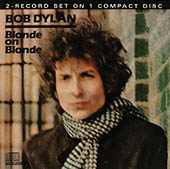
1. Rainy Day Women No's 12 $ 35
2. Pledging My Time
3. Visions Of Johanna
4. One Of Us Must Know (Sooner Or Later)
5. I Want You Stuck Inside Of Mobile With The Memphis Blues Again
6. Leopard-Skin Pill-Box Hat
7. Just Like A Woman
8. Most Likely You Go Your Way And I'll Go Mine
9. Temporary Like Achilles
10. Absolutely Sweet Marie
11. 4th Time Around
12. Obviously 5 Believers
13. Sad Eyed Lady Of The Lowlands
Amazon
Considered an unprecedented magnum opus when it arrived on two records in
May of 1966 (1997's Time out of Mind is actually only about a minute
shorter), Blonde on Blonde featured Dylan continuing to demonstrate
remarkable powers over the course of 14 new numbers. Working in Nashville
with session men and a few conscripted recruits (Al Kooper, Robbie
Robertson), Dylan continued to bend minds with his warped lyrics and
phrasing. Even dashed-off numbers such as "Obviously 5 Believers" and
"Rainy Day Women #12 & 35" contribute to the crazed, fun-house ambience.
Dylan will never be this wild again. --Steven Stolder
Barnes & Noble
Arguably one of the greatest rock 'n' roll records ever, BLONDE ON BLONDE
came out during a period of great creativity and considerable tumult for
Bob Dylan: The 1966 classic followed two other seminal recordings,
BRINGING IT ALL BACK HOME and HIGHWAY 61 REVISITED, and came at a time
when Dylan was playing his first concerts with a plugged-in band. His
predominantly folk constituency booed him vociferously at most tour stops,
but he was evidently roused by the response. Mostly written in hotel rooms
during his tours in '65 and '66, BLONDE ON BLONDE features enduring
novelties like "Rainy Day Women #12 and #35" and "Leopard-Skin Pill-Box
Hat" and bluesy romps such as "I Want You" and "Most Likely You Go Your
Way and I'll Go Mine," as well as beautiful ballads like "Visions of
Johanna," "Just Like a Woman," and "Sad Eyed Lady of the Lowlands."
Although it was recorded in Nashville, there isn't a pronounced country
sound on BLONDE ON BLONDE. However, following a hiatus (reportedly due to
a motorcycle accident), Dylan emerged with a more countrified sound on his
following recording, JOHN WESLEY HARDING, launching another controversial
chapter his career. Martin Johnson
All Music Guide
If Highway 61 Revisited played as a garage rock record, the double album
Blonde on Blonde inverted that sound, blending blues, country, rock and
folk into a wild, careening and dense sound. Replacing the fiery Michael
Bloomfield with the intense, weaving guitar of Robbie Robertson, Dylan led
a group comprised of his touring band the Hawks and session musicians
through his richest set of songs. Blonde on Blonde is an album of enormous
depth, providing endless lyrical and musical revelations on each play.
Leavening the edginess of Highway 61 with a sense of the absurd, Blonde on
Blonde is comprised entirely of songs driven by inventive, surreal and
witty wordplay, not only on the rockers but also on winding, moving
ballads like "Visions of Johanna," "Just Like a Woman," and "Sad Eyed Lady
of the Lowlands." Throughout the record, the music matches the
inventiveness of the songs, filled with cutting guitar riffs, liquid organ
riffs, crisp pianos and even woozy brass bands ("Rainy Day Women #12 &
35"). It's the culmination of Dylan's electric rock & roll period -- he
would never release a studio record that rocked this hard, or had such
bizarre imagery, ever again. Stephen Thomas Erlewine
CD Universe
A year after HIGHWAY 61 REVISITED, Dylan repeated the act with
further epitaphs of creative malarkey and intrigue. We were spoiled
with a double album, longer than anything we had previously heard,
yet still destined to endure. The punishing touring and high profile
drove Dylan to be creative beyond belief as he scribbled these gems
in his hotel rooms. Surrounding himself with the likes of Al Kooper,
Robbie Robertson, Charlie McCoy and Kenny Buttrey, these seasoned
musicians gave this album a relaxed confidence, quite unlike the
youthful energy of HIGHWAY 61 REVISITED. More than thirty years
later this album still rewards and surprises. A gigantic record.
Ink Blot
For the uninitiated, Blonde On Blonde is both the
perfect start-up record and the ultimate challenge in
the Dylan catalog. He distills the expansive surrealism
he pioneered on the two groundbreaking albums that
preceded (Bringing It All Back Home and Highway 61
Revisited) down to a thematic thread that runs
throughout the record. As befits Dylan, however, the
identity and meaning of this thread are a matter of both
speculation and disagreement. You know it's there, you
just can't explain it.
The songs defy not only description but interpretation,
despite inviting both at every turn. They burrow deep
into the grey matter of the listener without detour;
they are visceral rather than literal or even symbolic.
The positively epic "Visions Of Johanna" has the effect
of wrapping the listener in a warm, spangled word-veil
of mystical psychedelia, the classic "Stuck Inside Of
Mobile With The Memphis Blues Again" is a startling
initiation into a shadow world of Dylan's creation,
while "Most Likely You Go Your Way And I'll Go Mine"
chugs along like a magical train.
Blonde On Blonde was recorded at the peak of one of many
controversial periods in Dylan's career. He had recently
shocked and alienated the folk audience that claimed him
as their messiah by playing with an electric band at the
Newport Folk Festival. Although the booing of the crowd
was probably greatly exaggerated, the rumors of the
reaction proved more than enough inspiration for
similar, yet more intense audience response all
throughout the 1966 tour. The resulting conflict between
performer and audience was physically and mentally
taxing for Dylan, but had the effect of galvanizing both
his live performances and his recordings.
Ironically, Dylan produced his most cohesive album to
date in the midst of a musical power struggle between
his artistic alter egos; the folk messiah is here
reconciled with the prophet who brought forth the
bastard son of his own creation, the folk rocker. The
overall sound achieved on Blonde On Blonde is so
original and enjoyable that it utterly defies the
classification his "fans" attempted to foist upon him
(see sidebar) Dylan himself, in a 1978 interview,
described the sound of the record in typically mystical
fashion as "that thin, that wild mercury sound. It's
metallic and bright gold, with whatever that conjures
up..." The "wild mercury sound" must be heard to be
understood. You won't be sorry.
Q
Blood On The Tracks took away the taste of the
unedifying Planet Waves. Yet there's more to the "marital
strife" album than the hair-raisingly contemptuous Idiot Wind
(the way it starts, as if already halfway through, still
startles), since the love songs are sexier and the melodies
breezier than any he had written since, well, Blonde On
Blonde. Dylan the iconoclast, poet and junkyard dog can be
found in all his records (even Desire). But Dylan the
tunesmith never had better days than these
VH-1
By the time he cut this double album masterpiece, Dylan had hung around
the inkwell long enough to have Highway 61's florid phrasing and seductive
non sequiturs really make sense emotionally. Even the most outrageous
poesy resonated with a larger audience: Before 1965 you'd be hard-pressed
to find a image like a "dancing child with his Chinese suit" in the top
20. Dylan had found a way, based on melody and delivery, to shift rock's
lyrical paradigm while wooing AM radio listeners, and all of a sudden,
smart was popular. Blonde on Blonde was less of a rampage than its noble
predecessor, and the breadth of the song structures - from the cranky and
hilarious blues of "Leopard Skin Pill Box Hat" to the gliding waltz of
"4th Time Around" - offered listeners a near-cinematic scope. Even more
important was the fact that instead of social commentary (Highway 61's
driving force), the subject matter was love - and Dylan had a million ways
to say "au revoir" and "baby, please don't go." Whether cackling and
castigating or forgiving and pleading, he made the music enhance the
sentiment. Nashville's studio boys were perfect for the job, because
pliability is their strong suit. The dilemma of most artful communication
is finding a way to be both singular and universal. As lonesome organ
grinders, riverboat captains, and kings of Tyrus raise a glass to all
sorts of wholly American frustrations in Blonde on Blonde's honky-tonk
lagoon, Dylan makes it seem like a snap to radically reroute the world's
most popular art form .
|