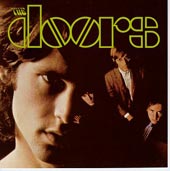
|
“ อัลบั้มเปิดตัวที่สร้างความตื่นตะลึงให้กับวงการเพลงในในยุค ’60 เนื้อเพลงของ The Doors เกือบทั้งหมดคือบทกลอนที่เขียนขึ้นโดยนักร้องนำ Jim Morrison เป็นเรื่องเกี่ยวกับการค้นหา ซึ่งสอดคล้องกับแนวคิดของการตั้งวงขึ้นค้นหาและทำลายกำแพงในความเป็นปัจเจก ในภาคดนตรีคือการสร้างสรรค์ซาวนด์ดนตรีบนฟื้นฐานทางด้านดนตรีร็อค บลูส์ แจ๊สและคลาสสิก ของสมาชิกในวง ลองฟัง Light My Fire และ Break On Through คุณจะบอกตัวเองได้ว่าคุณจะชอบหรือเกลียด The Doors”
- Break On Through (To The Other Side)
- Soul Kitchen
- The Crystal Ship
- Twentieth Century Fox
- Alabama Song
- Light My Fire
- Back Door Man
- I Looked At You
- End Of The Night
- Take It As It Comes
- The End
Barnes & Noble
When the Doors emerged in 1967, the world of rock had never seen anything quite like them before. Their closest relatives were probably New York's Velvet Underground, who also mixed poetry with decidedly anti-flower-power rock. But where the VU came from a gritty, more urban context, the Doors were influenced by the freewheeling approach of '60s West Coast psychedelia -- mostly in that they were a reaction against it. On the band's eponymous debut, a dark, lyrical sensibility stands at odds with the LSD-tinted visions of the Grateful Dead et al., but the depths to which the Doors' penetrating, unsettling visions were explored could only have been possible in a community set free by the psychedelic revolution. With their lack of a bass player, Ray Manzarek's semiclassical keyboard flourishes, John Densmore's jazzy, impressionistic drumming, and Jim Morrison's surreal, iconoclastic lyrics, the Doors were virtually without precedent in rock 'n' roll. On THE DOORS, they used blues (Willie Dixon's "Back Door Man"), pop ("Light My Fire"), and even Brecht-Weill art song ("Alabama Song") as vehicles to express their unique sentiments. While the catchy "Light My Fire" was the band's breakthrough hit, it is the groundbreaking 11-minute epic "The End" that showcases the band in all its improvisational, poetic glory. Jim Allen
All Muisc Guide
A tremendous debut album, and indeed one of the best first-time outings in rock history, introducing the band's fusion of rock, blues, classical, jazz, and poetry with a knockout punch. The lean, spidery guitar and organ riffs interwove with a hypnotic menace, providing a seductive backdrop for Jim Morrison's captivating vocals and probing prose. "Light My Fire" was the cut that would top the charts and establish the group as stars, but most of the rest of the album is just as impressive, including some of their best songs: the propulsive "Break On Through" (their first single), the beguiling Oriental mystery of "The Crystal Ship," the mysterious "End of the Night," "Take It As It Comes" (one of several tunes besides "Light My Fire" that also had hit potential), and the stomping rock of "Soul Kitchen" and "Twentieth Century Fox." The eleven-minute Oedipal drama "The End" was the group at their most daring and, some would contend, overambitious. It was nonetheless a haunting cap to an album whose nonstop melodicism and dynamic tension would never be equaled by the group again, let alone bettered. Richie Unterberger
Adrain's Album Reviews
They called themselves The Doors, as in 'the doors of perception' - Jim especially liked their name. It suited the kind of lyrics he had prepared. The group were formed by College buddies Jim Morrison and Ray Manzarek. Ray played Piano, Keyboards, Organ. He had a love for the blues and a heavy liking for Jazz music. After Robby Krieger and John Densmore were added to the line up on guitar and drums respectively - they still lacked a bass player. The solution arrived partly due to a technique ray learned from boogie woogie piano ( the left hand plays all the bass parts ) and also with the aid of a Fender Rhodes keyboard bass sat atop rays vox continental. Ray Manzareks left hand became the groups bass player! It would continue that way through live concerts - though as the Fender Rhodes wasn't so great in recording studios in terms of fidelity - they would switch to using assorted session guys for later albums. On this, their debut, Rays Fender runs through every song. I guess they stopped using it due to the way it would threaten to break up and distort. For me though it's a key element to the sound and appeal of this record and sets it apart from other Doors albums. This isn't really a slick sounding record but maybe because of that, it does have a certain edge.
John and Robbie were both adept at blues, rock and possessed knowledge of jazz. The long extended soloing in the middle section of 'Light My Fire' takes its inspiration directly from Jazz, certainly. Its also a thing of sheer hypnotic splendour! Its hallucinogenic - I can listen to that part over and over, and when it swings back in to Jim's vocal - is a thing to behold. This entire middle section was cut out from the single version. Consequently, although it became a massive hit for them, lost much of its power. The full extended album version however, well. This rocks! A similar although much shorter break was featured on opening song 'Break On Through'. Two and a half minutes of perfection. Everything The Doors ever were or would be is right here, in this one song. Plenty more to come though! Themes to be developed and expanded upon. 'The End' is also an important song, being the first extended epic The Doors produced. Well, the LP version of 'Light My Fire' clocks in at six minutes fifty ( although actually runs just past seven minutes ) but isn't an epic in the terms of 'The End' or their latter 'When The Music's Over'. 'The End' is all atmosphere. An excuse for Jim Morrison to provide us with poetry but it remains captivating given his vocal performance. A vocal full of doom and preacher like intensity.
With all of this heaviness the likes of 'Soul Kitchen' and the slightly silly 'Twentieth Century Fox' provide welcome diversions. Lighter material but still in keeping with the sound of the overall record. We have highlights with a suitably intense version of Willie Dixon's 'Back Door Man' as well as another cover, a dramatic, superb take on Brecht and Weills 'Alabama Song'. Here, the keyboard takes on a weird European circus flavour that combined with Jims deep but playful vocal certainly raises a smile. And! Still more highlights! The wonderful 'Crystal Ship' almost defies musical explanation. A number of shorter, simpler songs appearing towards the end of the album perhaps lack the genius of other cuts here but each plays a part in adding to the album as a whole. An album that bears up well to repeated listening. A classic debut that even manages to have classic artwork on its front sleeve. The way Jims face is shown coming out at you is striking and it all combines to provide a wonderfully complete and superb album.
Q
Over-rated and under-rated by turn, The Doors' frequent musical brilliance has not been helped by the fact that Jim Morrison was, apparently, a complete tit. Hearing the original albums - now repackaged in Action Man-sized cardboard sleeves (ideal for your doll friends) as part of Elektra's annual Doors-milking campaign - adds perspective and enables us to forget other interpretations of this music, whether from Oliver Stone or Echo & The Bunnymen. January 1967's The Doors is still their best album, a blurt of American Gothic teenybop, which astonishingly contains both the pop hit Light My Fire and the mum-shagging epic The End, as well the awesome Break On Through and the spooky End Of The Night. October 1967's (prolific, huh?) Strange Days sets the tone for the next three years, as both it and successors '68's Waiting For The Sun and '69's The Soft Parade are mixtures of hefty pop singles, bullfrog rockers and nonsense poetry. Next up are '70s's Morrison Hotel/Hard Rock Cafe and '71's LA Woman, The Doors going back to their biker bar band roots. LA Woman is the better of the two, with a title track that inadvertently invented Billy Idol. '97's Essential Rarities, a crappy hodgepodge, is neither essential or rare. Thankfully, The Best Of... pulls together all their career highlights in one - conventionally packaged - collection, with a limited edition remix disc featuring Nightmares On Wax, among others, pulling apart Riders On The Storm. 4/5
Warr
The Doors' debut was knocked off in just a couple of studio sessions, but it captures their entire schtick anyway. The main goal was to blast out a string of catchy pop songs with creepy, hard-to-follow lyrics, like the incoherent but exciting "Break On Through," the band's first single but not a success; the ultra-clever "20th Century Fox"; and Krieger's lengthy #1 hit "Light My Fire," with technically amateurish, but hypnotic guitar and organ solos that were edited out of the single version. But the band shows their other side on quieter, thoughtful numbers that are even more creepy ("Crystal Ship," an elliptical drug anthem; Kurt Weill's "Alabama Song"). One of the Doors' persistent themes was the rambling beat poetry freakout, done here for the first time and never surpassed ("The End" - yeah, the one where Morrison's Oedipal "FUCK YOU" got edited out on the official release). 4/5
Rolling Stone
Sixteen years after Jim Morrison's death, the Doors' immense popularity continues unabated, and all the reasons for that are embodied in their inspired debut album, "The Doors." Along with "Sgt. Pepper," "The Doors" provided the soundtrack to the Summer of Love. It was an album of startling breadth --~particularly for a debut. "Light My Fire" and "Break On Through (on the Other Side)" were calls to Dionysian ecstasy. A bold coupling of covers --~Kurt Weill and Bertolt Brecht's "Alabama Song (Whiskey Bar)" and Willie Dixon and Howlin' Wolf's "Back Door Man" -- indicated the Doors' willingness to take on both avantgarde theater and deep blues. And "The End" was a staggering, eleven-minute Oedipal drama that broadened the thematic scope that rock music could encompass. Iggy Pop, Patti Smith, John Cale, Billy Idol, Jim Carrol, Echo and the Bunnymen and the Cult are just a handful of the artists who were profoundly influenced by the wildly poetic persona Jim Morrison defined on "The Doors."
The Doors' legendary live shows -- powered by Morrison's charismatic stage presence and the musical versatility of keyboardist Ray Manzarek, guitarist Robby Krieger and drummer John Densmore --~had already made them a major force on the L.A. club scene when they began recording their first album in late 1966. The trick was capturing on record what producer Paul Rothchild calls "the very powerful drama, the psychology of the song that the Doors are so famous for now." According to Rothchild, he and the band set one goal. "Every song had to be perfect in that it took you on an aural, visual and psychological journey."
Keyboardist Ray Manzarek compares the spiritual atmosphere of the sessions to a "seance in which we tried to communicate with the basic power of the act of creating music. That was what we attempted to capture and communicate to the individual listener."
Recording was completed in about a week, and the songs were done live, typically in about two or three takes. Candles were lit and incense burned to set the mood, but according to Manzarek, the Doors required little external assistance to get where they wanted to go.
"This was the culmination of everything we had worked for," he says. "There were very few drugs; nobody needed to get high on anything. One of Morrison's lines of poetry is 'In that year we had an intense visitation of energy.' Well, in that two-week period we had an intense visitation of energy. The muse descended upon us."
The most intense visitation came during "The End," which was done in two takes. Rothchild, who has produced nearly 150 records, describes it as "one of the perfect moments of rock recording." When it came time to do 'The End,' a very different mood took Jim over," Manzarek says. "Jim became shamanistic and led the small group on a shamanistic voyage. He put himself into a trance and, through that, put us all into a trance." As the Doors were performing "The End," Manzarek says, Rothchild turned to engineer Bruce Botnick and said, "I don't know if you know what's happening here, but magic is being made. We are recording magic."
When he heard a complete playback of the album, Manzarek had a basic but suitably Oedipal response: "This is a motherfucker." Despite the band's hopes for success, the record didn't take off for some months; the first single released from it, "Break On Through (to the Other Side)," quickly disappeared. "I think it went to 106," Manzarek says. "We thought, 'Oh, shit, man. Ooh, God, that's scary.' We were hoping for Top Forty, at least." But when Rothchild shortened the seven-minute "Light My Fire" (which was written by Krieger) so it could be released as an AM-radio single, it shot to the top of the charts, and the Doors were on their way.
"Jim Morrison is now referred to as a poet, a rock immortal," says Manzarek proudly. "He's become a god." Those descriptions correspond perfectly to what he feels the Doors' visionary music was all about -- and may explain why it has lasted. "That's what we tried to convey: a spiritual force in the music, and poetry on top of that," says Manzarek. "People today are just as attuned to that as people in the sixties were." 4/5
|