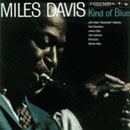
“Kind of Blue คือ อัลบั้มแจ๊สที่คลาสสิกจริง เป็นการขุนพลแนวหน้าทางแจ๊สอย่างมือเปียโนนิ้วหนวดปลาหมึก Bill Evans , ทีมแซ็กมหาปะลัย อย่าง John Coltrane และ Cannonball Adderley , เบสก็เป็น Paul Chambers, ให้จังหวะกลองโดย Jimmy Cobb ภายใต้การควบคุมและกำหนดแนวทางของมือมิวท์ทรัมเป็ตหัวก้าวหน้า Miles Davis ดนตรีใน Kind of Blue เป็นการกำหนดแนวทางคร่าวๆของรูปแบบของเพลงที่ไมล์ต้องการ นักดนตรีมีโอกาสใส่สิ่งที่ตัวเองต้องการเล่นลงไปในอิมโพรไวส์ซึ่งก็บันทึกกันสดๆ นั่นเอง ทำให้เพลงมีกลิ่นอายความสด ผมเคยดูวีดีโอการบันเสียง Kind of Blue ซึ่งเป็นบรรยากาศในห้องอัด ซึ่งดูเหมือนจะอยู่ในผับซะมากกว่าจะเป็นการบันทึกอัลบั้ม คนที่ถึงคิวเล่นก็เล่น ส่วนคนที่ไม่ได้เล่นก็ออกไปยืนรอดูดบุหรี่กันอยู่ด้านหลังพูดคุย ทั้งหมดนี่เกิดขึ้นในปี 1959 นี่คืออัลบั้มแจ๊สที่คนไม่ชอบแจ๊สจะต้องมีไว้ครอบครอง”
- So What
- Freddie Freeloader
- Blue Is Green
- All Blues
- Flemenco Sketches
Jazz Times
the absolutely beautiful Coltrane solo on the `Flamenco Sketches' alternate is alone worth the price....The restoration of the sound to the correct pitch makes enough of a difference to recommend repurchasing this classic even without the jazz track of the year aboard
Adrains Album Reviews
Miles may not have been the greatest Jazz trumpeter that ever lived, but he did have a distinctive style. One of his other talents was an ability to scout and recruit great sidemen to work with him. The band that surrounded him for 'Kind Of Blue' is held up by Jazz fans as one of the greatest in history. We get Miles himself, the incomparable John Coltrane, Bill Evans, Cannonball Adderly, Paul Chambers and Jimmy Cobb. None of individual pieces here were played by the band prior to the recording. Miles laid out themes and a few chords and the band improvised around them. Each soloist would know the key or tone of the solo and an approximate length. Everything else was down to them. So, the talents of the musicians Miles used cannot easily be underestimated when judging the overall importance or quality of this album! The fact that this music wasn't heavily scripted may also be part of the reason Jazz fans return to this record again and again. It's also sometimes recommended as a good starting point for those interested in delving into Jazz. I'm not so sure about that myself, but these pieces do maintain a mood and allow the listener in. The bass lines are relaxed but the music works equally as well as background music or to repay attentive headphone listening.
'So What' opens with quiet Piano before a distinctive bass line and melody appears. The bass pins this piece together, the Piano and trumpet take it in turns to play the main melody. Early on we get a solo section from Miles, and we move on through other sections but always underpinned by the bass and the main melody. When the Piano solo comes in for instance, around the seven minute mark, the trumpet returns to play the melody that holds the track together. This shifting between different instruments but always improvising around a single repeated melody works very well. Besides, the bass sounds wonderful. That's why it pins it all together for me! No other reason! 'Freddie Freeloader' maintains a medium tempo, and bases it around a blues form. Wynton Kelly was knowledgeable in blues form and played Piano here rather than Bill Evans. He does a fine job too through his solo spot. 'Blue In Green' is quietier and more meditative than either of the opening two pieces. It seems to offer few surprises and lacks the shifting atmosphere of 'So What' for example. It's a beautiful melody being played out by Miles, though.
'All Blues' is the longest piece here, reaching over eleven minutes. It returns to a shifting improvisation around a main melodic thread. The solo spots are all taken supremely well, as might be expected with a group of muscians of this quality. It works very well on the album following the too quiet and relaxed 'Blue In Green'. Yes, it's eleven minutes long, but the solo spots here really are of the highest quality. 'Flamenco Sketches' is a form of beauty. It opens with very deep bass notes, beautiful trumpet work, all very quiet. It stays quiet! The melodies are beautiful. This is all about melody, this isn't about showing off, or showcasing the talents within the group. They don't put a foot wrong and get everything absolutely 'right', but half of the idea of the method of composition Miles used through 'Kind Of Blue' was to highlight melody and to lessen complicated changes that he thought had blighted some Jazz prior to this release. 'Flamenco Sketches' is just so beautiful, very melodic and different melodies too. It closes something of a masterpiece work as a whole. Nothing is perfect in this world, but 'Kind Of Blue' is held up as a landmark release, one which other Jazz records seem to be judged against. Maybe 'Blue In Green' isn't really very interesting. Others would disagree. Still, a fine record. 9/10
Amazon
This is the one jazz record owned by people who don't listen to jazz, and with good reason. The band itself is extraordinary (proof of Miles Davis's masterful casting skills, if not of God's existence), listing John Coltrane and Julian "Cannonball" Adderley on saxophones, Bill Evans (or, on "Freddie Freeloader," Wynton Kelly) on piano, and the crack rhythm unit of Paul Chambers on bass and Jimmy Cobb on drums. Coltrane's astringency on tenor is counterpoised to Adderley's funky self on alto, with Davis moderating between them as Bill Evans conjures up a still lake of sound on which they walk. Meanwhile, the rhythm partnership of Cobb and Chambers is prepared to click off time until eternity. It was the key recording of what became modal jazz, a music free of the fixed harmonies and forms of pop songs. In Davis's men's hands it was a weightless music, but one that refused to fade into the background. In retrospect every note seems perfect, and each piece moves inexorably towards its destiny
Jazziz Magazine
As the painter needs his framework of parchment, the improvising musical group needs its framework in time," says Bill Evans in the liner notes to Kind of Blue. "Miles Davis presents here frameworks which are exquisite in their simplicity and yet contain all that is necessary to stimulate performance with a sure reference to the primary conception." Amen. During the past 40 years, the performances Davis' stimulated from Evans, John Coltrane, Cannonball Adderley, Paul Chambers, Jimmy Cobb, and Wynton Kelly have become some of the most storied in jazz, and all of them - classics such as "Freddie the Freeloader," "All Blues," "Blue in Green," and, of course, "So What" (featured) - are featured on this Columbia/Legacy reissue.
Barnes & Noble
Kind of magnificent! KIND OF BLUE has been called the greatest jazz album ever made so often that you're reluctant to believe it. Believe it. Five songs -- "So What," "Freddie Freeloader," "Blue in Green," "All Blues," and "Flamenco Sketches" -- four of them hovering around 10 minutes (taking advantage of the still-recent LP format) , and every one a masterpiece. Recorded in 1959 at a pivot point in jazz history --improvising over chords was giving way to the album's pioneering use of improvising over scales (or modes), and the abstractions of the '60s were brewing -- it includes everything good about the past 40 years and presages everything good about the next 40. Cool, calm, and concise, with some of jazz's most influential figures at their most potent (including Bill Evans, who also wrote the excellent liner notes, John Coltrane, and Cannonball Adderley), KIND OF BLUE is perfection. The latest reissue has better sound, extra liner notes, and an alternate take of "Flamenco Sketches." All unnecessary. Lee Jeske
All Music Guide
Kind of Blue isn't merely an artistic highlight for Miles Davis, it's an album that towers above its peers, a record generally considered as the definitive jazz album, a universally acknowledged standard of excellence. Why does Kind of Blue posses such a mystique? Perhaps because this music never flaunts its genius. It lures listeners in with the slow, luxurious bass line and gentle piano chords of "So What." From that moment on, the record never really changes pace -- each tune has a similar relaxed feel, as the music flows easily. Yet Kind of Blue is more than easy listening. It's the pinnacle of modal jazz -- tonality and solos build from chords, not the overall key, giving the music a subtly shifting quality. All of this doesn't quite explain why seasoned jazz fans return to this record even after they've memorized every nuance. They return because this is an exceptional band -- Miles, Coltrane, Bill Evans, Cannonball Adderly, Paul Chambers, Jimmy Cobb -- one of the greatest in history, playing at the peak of its power. As Evans said in the original liner notes for the record, the band did not play through any of these pieces prior to recording. Davis laid out the themes and chords before the tape rolled, and then the band improvised. The end results were wondrous and still crackle with vitality. Kind of Blue works on many different levels. It can be played as background music, yet it amply rewards close listening. It is advanced music that is extraordinarily enjoyable. It may be a stretch to say that if you don't like Kind of Blue, you don't like jazz -- but it's hard to imagine it as anything other than a cornerstone of any jazz collection. Stephen Thomas Erlewine
Musicians News
This is the one jazz record owned by people who don't listen to jazz, and with good reason. The band itself is extraordinary (proof of Miles Davis's masterful casting skills, if not of God's existence), listing John Coltrane and Julian "Cannonball" Adderley on saxophones, Bill Evans (or, on "Freddie Freeloader," Wynton Kelly) on piano, and the crack rhythm unit of Paul Chambers on bass and Jimmy Cobb on drums. Coltrane's astringency on tenor is counterpoised to Adderley's funky self on alto, with Davis moderating between them as Bill Evans conjures up a still lake of sound on which they walk. Meanwhile, the rhythm partnership of Cobb and Chambers is prepared to click off time until eternity. It was the key recording of what became modal jazz, a music free of the fixed harmonies and forms of pop songs. In Davis's men's hands it was a weightless music, but one that refused to fade into the background. In retrospect every note seems perfect, and each piece moves inexorably towards its destiny.
The Night Owl
Back in 1997, Classic Records released a vinyl edition of Kind of Blue, spread over two 180-gram LPs. The album quickly sold out and collectors who missed out have been clamoring for it ever since. Well, now they've taken it a step further. As the first title released on their new Quiex SV super vinyl, this album sounds even better than before. From the moment the needle settled into the groove on the new Quiex SV pressing, I knew I was in for a treat. The dynamic range and, in particular, the bass response seemed even better than before--something I didn't think was possible.
The overall sound quality on "So What" is noticeably warmer than before, and Coltrane's solo has a fuller, more vibrant tone. Miles' muted trumpet on "Blue in Green" sounds more natural now as well, and Bill Evans' piano sounds like it could be in the same room with you. In fact, the piano sound is so clear, you can almost hear the hammers hitting the strings. "All Blues" is another exemplary track. Jimmy Cobb's brushwork on the intro grabs your attention right away.
Classic Records has always put out quality product, and now with their Quiex SV super vinyl, they've taken things to a new level. They may have cut things down to a single album now (they're using the speed corrected version of side A, instead of both versions as released originally), but the results are absolutely breathtaking. If you haven't heard one of these releases yet, this is a perfect place to start.
Warr.org
One of the most famous jazz records ever made, this launched the "modal revolution," a style in which the complex chord substitutions of hard bop were replaced by extended soloing based on one or two scales or modes. The tunes are simple, often blues-based, and they're the starting point for some startling solos by Adderly, Coltrane, Bill Evans and Davis. If you've read this far, you probably have this album. If you don't, get it.
Q
Widely considered the greatest album in jazz history, Miles Davis' 1959 masterpiece is a collection of exquisitely melodic and deceptively simple modern jazz. At a time when instrumentalists seemed eager to hurl themselves into cluttered chord sequences, Davis characteristically set himself a new challenge, taking just a handful of scales and using them to create breathtakingly profound, spontaneous and lyrical improvisations. Each solo is marked by genuine genius - Davis' crisp and melodic trumpet contrasting with John Coltrane's complex and intense tenor saxophone and Cannonball Adderley's boppy and bubbly alto, while pianist Bill Evans strikes out in beautiful, Debussian form. Interestingly, this collectors' "gold" CD restores the tracks on the first side of the original record to their correct speed, after a quarter of a century played sharp.