



|
|
Maledpun Music ทางเลือกประสบการณ์ฟังเพลงคุณภาพ | ||||||
|
|
|
|
|||||
CD |
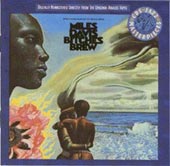
Bitches Brew (2 CDs) Miles Davis - 1970
|
||||||||
| อัลบั้มที่ใครฟังก็ต้องชอบ | |||||||||
| อัลบั้มแยกตามแนวดนตรี | |||||||||
| MP3 | |||||||||
| เพื่อนักดนตรี | |||||||||
| DVD & VCD | |||||||||
| คอนเสิร์ตและ MV คุณภาพ | |||||||||
|
“ไมล์ เดวิส คือนักดนตรีที่ไม่เคยจำกัดความสร้างสรรค์ทางดนตรีไว้เพียงแค่แนวเดียว เขาทดลองผสมผสานแนวตนตรีต่างๆเข้าด้วยกันเพื่อให้เกิดเสียงและแนวดนตรีใหม่ ในอัลบั้มใหม่เสมอ จนในในยุคหลังๆ จึงไม่สามารถบอกได้ว่าเขาเป็นนักดนตรีแนวไหน แต่โดยพื้นฐานแล้วเขาเติบโตมาจากงานดนตรีแจ๊ส ส่วนแนวคิดเบื้องหลัง Bitches Brew คือ ไมล์ต้องการฟอร์มวงร็อคแอนโรลที่ดีที่สุดในโลกเพื่อที่จะทำดนตรีที่เชื่อมโยงดนตรีแจ๊สเข้ากับดนตรีร็อคแบบจิมมี่ เฮนดริก และฟั้งกี้สไตล์ของสไล (Sly and The Family Stone) สมาชิกในวงจึงประกอบด้วยยอดฝีมืออย่าง Joe Zawinul, John McLaughlin, Wayne Shorter และอีกหลายคน ผลที่ออกมาก็คือสุดยอดเพลงบรรเลงที่เต็มไปด้วยกลิ่นไอของฟั้งกี้, ร็อค และแจ๊ส ที่ผสมกลมกลืนแปลกๆได้อย่างที่ตั้งใจไว้ ฟังอัลบั้มนี้เป็นประสบการณ์ทางดนตรีที่คุ้มค่าจริงๆ เหมือนกับนั่งอยู่ในห้องทดลองทางดนตรี”
Rolling Stone Miles' music continues to grow in its beauty, subtlety and sheer magnificence. Bitches' Brew is a further extension of the basic idea he investigated in his two previous albums, Filles De Kilimanjaro and In A Silent Way . In a larger sense, however, the record is yet another step in the unceasing process of evolution Miles has undergone since the Forties. The man never stops to rest on his accomplishments. Driven forward by a creative elan unequaled in the history of American music, he incorporates each successive triumph into the next leap forward. The wonderful thing about Miles' progress is that he encourages others to grow with him. Within the context of his sound there is more than enough room for both his musicians and his listeners to pursue their own special visions. Looking back on the history of Miles' ensemble, we find the likes of John Coltrane, Cannonball Adderley, Bill Evans, Tony Williams, Ron Carter, and Wayne Shorter. He always seems to select the best young jazzmen in the country and then gives them the freedom to develop their own unique modes of playing. Miles is known to be a stern disciplinarian, but never a tyrant. When a man has performed with the group long enough to gain a firm footing, he leaves as a recognized giant on his instrument. The present Miles Davis organization is certainly no exception to this tradition. There is more pure talent here than in any group of any kind currently performing. Chick Corea's piano is so full of technical and conceptual innovations that one is caught between a feeling of wonderment and the gnawing question, "I wonder how he does all those things?" It was about a year ago that a Downbeat reviewer went totally ga-ga trying to understand Chick's playing (he gave it "no stars" and complained about how far out it was), so rather than risk the record reviewer's funny farm I'll just ask you to listen to it. Dave Holland's bass and Jack DeJonette's drums lay down the amorphous rhythmic patterns for Miles' electrified sound. To put it briefly, these chaps have discovered a new way to cook, a way that seems just as natural and just as swinging as anything jazz has ever known. The soloists on the album—Wayne Shorter on soprano sax, Bennie Maupin on bass clarinet and John McLaughlin on electric guitar—are fully accustomed to this new groove and take one solid solo after another. The freedom which Miles makes available to his musicians is also there for the listener. If you haven't discovered it yet, all I can say is that Bitches' Brew is a marvelous place to start. This music is so rich in its form and substance that it permits and even encourages soaring flights of imagination by anyone who listens. If you want, you can experience it directly as a vast tapestry of sounds which envelop your whole being. You'll discover why fully one third of the audience at Miles' recent Fillmore West appearances left the hall in stunned silence, too deeply moved to want to stay for the other groups on the bill. As a personal matter, I also enjoy Miles' music as a soft background context for when I want to read or think deeply. In its current form, Miles' music bubbles and boils like some gigantic cauldron. As the musical ideas rise to the surface, the listener also finds his thoughts rising from the depths with a new clarity and precision. Miles is an invaluable companion for those long journeys you take into your imagination. But don't let my cerebral bent influence your listening. Whatever your temperament, Bitches' Brew will reward in direct proportion to the depth of your own involvement.
All Music Thought by many to be the most revolutionary album in jazz history, having virtually created the genre known as jazz-rock fusion (for better or worse) and being the jazz album to most influence rock and funk musicians, Bitches Brew is, by its very nature, mercurial. The original double LP included only six cuts and featured up to 12 musicians at any given time, most of whom would go on to be high-level players in their own right: Joe Zawinul, Wayne Shorter, Airto, John McLaughlin, Chick Corea, Jack DeJohnette, Dave Holland, Don Alias, Benny Maupin, Larry Young, Lenny White, and others. Originally thought to be a series of long jams locked into grooves around one or two keyboard, bass, or guitar figures, Bitches Brew is anything but. Producer Teo Macero had as much to do with the end product on Bitches Brew as Davis . Macero and Davis assembled, from splice to splice, section to section, much of the music recorded over three days in August 1969. First, there's the slow, modal, opening grooves of "Pharaoh's Dance," with its slippery trumpet lines to McLaughlin's snaky guitar figures skirting the edge of the rhythm section and Don Alias' conga slipping through the middle. The keyboards of Corea and Zawinul create a haunting, riffing groove echoed and accented by the two basses of Harvey Brooks and Dave Holland. The title cut was originally composed as a five-part suite, though only three were used. Here the keyboards punch through the mix, big chords and distorted harmonics ring up a racket for Davis to solo over rhythmically outside the mode. McLaughlin is comping on fat chords, creating the groove, and the bass and drums carry the rest for a small taste of deep-voodoo funk. Side three opens with McLaughlin and Davis trading funky fours and eights over the lock-step groove of hypnotic proportion that is "Spanish Key." Zawinul's trademark melodic sensibility provides a kind of chorus for Corea to flat around, and the congas and drummers working in complement against the bass lines. This nearly segues into the four-and-a-half minute "John McLaughlin," with its signature organ mode and arpeggiated blues guitar runs. The end of Bitches Brew, signified by the stellar "Miles Runs the Voodoo Down," echoes the influence of Jimi Hendrix; with its chuck-and-slip chords and lead figures and Davis playing a ghostly melody through the shimmering funkiness of the rhythm section, it literally dances and becomes increasingly more chaotic until about nine minutes in, where it falls apart. Yet one doesn't know it until near the end, when it simmers down into smoke-and-ice fog once more. The disc closes with "Sanctuary," a previously recorded Davis tune that is completely redone here as an electric moody ballad reworked for this band, but keeping enough of its modal integrity to be outside the rest of Bitches Brew's retinue. The CD reissue adds "Feio," a track recorded early in 1970 with the same band. Unreleased — except on the box set of the complete sessions — "Feio" has more in common with the exploratory music of the previous August than with later, more structured Davis music in the jazz-rock vein. A three-note bass vamp centers the entire thing as three different modes entwine one another, seeking a groove to bolt onto. It never finds it, but becomes its own nocturnal beast, offering ethereal dark tones and textures to slide the album out the door on. Thus Bitches Brew retains its freshness and mystery long after its original issue. |
http://www.geocities.com/maledpunmusic/
Updated October 2004