|
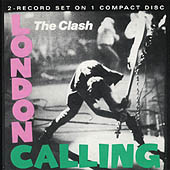
"งานที่ยอดเยี่ยมล้วนแต่มีพลังขับที่น่าสนใจ ชีวิตที่น่าเบื่อหน่าย ยาเสพติด ตกงาน ชีวิตที่ล่องลอย คนวัยหนุ่มต้องใช้ชีวิตอยู่กับยายในบ้านพักสวัสดิการ ทำเพลงในภาวะที่เป็นหนี้ ชีวิตเครียดๆ กับ 19 เพลงพั้งค์ร็อคที่รวมเข้าทั้งสกาและดิสโก้อัดแน่นความหลากหลายอยู่ในอัลบั้มเดียวอย่างที่ทำให้พระเจ้าก็ยังร้องอุทาน "พระเจ้าช่วย" London Calling มีอิทธิพลต่อแนวดนตรีในปัจจุบันอย่างมหาศาล นักดนตรีอาชีพล้วนแต่ผ่านรูหูมาแล้ว ถ้าไม่เคยฟัง ต้องรีบหามาฟังโดยด่วน"
1. London Calling
2. Brand New Cadillac
3. Jimmy Jazz
4. Hateful
5. Rudie Can't Fail
6. Spannish Bombs
7. The Right Profile
8. Lost In The Supermarket
9. Clampdown
10. The Guns Of Brixton
11. Wrong' Em Boyo
12. Death Or Glory
13. Koka Kola
14. The Card Cheat
15. Lovers Rock
16. Four Horsemen
17. I'm Not Down
18.Revolution Rock
19. Trian In Vain
Amazon
Bursting at the seams with creative energy, the Clash's stunning 1979 double album more than made up for the artistic and commercial disappointment of its predecessor, 1978's tried-too-hard Give 'Em Enough Rope. With ex-Mott the Hoople producer Guy Stevens harnessing their sound as never before, the band yielded what proved to be the best work of their career. Bouncing from hard rock (the apocalyptic vision of the title track) to rockabilly ("Brand New Cadillac") to reggae ("Rudy Can't Fail") to pop (the Top 40 hit "Train in Vain"), the Clash knocked down all musical walls and, in the process, ended the argument over punk's viability in the U.S. --Billy Altman
armchair reviews
This review was prompted by the recent meeting of some self proclaimed Clash fans that did not have or did not know about this CD.
I don't want to come off as a Clash snob or Clash expert, but I'm a pretty darn big Clash fan. So when I come across a person who claims to be a fan of The Clash, I immediately start talking the talk. I don't try to quiz the person or entrap them into revealing their amateur status as a Clash fan. I'm just excited to swap the millions of little tidbits surrounding The Clash and their music. So, when I hear that "London Calling" is their favorite album, or that "Rock the Casbah" was the best Clash song ever written, I immediately get suspicious.
First of all - London Calling was everybody's favorite album at one point or another. If it's still your favorite album, then you haven't listened to it enough to get bored with it yet. (Which takes a long time, by the way). And as far as "Rock the Casbah", yeah, okay, whatever…
Okay. Super Black Market Clash. First of all, this isn't a greatest hits album. If you want the greatest hits, then get "The Singles" or "The Story of The Clash" or "The Clash on Broadway" or one of the zillions of compilations or movie soundtrack that have them. No, Super Black Market Clash is almost exactly what it says.
Prompted by the amount of bootleg recordings of unreleased Clash tunes being sold and distributed around the world, the studio decided to jump on the bandwagon and make some money. They compiled this collection of Clash songs, and released clean, original recordings under the title "Super Black Market Clash".
This CD contains 21 recordings. 2 of which were never released, 10 had never been on CD, and the rest were remixes or original recordings that were later shortened for radio play.
I love this CD. This is one of the few Clash albums (along with London Calling) that you do not have to skip around to your favorite tunes. Every song is great. Even those you might not be familiar with. It's got old classics like "1-2 Crush on you" and "Pressure Drop" and "Gates of the West". Then it's got amazing remix versions of "The Magnificent Seven" (called "The Magnificent Dance"), and "Rock the Casbah" (called "Mustapha Dance") and "This is Radio Clash" (simply re-titled "Radio Clash"). As well as instrumentals, like, "Time is Tight" and "The Cool Out".
I would insist that Super Black Market Clash is an essential "must-have" for any true Clash fan. But I would also like to add that this CD is a perfect introduction to The Clash for new fans and amateurs because of it's studio handpicked production. This album was put together for the sole purpose of making money. It contains some of the best recordings of the best Clash tunes. A perfect mix of Dance, Ska, Reggae, punk and pure English Rock and Roll.
Barnes & Noble
By 1979, the Clash had established themselves as one of the premier
avatars of the punk movement, but the release of LONDON CALLING made a
strong case for their consideration among rock's all-time greats. The
two-record set is a sprawling epic that captures the raw intensity of
their earlier work on some tracks, opens new vistas on others, and in
general reveals a considerably more mature and adventurous band of punks.
"Train in Vain" even made it to the American pop charts, while the title
track captures all the anger and dismay of Thatcherite England. "Spanish
Bombs" refines the blueprint for heroic anthems, and "Lost in the
Supermarket" takes the contempt of their earlier "I'm So Bored with the
U.S.A" and morphs it into a scathing critique of consumerism. Elsewhere,
their facility with reggae and rockabilly influences enhanced their role
as low-fi aesthetes. Rolling Stone proclaimed LONDON CALLING the No.1
record of the '80s despite its British release date of 1979, but such a
distinction only underscores the album's value as one of the best
recordings of any decade. Martin Johnson
All Music Guide
Give 'Em Enough Rope, for all of its many attributes, was essentially a
holding pattern for the Clash, but the double album London Calling is a
remarkable leap forward, incorporating the punk aesthetic into rock & roll
mythology and roots music. Before, the Clash had experimented with reggae,
but that was no preparation for the dizzying array of styles on London
Calling. There's punk and reggae, but there's also rockabilly, ska, New
Orleans R&B, pop, lounge jazz, and hard rock; and while the record isn't
tied together by a specific theme, its eclecticism and anthemic punk
function as a rallying call. While many of the songs -- particuarly
"London Calling," "Spanish Bombs," and "The Guns of Brixton" -- are
explicitly political, by acknowledging no boundaries the music itself is
political and revolutionary. But it is also invigorating, rocking harder
and with more purpose than most albums, let alone double albums. Over the
course of the record, Strummer and Jones (and Paul Simonon, who wrote "The
Guns of Brixton") explore their familiar themes of working-class rebellion
and anti-establishment rants, but they also tie them in to old rock & roll
traditions and myths, whether it's rockabilly greasers or "Stagger Lee,"
as well as mavericks like doomed actor Montgomery Clift. The result is a
stunning statement of purpose and one of the greatest rock & roll albums
ever recorded.
ink blot magazine
Here The Clash shake off punk's straightjacket and try on every musical zoot suit they take a fancy to; yet despite the manic ambition, it's all wound tight as a golf ball. Nineteen tracks, 66 minutes and it never blinks. Where many double albums sprawl and stumble, London Calling gets more focused with every track, until the ferocious hidden kiss-off "Train In Vain" sends you back to side one.
Jones and Strummer's lyrics (and Simonon's, on the fantastic skank "The Guns of Brixton") certainly do, not least because you can't make out what they're saying most of the time. But muddle through the cockney thug vocals and you'll find sharp characterizations, funny storytelling and righteous enthusiasm. Like most pop lyricists, their politics are really shallow sloganeering, but here they're so interesting. Andalucian revolutionaries, washed-up movie stars, Yardies and Welsh gangsters - London Calling invites them all to the apocalyptic rally.
Of course, the soundtrack is even more extraordinary. The title track is rock pounding on reggae's door, and "The Guns of Brixton" is what happens when it breaks down. "Rudie Can't Fail" and "Hateful" are joyous blasts of Bo Diddley gone ska, while "Clampdown" and "Death or Glory" are pure anthems on the flip side of "Jimmy Jazz" and its low-key year-zero rock.
London Calling does so much, so well, it's really required listening. If you don't like this album, you probably don't like rock 'n' roll.
Q
London Calling, a mere year later, was a 19-track, filler-free double album. Certainly it would be the best Clash album and therefore is among the very best albums ever recorded. The opening title track is a call to post-nuclear arms and mentions "nodding out". Towards the end, at the two-minute 40-second mark, there's an instrumental break through which Strummer howls like a dog before letting the guitars have their say. Then, immediately before one last declamatory chorus, he snarls "Now get this..." It was The Clash's greatest split second. Clampdown confirmed that The Clash could turn the political into the personal and begins with the still staggering line "Taking off his turban they said, Is this man a Jew?", Spanish Bombs was all Homage To Catalonia, Hateful is the drugs song and even bassist Simonon chipped in with The Guns Of Brixton. Another day, another slew of songs will stand out. That's a mark of greatness and Train In Vain gave them a proper American hit.
Rolling Stone
By now, our expectations of the Clash might seem to have become inflated beyond any possibility of fulfillment. It's not simply that they're the greatest rock & roll band in the world-indeed, after years of watching too many superstars compromise, blow chances and sell out, being the greatest is just about synonymous with being the music's last hope. While the group itself resists such labels, they do tell you exactly how high the stakes are, and how urgent the need. The Clash got their start on the crest of what looked like a revolution, only to see the punk movement either smash up on its own violent momentum or be absorbed into the same corporate-rock machinery it had meant to destroy. Now, almost against their will, they're the only ones left.
Give 'Em Enough Rope, the band's last recording, railed against the notion that being rock & roll heroes meant martyrdom. Yet the album also presented itself so flamboyantly as a last stand that it created a near-insoluble problem: after you've already brought the apocalypse crashing down on your head, how can you possibly go on? On the Clash's new LP, London Calling, there's a composition called "Death or Glory" that seems to disavow the struggle completely. Over a harsh and stormy guitar riff, lead singer Joe Strummer offers a grim litany of failure. Then his cohort, Mick Jones, steps forward to drive what appears to be the final nail into the coffin. "Death or glory," he bitterly announces, "become just another story."
But "Death or Glory" - in many ways, the pivotal song on London Calling - reverses itself midway. After Jones' last, anguished cry drops off into silence, the music seems to scatter from the echo of his words. Strummer reenters, quiet and undramatic, talking almost to himself at first and not much caring if anyone else is listening. "We're gonna march a long way," he whispers. "Gonna fight - a long time." The guitars, distant as bugles on some faraway plain, begin to rally. The drums collect into a beat, and Strummer slowly picks up strength and authority as he sings:
We've gotta travel - over mountains
We've gotta travel - over seas
We're gonna fight - you, brother
We're gonna fight - till you lose
We're gonna raise -
TROUBLE!
The band races back to the firing line, and when the singers go surging into the final chorus of "Death or glory...just another story," you know what they're really saying: like hell it is!
Merry and tough, passionate and large-spirited, London Calling celebrates the romance of rock & roll rebellion in grand, epic terms. It doesn't merely reaffirm the Clash's own commitment to rock-as-revolution. Instead, the record ranges across the whole of rock & roll's past for its sound, and digs deeply into rock legend, history, politics and myth for its images and themes. Everything has been brought together into a single, vast, stirring story - one that, as the Clash tell it, seems not only theirs but ours. For all its first-take scrappiness and guerrilla production, this two-LP set-which, at the group's insistence, sells for not much more than the price of one-is music that means to endure. It's so rich and far-reaching that it leaves you not just exhilarated but exalted and triumphantly alive.
From the start, however, you know how tough a fight it's going to be. "London Calling" opens the album on an ominous note. When Strummer comes in on the downbeat, he sounds weary, used up, desperate: "The Ice Age is coming/The sun is zooming in/Meltdown expected/The wheat is growing thin.'
The rest of the record never turns its back on that vision of dread. Rather, it pulls you through the horror and out the other side. The Clash's brand of heroism may be supremely romantic, even naive, but their utter refusal to sentimentalize their own myth - and their determination to live up to an actual code of honor in the real world, without ever minimizing the odds - makes such romanticism seem not only brave but absolutely necessary. London Calling sounds like a series of insistent messages sent to the scattered armies of the night, proffering warnings and comfort, good cheer and exhortations to keep moving. If we begin amid the desolation of the title track, we end, four sides later, with Mick Jones spitting out heroic defiance in "I'm Not Down" and finding a majestic metaphor at the pit of his depression that lifts him - and us - right off the ground. "Like skyscrapers rising up," Jones screams. "Floor by floor-I'm not giving up." Then Joe Strummer invites the audience, with a wink and a grin, to "smash up your seats and rock to this brand new beat" in the merry-go-round invocation of "Revolution Rock."
Against all the brutality, injustice and large and small betrayals delineated in song after song here - the assembly-line Fascists in "Clampdown," the advertising executives of "Koka Kola," the drug dealer who turns out to be the singer's one friend in the jittery, hypnotic "Hateful" - the Clash can only offer their sense of historic purpose and the faith, innocence, humor and camaraderie embodied in the band itself. This shines through everywhere, balancing out the terrors that the LP faces again and again. It can take forms as simple as letting bassist Paul Simonon sing his own "The Guns of Brixton," or as relatively subtle as the way Strummer modestly moves in to support Jones' fragile lead vocal on the forlorn "Lost in the Supermarket." It can be as intimate and hilarious as the moment when Joe Strummer deflates any hint of portentousness in the sexual-equality polemics of "Lover's Rock" by squawking "I'm so nervous!" to close the tune. In "Four Horsemen," which sounds like the movie soundtrack to a rock & roll version of The Seven Samurai, the Clash's martial pride turns openly exultant. The guitars and drums start at a thundering gallop, and when Strummer sings, "Four horsemen ...," the other members of the group charge into line to shout joyously: "...and it's gonna be us!"
London Calling is spacious and extravagant. It's as packed with characters and incidents as a great novel, and the band's new stylistic expansions - brass, organ, occasional piano, blues grind, pop airiness and the reggae-dub influence that percolates subversively through nearly every number - add density and richness to the sound. The riotous rockabilly-meets-the-Ventures quality of "Brand New Cadillac" ("Jesus Christ!" Strummer yells to his ex-girlfriend, having so much fun he almost forgets to be angry, "Whereja get that Cadillac?") slips without pause into the strung-out shuffle of "Jimmy Jazz," a Nelson Algren-like street scene that limps along as slowly as its hero, just one step ahead of the cops. If "Rudie Can't Fail" (the "She's Leaving Home" of our generation) celebrates an initiation into bohemian lowlife with affection and panache, "The Card Cheat" picks up on what might be the same character twenty years later, shot down in a last grab for "more time away from the darkest door." An awesome orchestral backing track gives this lower-depths anecdote a somber weight far beyond its scope. At the end of "The Card Cheat," the song suddenly explodes into a magnificent panoramic overview - "from the Hundred Year War to the Crimea"-that turns ephemeral pathos into permanent tragedy.
Other tracks tackle history head-on, and claim it as the Clash's own. "Wrong 'Em Boyo" updates the story of Stagger Lee in bumptious reggae terms, forging links between rock & roll legend and the group's own politicized roots-rock rebel. "The Right Profile," which is about Montgomery Clift, accomplishes a different kind of transformation. Over braying and sarcastic horns, Joe Strummer gags, mugs, mocks and snickers his way through a comic-horrible account of the actor's collapse on booze and pills, only to close with a grudging admiration that becomes unexpectedly and astonishingly moving. It's as if the singer is saying, no matter how ugly and pathetic Clift's life was, he was still-in spite of everything-one of us.
"Spanish Bombs" is probably London Calling's best and most ambitious song. A soaring, chiming intro pulls you in, and before you can get your bearings, Strummer's already halfway into his tale. Lost and lonely in his "disco casino," he's unable to tell whether the gunfire he hears is out on the streets or inside his head. Bits of Spanish doggerel, fragments of combat scenes, jangling flamenco guitars and the lilting vocals of a children's tune mesh in a swirling kaleidoscope of courage and disillusionment, old wars and new corruption. The evocation of the Spanish Civil War is sumptuously romantic: "With trenches full of poets, the ragged army, fixin' bayonets to fight the other line." Strummer sings, as Jones throws in some lovely, softly stinging notes behind him. Here as elsewhere, the heroic past isn't simply resurrected for nostalgia's sake. Instead, the Clash state that the lessons of the past must be earned before we can apply them to the present.
London Calling certainly lives up to that challenge. With its grainy cover photo, its immediate, on-the-run sound, and songs that bristle with names and phrases from today's headlines, it's as topical as a broadside. But the album also claims to be no more than the latest battlefield in a war of rock & roll, culture and politics that'll undoubtedly go on forever. "Revolution Rock," the LP's formal coda, celebrates the joys of this struggle as an eternal carnival. A spiraling organ weaves circles around Joe Strummer's voice, while the horn section totters, sways and recovers like a drunken mariachi band. "This must be the way out," Strummer calls over his shoulder, so full of glee at his own good luck that he can hardly believe it." El Clash Combo," he drawls like a proud father, coasting now, sure he's made it home. "Weddings, parties, anything... And bongo jazz a specialty."
But it's Mick Jones who has the last word. "Train in Vain" arrives like an orphan in the wake of "Revolution Rock." It's not even listed on the label, and it sounds faint, almost overheard. Longing, tenderness and regret mingle in Jones' voice as he tries to get across to his girl that losing her meant losing everything, yet he's going to manage somehow. Though his sorrow is complete, his pride is that he can sing about it. A wistful, simple number about love and loss and perseverance, "Tram in Vain" seems like an odd ending to the anthemic tumult of London Calling. But it's absolutely appropriate, because if this record has told us anything, it's that a love affair and a revolution-small battles as well as large ones - are not that different. They're all part of the same long, bloody march. (RS 314)
TOM CARSON
virgin
originally released 1979
With a beautiful parody/tribute of a famed Elvis Presley album cover, London Calling is an album of almost unparalleled energy, anthems and simply catching lightning in a bottle. From the punk title track to rockabilly on "Brand New Cadillac" to the ska "Rudie Can't Fail," Mott The Hoople producer Guy Stevens oversaw these original tracks with great success. The greatness of this CD is its casual approach on tracks as diverse as the vigilant "Guns Of Brixton" to smash hit "Train In Vain" which went to #23 on the Billboard charts and got them a musical slot on "Fridays," a Saturday Night Live carbon copy. This is the first time that The Clash merge commerce and art with great success.
Brett Lintott Hamilton Canada:
I've never heard an album better than The Clash's London Calling. But it's not always my favourite Clash album. I'm a huge Clash fan, and my favourite album switches all the time. Sometimes I love the raw punk of the eponymous debut, or the wildly eclectic album Sandinista!, or the cleaner punk sounds of Give 'Em Enough Rope, or the dark mood on Combat Rock. But London Calling is the greatest work The Clash produced. Every single song is top. I can't think of ant other bands that could make a double album as cohesive as this one. Even The Beatles couldn't pull it off this well. If you need a reason for why The Clash were a great rock band, look at their other albums, but if you need a reason to see why the were the greatest rock band, look no further than London Calling 10/10:
Gilmore Belfast Ireland
I think this album is really good but i gave it 8 out of 10 because they went kind of soft on it when i expected it to be like the rest of their stuff like White Riot from their first album or Tommy Gun from the second album Give Em Enough Rope. Jimmy Jazz is too slow for my likings but I still prefer this album 110% more than Sandinista which upset me when i bought it a few months back, came home and listened to it. I couldnt beleive The Clash could sell-out like that. All in all I do like the album as I own a t-shirt of the LONDON CLASSING cover, the LP and the CD of it. 8/10
|