



|
|
Maledpun Music ทางเลือกประสบการณ์ฟังเพลงคุณภาพ | ||||||
|
|
|
|
|||||
CD |
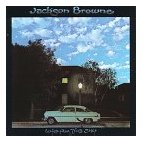
Late for the Sky Jackson Browne - 1974
|
||||||||
| อัลบั้มที่ใครฟังก็ต้องชอบ | |||||||||
| อัลบั้มแยกตามแนวดนตรี | |||||||||
| MP3 | |||||||||
| เพื่อนักดนตรี | |||||||||
| DVD & VCD | |||||||||
| คอนเสิร์ตและ MV คุณภาพ | |||||||||
Rolling Stone Like Browne's two previous albums, Late for the Sky contains no lyric sheet. The three or four hours required to make a full transcription will, however, be well worth the effort for anyone interested in discovering lyric genius. I can't think of another writer who merges with such natural grace and fluidity his private and public personas in a voice that is morally compelling yet noncoercive. Late for the Sky , Jackson Browne's third Asylum album, is his most mature, conceptually unified work to date. Its overriding theme: the exploration of romantic possibility in the shadow of apocalypse. No contemporary male singer/songwriter has dealt so honestly and deeply with the vulnerability of romantic idealism and the pain of adjustment from youthful narcissism to adult survival as Browne has in this album. Late for the Sky is the autobiography of his young manhood. The album's eight loosely constructed narratives rely for much of their impact upon stunning sections of aphoristic verse, whose central images, the antinomies of water and sand, reality and dreams, sky and road, inextricably connect them. Browne's melodic style, though limited, serves his ideas brilliantly. He generally avoids the plaintive harmonies of southern California rock ballads for a starker, more eloquent musical diction derived from Protestant hymns. Likewise his open-ended poetry achieves power from the nearly religious intensity that accumulates around the central motifs; its fervor is underscored by the sparest and hardest production to be found on any Browne album yet ( Late for the Sky was produced by Browne with Al Schmitt), as well as by his impassioned, oracular singing style. On side one, Browne tells bluntly about his personal conflict between fantasy and reality in erotic relationships, struggling with his quest for idyllic bliss. The title cut explores an affair at its nadir ("Looking hard into your eyes/There was nobody I'd ever known"), concluding with an image of the sky, the album's symbol for escape, salvation and death. "Fountain Of Sorrow" develops parallel themes of sex and nothingness, fantasy and realism, as Browne, looking at the photograph of a former lover, recalls: "When you see through love's illusion, there lies the danger/And your perfect lover just looks like a perfect fool/So you go running off in search of a perfect stranger." In the chorus, highly romanticized sexuality becomes a "fountain of sorrow, fountain of light." Later in the album the water images are developed into a larger metaphor for death and rebirth. "Farther On" and "The Late Show" complete the first part of the song cycle. Locating the sources of Browne's exacerbated romanticism "in books and films and song," "a world of illusion and fantasy," "Farther On" defines Browne's quest as a "citadel" in "a vision of paradise." Its desolate conclusion finds Browne alone and older, "with my maps and my faith in the distance, moving farther on." By "The Late Show," Browne is so absorbed in despair that if he "stumbled on someone real" he'd "never know." Midway in the song, however, he meets a lover and in an impulsive gesture they drive away from the past in the "early model Chevrolet" pictured on the album cover. The second side of the album describes the precariousness of the journey, as Browne's sense of personal tragedy metamorphoses into a larger social apprehension. "The Road and the Sky," a jaunty rock song, reintroduces the water motif: "Can you see those dark clouds gathering up ahead/They're gonna wash this planet clean like the Bible said." "For A Dancer," which follows, is one of the album's two master-pieces, a meditation on death that harks back to "Song For Adam" on Browne's first album: "I don't know what happens when people die/Can't seem to grasp it as hard as I try/It's like a song I can hear playing right in my ear but I can't sing/I can't help listening." But "For A Dancer" is not a lament; it calls for joyful procreation to combat metaphysical terror. Browne's graceful lyric, as fine as any he's written, finds its counterpart in the music, an ethereal tango in which David Lindley's fiddle dances against Browne's vocal. A crisp little rock song, "Walking Slow," celebrates Browne's new-found domestic stability. "Before The Deluge," the album's summary cut, brings together in a comprehensive social context the themes of the rest of the album. A march for three voices—Browne, Lindley's fiddle and backup chorus — the song evokes the spiritual malaise following Woodstock : And in the end they traded their tired wings For the resignation that living brings And exchanged love's bright and fragile glow For the glitter and the rouge And in a moment they were swept Before the deluge * The verses are linked by a moving secular prayer for music, shelter and spiritual sustenance: "Let creation reveal its secrets by and by/When the light that's lost within us reaches the sky." This chorus's final statement follows a verse so imagistically potent as to suggest literal prophecy: * "Before The Deluge" by Jackson Browne ©1974, Benchmark Musse. And when the sand was gone and the time arrived In the naked dawn only a few survived And in attempts to understand a thing so simple and so huge Believed that they were meant to live After the deluge
All Music On his third album, Jackson Browne returned to the themes of his debut record (love, loss, identity, apocalypse), and, amazingly, delved even deeper into them. "For a Dancer," and a meditation on death like the first album's "Song for Adam," is a more eloquent eulogy; "Farther On" extends the "moving on" point of "Looking Into You"; "Before the Deluge" is a glimpse beyond the apocalypse evoked on "My Opening Farewell" and the second album's "For Everyman." If Browne had seemed to question everything in his first records, here he even questioned himself. "For me some words come easy, but I know that they don't mean that much," he sang on the opening track, "Late for the Sky," and added in "Farther On," "I'm not sure what I'm trying to say." Yet his seeming uncertainty and self-doubt reflected the size and complexity of the problems he was addressing in these songs, and few had ever explored such territory, much less mapped it so well. "The Late Show," the album's thematic center, doubted but ultimately affirmed the nature of relationships, while by the end, "After the Deluge," if "only a few survived," the human race continued nonetheless. It was a lot to put into a pop music album, but Browne stretched the limits of what could be found in what he called "the beauty in songs," just as Bob Dylan had a decade before. |
http://www.geocities.com/maledpunmusic/
Updated October 2004