General Appearance
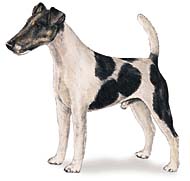 The
dog must present a generally gay, lively and active appearance; bone and
strength in a small compass are essentials; but this must not be taken to mean
that a Fox Terrier should be cloddy, or in any way coarse--speed and endurance
must be looked to as well as power, and the symmetry of the Foxhound taken as a
model. The Terrier, like the Hound, must on no account be leggy, nor must he be
too short in the leg. He should stand like a cleverly made hunter, covering a
lot of ground, yet with a short back, as stated below. He will then attain the
highest degree of propelling power, together with the greatest length of stride
that is compatible with the length of his body. Weight is not a certain
criterion of a Terrier's fitness for his work-general shape, size and contour
are the main points; and if a dog can gallop and stay, and follow his fox up a
drain, it matters little what his weight is to a pound or so.
The
dog must present a generally gay, lively and active appearance; bone and
strength in a small compass are essentials; but this must not be taken to mean
that a Fox Terrier should be cloddy, or in any way coarse--speed and endurance
must be looked to as well as power, and the symmetry of the Foxhound taken as a
model. The Terrier, like the Hound, must on no account be leggy, nor must he be
too short in the leg. He should stand like a cleverly made hunter, covering a
lot of ground, yet with a short back, as stated below. He will then attain the
highest degree of propelling power, together with the greatest length of stride
that is compatible with the length of his body. Weight is not a certain
criterion of a Terrier's fitness for his work-general shape, size and contour
are the main points; and if a dog can gallop and stay, and follow his fox up a
drain, it matters little what his weight is to a pound or so.
N.B. Old scars or injuries, the result of work or accident, should not be
allowed to prejudice a Terrier's chance in the show ring, unless they interfere
with its movement or with its utility for work or stud.
Size, Proportion, Substance
According to present-day requirements, a full-sized, well balanced dog should
not exceed 15½ inches at the withers--the bitch being proportionately
lower--nor should the length of back from withers to root of tail exceed 12
inches, while to maintain the relative proportions, the head should not exceed 7¼
inches or be less than 7 inches. A dog with these measurements should scale 18
pounds in show condition--a bitch weighing some two pounds less-with a margin of
one pound either way.
Balance This may be defined as the correct proportions of a certain
point, or points, when considered in relation to a certain other point or
points. It is the keystone of the Terrier's anatomy. The chief points for
consideration are the relative proportions of skull and foreface; head and back;
height at withers and length of body from shoulder point to buttock-the ideal of
proportion being reached when the last two measurements are the same. It should
be added that, although the head measurements can be taken with absolute
accuracy, the height at withers and length of back and coat are approximate, and
are inserted for the information of breeders and exhibitors rather than as a
hard-and-fast rule.
Head
Eyes and rims should be dark in color, moderately small and rather
deep set, full of fire, life and intelligence and as nearly possible circular in
shape. Anything approaching a yellow eye is most objectionable. Ears
should be V-shaped and small, of moderate thickness, and dropping forward close
to the cheek, not hanging by the side of the head like a Foxhound. The topline
of the folded ear should be well above the level of the skull. Disqualifications
Ears prick, tulip or rose.
The skull should be flat and moderately narrow, gradually decreasing in
width to the eyes. Not much "stop" should be apparent, but there
should be more dip in the profile between the forehead and the top jaw than is
seen in the case of a Greyhound. It should be noticed that although the foreface
should gradually taper from eye to muzzle and should tip slightly at its
junction with the forehead, it should not "dish" or fall away quickly
below the eyes, where it should be full and well made up, but relieved from
"wedginess" by a little delicate chiseling. There should be apparent
little difference in length between the skull and foreface of a well balanced
head. Cheeks must not be full.
Jaws, upper and lower, should be strong and muscular and of fair
punishing strength, but not so as in any way to resemble the Greyhound or modern
English Terrier. There should not be much falling away below the eyes. This part
of the head should, however, be moderately chiseled out, so as not to go down in
a straight slope like a wedge. The nose, toward which the muzzle must
gradually taper, should be black. Disqualifications Nose white, cherry or
spotted to a considerable extent with either of these colors.
The teeth should be as nearly as possible together, i.e., the points of
the upper (incisors) teeth on the outside of or slightly overlapping the lower
teeth. Disqualifications-Much undershot, or much overshot.
Neck, Topline, Body
Neck should be clean and muscular, without throatiness, of fair length,
and gradually widening to the shoulders. Back should be short, straight
(i.e., level), and strong, with no appearance of slackness. Chest deep and not
broad. Brisket should be deep, yet not exaggerated. The foreribs should be
moderately arched, the back ribs deep and well sprung, and the dog should be
well ribbed up. Loin should be very powerful, muscular and very slightly arched.
Stern should be set on rather high, and carried gaily, but not over the
back or curled. It should be of good strength, anything approaching a "Pipestopper"
tail being especially objectionable.
Forequarters
Shoulders should be long and sloping, well laid back, fine at the points,
and clearly cut at the withers. The elbows should hang perpendicular to the
body, working free of the sides. The forelegs viewed from any direction must be
straight with bone strong right down to the feet, showing little or no
appearance of ankle in front, and being short and straight in pastern. Both fore
and hind legs should be carried straight forward in traveling.
Feet should be round, compact, and not large; the soles hard and tough;
the toes moderately arched, and turned neither in nor out.
Hindquarters
Should be strong and muscular, quite free from droop or crouch; the thighs long
and powerful, stifles well curved and turned neither in nor out; hocks well bent
and near the ground should be perfectly upright and parallel each with the other
when viewed from behind, the dog standing well up on them like a Foxhound, and
not straight in the stifle. The worst possible form of hindquarters consists of
a short second thigh and a straight stifle. Both fore and hind legs should be
carried straight forward in traveling, the stifles not turning outward. Feet as
in front.
Coat
Should be smooth, flat, but hard, dense and abundant. The belly and underside of
the thighs should not be bare.
Color
White should predominate; brindle, red or liver markings are objectionable.
Otherwise this point is of little or no importance.
Gait
Movement, or action, is the crucial test of conformation. The Terrier's legs
should be carried straight forward while traveling, the forelegs hanging
perpendicular and swinging parallel with the sides, like the pendulum of a
clock. The principal propulsive power is furnished by the hind legs, perfection
of action being found in the Terrier possessing long thighs and muscular second
thighs well bent at the stifles, which admit of a strong forward thrust or
"snatch" of the hocks. When approaching, the forelegs should form a
continuation of the straight line of the front, the feet being the same distance
apart as the elbows. When stationary it is often difficult to determine whether
a dog is slightly out at shoulder, but, directly he moves, the defect--if it
exists--becomes more apparent, the forefeet having a tendency to cross,
"weave," or "dish." When, on the contrary, the dog is tied
at the shoulder, the tendency of the feet is to move wider apart, with a sort of
paddling action. When the hocks are turned in-cow-hocks-the stifles and feet are
turned outwards, resulting in a serious loss of propulsive power. When the hocks
are turned outward the tendency of the hind feet is to cross, resulting in an
ungainly waddle.
Temperament
The dog must present a generally gay, lively and active appearance.
Disqualifications
Ears prick, tulip or rose.
Nose white, cherry or spotted to a considerable extent with either of these
colors.
Mouth much undershot, or much overshot.