POETRY BY IRENA KNEHTL
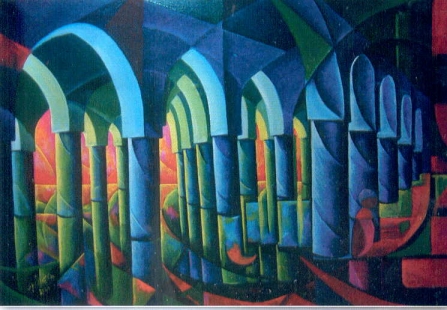
Yemeni artist Hani Ali Mohammed
Did you know stone is made of frozen white clouds When the sun shines from above Sanaa - The city of white Dancer in the Desert Remember to Forget Sands of Desire and Burden of Waves I warned You A journey to the Mountains of Barat Fasting and Feasting in Sanaa Castles of Sand, Gardens from Heaven What news from those Sands whiter The Perfumed Gardens Yemeni Crafts: Emroidered sentiments
DID YOU KNOW STONE IS MADE OF FROZEN WHITE CLOUDS
Traveling with clear power in the sun. Sunlight entered my hands for the purple blue water. I yearn for a sound that is missing. Life seems so fragile, and all its shadows
are seasonal, including pain. I saw how my shadow detached it self from a horizon that linked me with others. My shadow has preceded me. How could it recognize that
light to which it was attached? This port World rose with its terror in an era of defeat. Terraces after terraces, slope after slope. It named impossible mountains, although smoke forgot the earth. There was fear and pride of age before beauty. We think of the past as better forgotten that fixed with stony regret. There were pillars that fell,
leaving a blue space for a single God, where the old gods stood before. Clouds were rising like leaves from green shade. Then far out at the sea in a sparkling slower arrows of rain arched from the emerald breakwater of the reef. The rivers envying the sea tired of being crossed. I remember this sun burn river and hours drowned like
centuries. The fisherman hearing the cries from the ochre shore as they would be the only fisherman left to the world using old ways and who believed their work was prayer to the changing rose of light. The breeze trashed the palms of the cool road. Change perhaps lay in our silence. Have we come to the bend? The names bent like
the trees in the anchor the sorrow. While others rise from other direction. With its unsettling shadow but the right journey is motionless. Where the trees are waged by wind and the cliffs. In the sun behind then stood villages and hoisting their arms to the light. Worried by the salt wind. And weather night. Between dawn and dusk. Who
glowed and swing like a lantern on the sea. Each boat as capacious as those. Crossing the lowland at dusk of the sea lace. The blue ridges of waves. Then one afternoon, the Ocean lowered and clarified its ceiling, its emerald net after centuries of walking. Chocked with old leaves, old wounds, by blue silent bay. After a night of rough wind
rolled over the eyes like pots left out in the rain. A beach now burns their memory copper almond leaves with a stunned summer going. Grass that is going brown, faces in salad landscapes. In the blue distance as summer winds. And butterflies sail in their yellow odysseys. The shadows everywhere wear the same size. The night will say its
stars for the first time. I mistook them for lakes. I look through the glass for a land that was lost and a man who was gone. The grass by the river shore is silvery green with its white lace. Where is the light of the world. The city that can buy and sell us. The packets to tea stirred with our crystals of sweet. Silence was in flower. The
weight of the place, its handle, its ancient name. A cloud hangs a branch in the orange hour to the changing rose of light. The dead were singing. The pillars, crossed terraces on the ruined hills and were quiet as the sail. The pink blossoms of an oleander and hums. Villages with cracked plaster walls. The flutes in the square cling like a
butterfly to the elbow. An olive branch, freeze from a change. Sometime my heart is as hard as that mast. You dream of Africa and pray to your God. Since the rain was shinning and the sun was raising my eyes were clear. Palm-stripped pavilions, Arab dhows and tea brown rivers. Sandstorm seaming their eyes, horizontal monsoon, and
mimosa memories. Everything was forgotten now. The Ocean has changed around every name, tress, men. Because the Ocean had to live, because it was life. Time perhaps – even in its on – rush, even as it moves on – doing new things, repeating old ones. Even further. .
Sanaa, Yemen, 8th September 2004
Irena Knehtl
WHEN
THE SUN SHINES FROM ABOVE
Once history will ask about rooms in which the light did not pass. While we
were the light and the light was us…
*
It was in the season of mangoes, water melons, and red water melons when the
Arabs died. They died standing like palm trees in the wind or Apricot trees in
the spring. Overnight their glory and Tales from Thousand and One Night turned
into desert dust. Like broken mirrors. The Island of Arabs is in a state of
shock, covered in silence.
The voice has swallowed the silence, the silence has swallowed the voice.
It does not go for an emotional affair, or plast glories, or Tales from Thousand
and One Night.. It goes for Algebra of injustice, it goes for business,
interests, for strategies and new maps. What destiny the Sky is writing now?
News have been
intruding from everywhere, from the sky, internet, words of mouths, mangoes,
water
melons, holes of houses. The city wires shook with the news. And the breeze of
the road at night had eyes. Silence and shadow of death. No glory after today
and no joy.
Time change, change of power, change of tongue and water.
Scent of power, power of scent, beauty of scent, scent of beauty.
The skies now have become clouded and the nights cooler.
Beginning of the Third World War. A war for maps, interests and strategies.
Without hearts of people. Being trappeed in the bog of a story that was and was
not
theirs. That had set out with the semblance of structure and order then boltered
like frightened horse into anarchy.
Baghdad, torcher chambers, underground tunnels, mass graves.
uncovering its layers veil by veil. They were on the way to have their hero. But
he fell
from the horse, and broke into thousand pieces. Millions who were building one
boat for one dreamer under the green moonlight on a summer night. While roses
felt from the hand. And pale lips did not approach prayer at dawn. Million who
work hard and do not dream of the death of a butterfly. Or of a sail glowing.
What will happen to Iraqi POWs? Iraq, big business.
Someday the Sky and not Sheherezade will tell different Tales from One Thousand
and One night. Without glory. Without dignity. Without justice.
Time chagne, drying up of the spirit and of the pen.
The sun now is in the middle of the sky.
Baghdad, death civilians, death soldiers. Suicide bomber. Looters.
Citizens without glory and dignity have become looters.
We are in the season of mangoes. It is the season of melons, and red water
melons.
Time for new maps, interests and big business. The maps of hearts were
forgotten,
excluded. As Tales from Thousand and One Night, that told of glory and dignity
will be deleted. Countries will be crossed out, cancelled or will ease to exist.
Harun AlRashed from Thousand and One Night will be deleted. Antar and Abla were
never
in love. Salah AlDin will be deleted. Omar AlMohtar fell from the hourse and
disappeared. We sail unanchored on troubled sea. We may never be allowed ashore.
Our sorrows will never be sad enough, our joys never happy enough, our dreams
never big enough, our lives never important enough. To matter. And when we
look through the windows all we see are shadows. And when we try to listen, all
we
hear is whispering. And we cannot understand the whispering because our minds
have been invaded by war. A war that we have won and lost. A war that captures
dreams. Fearing for the dream hoping to be that may end.
Sun and shade: We failed to sing with the voices of the mountains. We failed to
paint
with the colors of the wind. Our poems are without colors. Without bite. Without
sound. The winds have turned aways. Pain has not depth and regret no taste.
The Island of Arabs is in the state of shock. Anglo-American as new Crusaders
have
returned with new maps without hearts of people. During the season of mangoes,
melons and red water melons, the Island of Arabs, their past glories, dignity
and Tales from One Thousand and One Night, have become desert dust. The Island
of Arab fled and took with it the Palace of Tales. As the desert and mountains
of their
eyes, their hands, and their hearts. In the age that lost the truth across in
the desert
wind a Million flowers were crushed underfoot. Once history will talk about fire
with no flames. About lanes and houses in fever. About a spark that was about to
fly. About the dead about to rise. History will ask about rooms in which light
did not pass.
While we were the light, and the light was us. How can we defeat pain: postpone
till next morning or evening. Occupy it, divert it with a toy or song? Or tell
it an old story of a forgotten tune? Will it sleep if we smile and sing: from
thousand ports I came, to a thousand ports I will be gone. And in my eyes are a
thousand waiting. There are no
clouds to make green our wishes And the sea is divided between old and new, the
sands of silence and carpets covered with thousands of baskets. The sea cannot
clear sins, nor can tears.
It was and it was… that the essence of fire was behaving as water, such as
rainbow.
The dark essence of earth as air, water, and ice. The essence of water as fire
such as
running river, and as cold rain, and warmth as desert storm. And dark essence of
air as clear blue sky.
The inhabitants of the Peninsula had, for as long as it can be remembered,
referred to
it as Jazirat alArab, the island of Arab. It used to be a beautiful Island. Once
full of
glory, pride and dignity of man. And Tales from Thousand and one Night. The
history will remember it and tell about it still
Sanaa, Yemen 8th March 2004 Irena Knehtl
SANAA- THE CITY OF WHITE
During 2004 the Yemeni capital Sanaa has been named “The Arab Culture Capital”
The summer sunset pours soft apricot light on the walls and rooftops of what is
probably the worlds oldest continuously inhabited city. Viewed from the cool
heights there is nothing remarkable about the streets of Sanaa. They slide
through or dwindle into alleyways of the ancient quarter. It is when you descent
from the hilltop and begin to walk the streets and alleys of the ancient Sanaani
capital that they reveal themselves as an ever changing people stage upon which
the city displays its unique character.
On busy avenues and quiet shaded lanes Sanaa buys and sells, boils, and plays,
celebrates life and morns its passing. And with each season come changes in the
colors, moods, and rhythm of the cities streets. Lights flash on the amusement
rides, restaurants music blasts from speakers.
After the sun goes down the city becomes alive.
The sun rises on streets empty of strollers, vendors or even cats.
A man and mule come into view, a produce vendor riding into the city from his
farm near bye.
Flat breads, onions, potatos, tomatos and water melons.
Jasmin and incense. Raisens with the color of henna.
Papayas and mangos from the Tihama. Oranges from Mareb.
Melons from Saadah. Rose water in bottles.
Grapes and dates. Almonds and nuts.
Coffee beans and spices.
From its green geometric terraces and wadis.
Schoolchildren soon appear, some walking, other waiting for buses. A man gathers
sweetened jasmine blossoms as he walks down the sidewalk.
Further at Tahrir square where old and new Sanaa meet, the street offers
photocopying and photography services. The best place for open air photography
is Tahir square. The place is awash with tourist, local and foreign. Both have
their picture taken.
With plastic roses behind.
The side walks around Tahrir are thick with goods and services.
Shoe shines, nuts, dried seeds, grilled meat, tea and coffee.
Watches, textiles. Street side stand are selling fresh squeezed juices.
The fruit of the season serves as its own advertisement.
Oranges, pomegrates, bananans, grapes, guafas, melons, mangos.
The smell of jasmine and incense, a longing for past and its purity.
The streets and alleys of the old city begin to bustle once again as the setting
sun loses its strength and the shadows strengthen. Merchants chew delicious
green leaves of qat. The songs rise above the dust and the mingled smells of
meat and garlic and apricots, grapes, raisons, and spices.
The Rhythm of the street quickens.
Shop keepers spot passing tourists. Local made cloths with the color of the sun,
and patterns of the earth and green wadis are on display. The perfume vendors in
front of the Grand mosque dispenses a hundred scents some as ancient as the
trade routes from the East, others as modern as yesterday Paris fashion.
By the time the days final call to prayer fades away the market streets are calm
at last. After the sun has set in the watches of the night, the God of Moon
whitens the faces.
Moon, stars, clouds.
But the old city rises early the next morning with more bustle, more color, more
voice. Shopkeepers these days tend to do their own sprinkling. Clothing vendors
hang long night gowns, scarves, blouses. Beans, lever, fish, kebabs, eggs,
cheese are breakfast food in Sanaa. Children pile into school buses. Mini buses
decorated with advertisements. Bicyclist, scooters, pedestrians, all view for a
place on the road. Traffic policemen whistle and wave.
Once again the roads that waited have gone to sleep. Dust has wiped out all the
footsteps. It is a little cold. A little quiet. The Air.
Look at the stars, they are dripping incense and spices.
They return at dawn with news of the world. Passed ancient trees, wild flowers
and roses. Past butterflies drifting through the air, like happy messengers.
It is still a little cold. A little quiet.
Spring brings warmth back to the city. The skies became clouded and the nights
cooler. Expectation of rain, sun and flowers. Flowers real or plastic are for
weddings, for parties, for funerals, for love and hope, for sadness and regret.
A procession winds slowly towards the sementery through the streets of the old
city.
Past branches filled with apricots.
Passed houses leaning upon each other.
It a great city – our fathers have told us that existed of old – a city of rich
and treasure. Sanaa has lived a thousand years and it is yet to be born.
Dancer in
the Desert
AN ETERNAL VOYAGE
A voyage travels within us
Like ocean drops
They fell down with rain.
As each spring comes
Desert always dreams of roses.
And having bared branches clothed
No longer autumn flows.
Before a dream is born, it dies.
A dream is being delivered
This time at the womb of mountains.
As a talk season ends
Another season begins.
* * *
THAT I MAY FORGETT
And you may be no more my chain
And I shall love you in the water movement.
I shall flood into a sea.
For you want me in vision
And I want you and me
Fire that danced, and was lost
In whirling.
A long silence of memory
There is room for the sea
I go towards this summer
Like the rain
* * *
IT WAS MIDDAY
Rosters were crowing and
Children were playing
In the alleys and on the rooftops
Would I betray you?
The bulls were ploughing
If I enchain my play-guittar, forgive me
But his father was a blind man
Selling veils in our quarter
Would I betray you?
Journeys into public spheres
With ardent hope an burning fever
I thirst for meeting you
My beloved.
But there is my veil, my course,
Oh, my beloved.
It was midday
Children were playing
In the alleys and on the rooftops.
Would I betray you?
* * *
DANCER IN THE DESERT
The Scent of Power,
The Scent of Beauty
The Beauty of Scent
The Deep magic sea
Flutes of death
Trembling and fear.
Fountain and tomb
War for voices
In search for shadows
And part of a treasure map
In geography to nowhere.
Caravans of time in poetry of place.
Dancer in the desert with stars in his eyes
And Caravans of Joy
Dances the dance of truth and beauty.
Above the sun and the moon.
* * *
GREEN FIELDS have become
Dry and gray.
I fly not of feathers, but
metal my wings are.
Which land they take me?
I do not know.
How far?
I do not know.
Sanaa, Yemen 1st February 2004
REMEMBER TO
FORGET
Years after wars, dry seasons, sand storms,
wild seas, and seasons plenty of rains
when baskets were full of grapes, gold brown dates, melons,
papayas and mangos, he phoned her.
Peace be with you, said the voice.
She immediately recognized him at once from the voice. His voice was
trembling. He seemed nervous, afraid. With the trembling she, suddenly,
heard again the voices of near bye mountains. Now brown and dusty.
Where the silence fell with the waking birds. And setting moon.
The aridity of the soil.
The tiny mountain pathways.
The summer head in the shadowless roads.
Great clouds of rising dust.
In the souks the morning clamour was stilled, as merchants and customers
alike stood immobile, women whispered and some prayed.
Peace be with you, she replied.
He did not know what to say.
How is it, he finally asked after long pause.
Good, she replied short.
Again long pause. He knew, she begun writing. About man, land, dignity,
and freedom. About freedom of thousand faces above the sky, which they
never had. He remembered the fire in his heart. And apricot blossoms
in her hair. How he remembered to forget. How he wanted to be like a
mountain in front of her….to shield her.
His voice was trembling now. Was afraid. All life was good. He knew it now.
Only man makes it evil. He was free now to desert purpose and seek harmony.
There were rumors of rain.
A chain of voices
Imaginings of sand
He had rose water brought to wash his eyes.
He could spend the winter, the summer, and then another winter and another
summer here.
For he was in his own land in midst of
Pavilion of roses and
The sea of mood.
He did not know what to say. And then he told her. Told her
what he could not tell her all the many years.
The he loves her.
Will always love her.
Only her.
Copyright ©Irenaknehtl2003
Sanaa, Yemen,
21st June 2003
SANDS OF DESIRE AND BURDEN OF WAVES
Am Free
I find myself rootless and abandoned.
Like a stone.
I sail in vessels of salt and Crystal
In the harbor of dreams
I find myself in the world that is reduced to the toy.
A blind singer begins a song with flute life and death..
A lover in the dark of the night.
I fall in love with all the blind
Tonight I am born.
Tonight I die.
Greetings to all the living
And all the dead.
I warned you, but you would not listen.
If the fortune teller had said that you would be my love
I would not have written love poems for any other man,
But played in silence.
If the fortune teller had said that I would touch the moons face,
I would never have played with the pebbles in the river,
or shrunk my hopes on beads
I warned you, but you would not listen.
If the fortune teller had said that I would meet you in this
Wilderness,
I would never have wept for anything on earth
But collected my tears all my tears for the days you might leave me
I warned you, but you would not listen.
You rode the air and wild unconquered places,
opened veins of the earth, and doors beyond reach.
Flew clouds and walked the Sea.
The world was caught in a whir wind and almost drowned.
I warned you but you would not listen.
I saw your face calling me for all the cities and seas of the world
But when I turned to follow love was shouted down
By voices
You never stopped calling
I warned you but you would not listen.
It was and it was… that…
The essence of fire was behaving as water, such as rainbow, and .
The dark essence of earth as air, water, and ice.
The essence of water as fire such as running river, and
as cold rain, and earth as desert storm….
And dark essence of air as clear blue sky.
What is now between us?
…A laughing cry.
The wild Arab Sea crossing into the Indian Ocean.
Nights like elbow resting on the Sea and watching.
…Fear and trembling.
Shells and corals from the Red Sea
Brown dusty mountains in desert storm
Green geometric terraces swaddled in silence
…Voices in the color of the wind.
The Moon and the stars drifting.
And love that broke like glass beads.
Bring the candles and take away the tea cups. :
There is nobody, nobody is coming.
.
We sail unanchored the troubled seas of time.
We may never be allowed ashore.
And when we look through the windows all we see are shadows.
Because we are in the war with voices in search of shadows.
And when we try to listen all we hear is whispering.
We cannot understand the whispering.,
Because our minds are in war that captures dreams
With red shells in them.
Sanaa, Yemen 6th December 2003
A JOURNEY TO THE MOUNTAINS OF BARAT
I have been visiting Barati mountains at the outskirts of AlRub AlKhali during a span of five years. This is not such a long time if one thinks in terms of relationships to places and people. But we seem to get along. Barat in the past used to be brown and dusty, Barat without rain, but last time, after substantial rains it glared in the sun and
looked happy: It was that cloud brought this rain. The mountains of Barat occupy the northern plateau and eastern slopes. This is also the place of mans unavoidable meeting with the destiny of nature. Here houses, mosques, towers grow off the ground: rising up the sky and stretching out of earth. A place made out of people and
land. Faces in the shape of their mountains. Thus its inhabitants have created one of the most unusual cultures on the Arabian Peninsula. A symphony of colors: houses are the most striking feature of this region. Houses the same colors of the sand and a contrasting explosions of colors from inside. Houses earth brown, brown walled,
flat-roofed and swaddled in silence. Houses that are built using available materials in all shapes, square, round towers, four to six stories high mud skyscrapers. Colors are the most decorative device, red or blue with accompanying white straps around their windows and doors. Flat roofs decorated with gray or white triangular motives. Most
houses have small vegetable gardens at hand. Here Barati dreams were captured and re-dreamed. Markets in Suq AlEnan and Rajuza offer wheat and barley, dry fruits, animal fat, sweetest dates, grapes, raisins, almonds, tea, sugar, coffee, fresh vegetables, species. The scent of finest perfumes, mixed with rose water, ambergris,
and saffron, and sweet basil. Flavors much too strong, scents too intense, and contrasts much too extreme. Barat is also home to two oldest Arab tribes: Dhu Mohammed an Dhu Hussein. From these mountains came soldiers who during the making of the Islamic State used to be an important source of armed strength
and conquered vast territories for Islam. They settled in far away places such as Syria, Morocco, Andalusia, Sicily, and even Malta. It was spring when the desert dreamt of roses, when they left. Dusty and unkempt. For new religion and Book of Life. They eyes turned back, but the Barati mountains were no longer visible…their hearts turned
back… everywhere they were foreign, and everywhere they met relatives…war is not just talk it is what we saw and tasted… As they went, they returned. Since they are on an eternal voyage, a voyage that travels within them, like ocean drops, then fell down with rain…. The essence of Arabias past is embodied in Yemeni ancient settlement.
The predominantly mud brick settlements like Barat are living craft industries. Yet it is these houses and crafts produced under rigorous conditions by individuals or in small family workshops which are most representative of Yemen, its people and its past. They are an extraordinary heritage and culture. A rich cultural heritage that
needs to be cherished. The tribesman of Dhu Mohammed are grain farmers who rely on rainfall for their cultivation of wheat and barley and produce largely for their own use. They are mainly villagers who grow sorghum, barley, and wheat by “dry” (rain-fed) cultivation. When rains became scarce than migrations to the southern, greener
places such as Epp became inevitable carrying with them the landscape into which they were born. Barat is above an old place where people have settled so long. When the land still lived but part of the rich sea that washed the villages, life was made equally of the seen and unseen, balanced in careful harmony. The mountains might be
persuaded to put down their roots again and link the place with heaven. Once more. Among the different sorts of time that make up history the long term thus presents itself as a troublesome, complicated, often entirely new characters. It is in relation to such vast expanses of slow-moving history that the totality of history is to be
rethought. Every one of the thousand levels, the thousand explosions of historical time can be grasped. Unusual glamorous sunset turning over to the darkness interwoven with light, golden, brown sun lines on their skies before Baratis after saying their evening prayers went into their night dreaming. I viewed it from a place where the
wind carried small rare white blossoms. As in a dream everything was simple and clear. The silence now was overwhelming. Far bellow a yellow haze hid the desert of the east and blinding glare in a land without shade or cloud. We breath their air, their scent and their strength. It was a rare moment, and I wanted to interrupt it as long as it
was untouched in order to receive it untouched another time.
Copyright ©Irena Knehtl .
Sanaa, Yemen 14th September 2004
This year the scared month of Ramadan feel in October. On this autumn afternoon, the sun was made milder by thick clouds, and everywhere in Sanaa thousands people were talking to one another. Their voice mingling in a tremendous hubbub. The firing of a cannon from the heights of Jibal Nugum, which now changed like water with the
reflection of the sky – heard instantaneously throughout the country on radio and television – is a signal releasing Muslims form their fast. It is a signal to the waiting city the end of each day of fasting at the very moment of sunset. And also re-imposing the fast at the moment of daybreak. The boom of the cannon is called “the cannon of
the removal”. Brightness, both real and imaginary, have always been special to Yemen. The Yemeni capital Sanaa is surrounded by fields of wheat and barley and fine orchards. As one of the oldest cities in the world, it has a history which goes back deep in time. It has been mentioned in writings you can find things which you will
never find anywhere else in the world. And had made me taste two real kind of happiness: that of an ancient city being reborn adorned with beauty. A rush of feet, a tumult of voices, watching the silhouettes of the city which is about to be outlined against the setting sun. Nearly everyone is trying to get home in time to break the
days fast with family and friends. As the call to prayer marking sunset ripples outward from the Sanaani mosques, everything else falls silent. The streets, suddenly, empty and the city motionless. It is time for iftar, the sundown meal during which Muslims break a day of fasting. Like a wave, iftar moves across the continents. It has been an
hour since Saudis broke their fast, next will be the Sudanese across the Red Sea, Moroccans, and much later, American Muslims. A month of contrasts, celebration as well as reflections. Measures abandon as well as strict discipline. During Ramadan, Sanaa is transformed, perhaps more vibrantly than any other city in Arab world, into a
kaleidoscope of light and color. The scared month of Ramadan is the ninth month of the Muslim lunar year, is a time of fasting, blessings and prayers. It also commemorates the revelations of the first verses of the Holy Quran to Prophet Mohammed (PBUH). Because that calendar is lunar, Ramadan falls 11 days earlier
each solar year. The hours of the night, until dawn, are marked by prayers, ceremonial meals and celebration of the days spiritual victory over human desires. Each time the sun wet down and the minarets and domes are silhouetted against the sky, a new magic possesses the city. The scared month of Ramadan is about to become real self,
to be able to express oneself in the simplest way, to have space and time and peace of mind. It is about humans encountering each other and leaving everlasting impressions of their fellow humans. To strive that all men may one day be able to understand each other, is that not the noblest of ideals? But is this not in part, what I am doing: what
have I gained, what have I lost, which I shall say to the supreme Creator? And return to Him, at the time He ordains bearing no other treasure than our shrouds and our good deeds. Where all worlds, all gestures, all looks became futile. That there were tales that did not begin the same way. Sidewalks serve as “tables of mercy” and offer
free iftar meals to the needy and poor. For His eyes passes as well through the imposing façade of palace as through the clay wall of a hovel. A traditional Sanaani iftar table is topped with dishes of meat, rice and vegetables. Many of Sanaani finest dishes are centuries old. Over centuries many exotic dishes from India, Syria,
Indonesia, Turkey, and Central Asia have been adopted. They have assimilated them so completely that today it is difficult to think of those dishes as foreign. Part of the table comes from a common culinary food, part developed from the eastern, inland traditions, or coastal. Long favored vegetable and meat dishes, white beans, cubed
potatoes, okra - lady fingers, peas or other available vegetables are prepared with meat and variety of spices and sauces. Stuffed vegetables, Mediterranean or Turkish in origin are also popular. Lamb, chicken, fish cooked in gravy, or kuftah are served with lemon wedges and Yemeni bread. Rice dishes, widely considered the supreme
test of culinary skill, are another. Flavored with rose water or saffron, garnished with raisins, onions, dried limes and various mixed spices, rice is also fit for all celebrations of all kind. Dried limes, cloves, cinnamon sticks and each household proprietary spice mixture give dish its zest. The meal is rounded with fresh fruits and
desserts, followed by mint of green tea or Yemeni coffee. During the month of Ramadan, elaborate sweets are considered essential. The preference is likely to be fruit, local apples, apricots, grapes, figs, pomegrates. The common denominator is the flat, round Yemeni bread. In Yemen, the art of cooking is still passed on from mother
to daughter as it has always been. Nowadays, Sanaani women have begun to prepare dishes form other regions of Yemen than their own. Traditional dishes are thus preserved, but are also giving rise to new variations and new possibilities. As in the rest of Arabia, hospitality is an important cultural trait, and the hallmark of the
Yemeni people. Customary, iftar begins with dried dates and a drink, which is how the Prophet Muhammed (PBUH) broke his fast some 14 centuries ago. And a sip of qamar ad-din, a thickish drink prepared from sheets of dried, pressed apricots, chopt and poured with water. The date is divided into more than 100 genera. It is the date
palm which is the palm tree throughout the Arab peninsula, and even further. Spreading out from the Middle East, date palms were carried far and wide by Yemeni and Arab Muslim traders and travelers. Date is not simply valued as a dried food. Pressed into cakes, it is still used as feed for animals, the palm also provides the wood. Dates stones can be ground and mixed with other flour, and the result is a delicious nutty-tasting bread. The meal itself begins with a thick nourishing soap and sambusak, paper thin pastry made up in triangular shapes. The most popular site to pray after iftar is the Great mosque in the Old City of Sanaa. For many, praying
tarawih with hundreds of others, the murmur of prayer in the Great mosque, is a scared experience. Lips were murmuring the words of the Most high without stammering or distortion: There are signs on earth for those whose faith is solid. There are sign in yourself, do you not see them? There are also good things in Heaven
which are destined for you. One keeps a thousand memories of the scared month. Also during this time of the year, we are once more set out to acknowledge the great value and potential and the cultural heritage of Yemen. By eight oclock, prayers are over and the area around the Great mosque in the Old City is bustling with activity.
People are out shopping, or visiting. Here are the scents of rare perfumes, sounds and wares of the markets, incense burners, perfumed air, miniature Sanaani houses, jewelry, faint scent of spices, frankincense, herbs, henna stalls, finest grades of Yemeni coffee, which are their own shade of greenish-brown. During the month of
Ramadan, Yemeni coffee is spiced with saffron, cloves and other spices such as cardamon, all according to the preferences and the creativity of whoever prepares it. Popular conversation spots and an enduring scent that breathes of long tradition. For centuries before the coming of electricity, Sanaa was noted for its spectacular use of
lantern to illuminate, especially during the scared month of Ramadan. Then lantern hung at the end of stalls. People would say with a smile that this was the shortest night of the year, that there was no point in sleeping. The Book of Life says “blessed is He who made constellation in the skies and place therein a lamp and a moon giving light.
And it is He who made the night and day to follow each other. For such as have the will to celebrate His praises or to show their gratitude: The “noble month” of Ramadan would produce the most spectacular nightly illuminations of the year. In Sanaa you know the falling of its sands by the sounds. You are awakened in the time
of stillness, between night and morning, in space of a day and a night, before the first call to prayer, the finest hour in the city. It was already daylight, but the fine crescent moon of the new day could still be seen. It is the moon, full or new, that the stages of a caravans used to be calculated. After few hours we wake up and, with Muslims around the world, begins another day of fasting.
Sanaa, Yemen 15th November 2004 Irena Knehtl
Castles from sand, Gardens from heaven
Situated on the western edge of the forbidding sands of Rub AlKhali or Empy Quarter desert, an hour drive from Najran, and two hours from Hazem in Aljawf governorate, surrounded on the other three sides by rugged granite cliffs, is the Khabb valley. It stands at the confluence of the wadi, mountains and sands, whose fertile soil have
been cultivated by man since time immemorial. A rich, beautiful, and fertile valley with ancient history, where traditional skills and style of living have survived into harsh modern era. In contrast to the stark surroundings, the Wadi Khabb valley has for thousands of years formed a garden retreat of great natural beauty and wealth, where
traditional clay houses lie hidden among the dense palm groves, flowering orchards, and lush green fields. Fertility and architecture: traditional clay houses are surrounded by luxuriant palm groves, each is a kind of domestic fortress as much as
nine stories high whose flat-top towers are crowned with ornately molded
crenellations. Sand-castle like, they are not built to a single rigid design. But have their own individual form. In the past they may served as effective fortifications. But they retain a warmth and softness – a homeliness - that accounts for their unique
aesthetic appeal. The thick clay walls provide coolness, and an of tranquility of the
interiors enhanced by diffused light that filters through strained – glass windows, surrounded with green fields, and orange groves. Serene towers are rising naturally out of the earth. They were made in the midst of green palm groves. During another
trip, Wadi Khabb was in full flood. Behind the long glittering sweep of the palm with
soft dark clouds, hanging over the mountains in the background capturing the play of light and shade. The shelters of their inaccessible mountains were shared with eagles, their companions in dignity. Countless little dishes were pressed upon us, dates in all
varieties, shapes and tastes staring with date juice, date fetta, and date bread, date
biscuits, but also almonds, nuts, dried and fresh fruits as from the time immemorial when there was joy in living and glory and dying. The wadi was covered in a veil of peace and serenity which nothing seems to be able to destroy. Everywhere people
were sitting on the roofs, as if on terraces. Thousands of dates were drying on the
roofs. The night hid the murmur of a thousand prayer and a thousand of memories were kept. In the past, long caravans came here to pass. Caravans knew that for weeks, and months, they had proceed in the same direction from Marib to Najran and onwards to the shores of Mediterranean confront the sands, perils, live, eat and pray,
enjoy, grieve and sometimes die together. They eased to be strangers to each other, no vice remained hidden, no artifice could last. With the passing of caravans they
accumulated riches and knowledge, or perhaps a story, anecdote, a word, or greetings. They saw passing through different peoples, merchants, notables, students, or ulama.
Countless palm gardens were once more full of delicious tender fruits, the dates. From their watch towers once so high, most of them remain in tact. Flat-topped towers,
sand-like castles are hidden among dense palm groves, flowering orchards, and lush green fields. Here every day seems identical from dawn to dusk. Houses of the same
colors of the sand and a contrasting explosion of color from inside. When prayers are finished conversation begins. During the afternoons visiting begins, recognizing each other worth. It will be the same tomorrow and every day. The sun is about to burs behind the mountains. Incense burners release fragrant whisper of smoke, and
sweetened their drinking water. An unique island civilization in the middle of vast sea of sand and rock. The scent of old Arabia is here, a mixture of triumph and personal sadness. What is the sweetest thing in creation is being asked. The sweetest things is love from the heart, am told. Towards the east palm groves soon fade into
sands and the luxuriness of Wadi Khabb quickly vanishes. Behind is the realm of sand, wind and drought. Lost in the silence are the steps the sand dunes roll away. Great grandeur, full moon, edge of Empty Quarter across the filed of dead grass and coastline of sand along the horizon.
Sanaa, Yemen 23rd November, 2004
WHAT NEWS FROM THOSE SANDS WHITER
Poetry from Yemeni Sands
Yemeni eastern and southern governorates, AlJawf, Marib, Shabwa and Hadramawt surround the Sands, the AlRub AlKhali desert, or Empty Quarter, the great desert of Southern Arabia. There the Yemeni governorates fade into winds, draught and barren stretches. Inside is more sand, both in surface and volume. And a more daunting
landscape featuring high sand dunes. A desiccated place, where rare blooming flowers are a sign of hot weather to come. Although here everything still bears the mark of the past, the area stood on an ancient trade route from India. An unique “island civilization” developed in the middle of vast sea of sand and rock. Odor of camel
clung from lamb fat and sesame oil. Scent of perfumed smoke, cardamon coffee was the air. Not a bird, not a blade of grass, but great grandeur. A full moon which presides over the starts, and once foretold the destiny of nations. Roads here
have particular significance, and in Arabia one of the most important rights is the
right to passage. I went there just in time to write down some oral poetry. And before man lost or gave up his battle with nature. The human strength and weakness, the only elements needed for a powerful and strong being the triumph.
Rain oh cloud up to the root of the trees…
Oh, how my heart is being pulled because of Dhayjim, Like the rope is pulled over the roller. The emotions, I tried repress, have burst open. Bitter is my cure. Even bitter herbs do not cure the hearts of those who love. Everything imaginable occurred to me all at once. While my heart boiled over like a coffee in a pot made in AlAkhsa. Earth
and sky I gobbled up, but for me it was not even chicken feed. I drank the oceans in one sip and swallowed the years. As clock of course wool, I threw the day around my shoulders, wrapped myself in the dark night, gathered the stars. A rider of month left since the summer. O God, send us a night where clouds are not dispersed by the wind.
Making good on their promise with floods. I climbed a rock, a lovely rock, where white dark – wringed falcons made their abode. O, my heart that is swept by the bowling winds, as foam and dust from the surface of a desert pool left by torrent.
O God, grant us a night with the promise of flashing lighting and heavy clouds that
will bring rains from Al-Hazim, from Al- Jawf. Its violent gushes tear into the fine crests of the sand dunes. The joy of cultivators who will toil to irrigate their majestic palms from wells. Refreshing camels, weakened by far from water in the hot season. With necks as graceful as those of gazelles. Well covered with fat, their
woolly hair coal-black with some silvery behind their ears. The legs of camel are long, her color black and her neck slender. Heavy clouds rolling in the wake of other. A vast darkness, its flashes of lighting. The stormy mood and distant thunder, the blinding flashes, the lowering clouds. Wind scented with winter rain, pointing to the
sands. What news had they of those sands whiter. She loves the man who is sent to draw the water. And he is fond of her. With the festive, swinging fait, she heads straight to the well. Her lips a mosaic of coral. Her neck like the gazelle of the garden. With her back against the date palm he watched her walk away. He saw her and that
was enough. The camel troops were overwhelmed. O, God, he who knows the souls intentions secrets. For you, I ask a night stretching from the east, he promised. Flashes of lighting and ruling thunder are unmistakable signs. As soon as one cloud drifts away the next one follows in its traces and brings to blossom the wide empty vastness
that they lay bare for so long. Camels now appears dark like indigo. As slopes washed by the powerful rain. Like a prince who rides at the head of his army. When a host of nomads who view for the water at the well. A messenger, riding a camel from Oman. He winds his way through the rolling stony hills. Seen from a distance his silhouette is
as fast moving object. He burns up the mils in the wide empty plains. His legs paddling like a swimmier, his color is reddish, his ride magnificent. Though he is not flying, neither is he running. Like ships at sea hurling on the waves. His legs rocking. Its front parts curving down as gazelles on the run. Earth and the sky may heavy
clouds release their rains. Seaming curtains of rain are pouring down on the earth. Rains that irrigate the branches of palms and their yellow stalks heavy with burdens of young dates that are enveloped for protection. They irrigate the watering place of her whose curls are sprinkled with perfume. The gray sheets of rains keep falling, the
thunder rumbling in their rain. And the sky water splashes in the gullies of the sand files with pouring rains and lighting ripping through the dark. And flashes like the glittering steel of Indian swords while the clouds dip towards the crests of the sand-hills of a mountain socked with rain in heavy clouds. Oh, rider of camel who
travels the empty wilderness. Beware of places once inhabited by your loved one. Like dreams at night, they seem to have never existed at all. When the sea surges – nothing has the power to contain it. Even the clouds above the hilltops are now swept up by the water. Above the clouds the freedom has a thousand faces to show. Count
the grains of sand in the dune. Ours is a journey of Ninety years. Grains are as pearl anointed with grace and beauty that cannot be bought, not even for princely sums. No price, no matter how high can be set for a thing so precious. For us every grain in its soil is worth a fight. In war we glory once its gate is opened. Once two thousand tents
in the desert drew water from our well. One day an enemy tribe took up position in the sand – hills. But the land is ours - not that of anyone else. And the sands seal off the well from which we drew our water.
Sanaa, 23st November 2004 Irena Knehtl
AlHazim in AlJawf is the center of Yemeni eastern governorate
There was and there was… There was basil and there were lilies which
grew everywhere. You who tend the lilies, do you know how many leaves
does it hold? You who studied the book of God, tell me how many stars
are in the sky!
How many fish in the water. And dots in the Quran.?
*
Place of scent.
The Arabian Peninsula is an area with strong flavors, and smells too
intense, and contrasts much to extreme, stretching from the desert
lowlands, mountain tops wrapped in thick clouds, wilderness, to the
cities and villages of Yemen, and the shores of Red and Arab sea,
turning over to the Indian Ocean. With sea secrets in it,
and the sky beyond. It is here that the scent is the strongest. Scent,
so it is being said, also clears the darkness of vision. This is also
an area with rich commercial and cultural links. It was them who have
illuminated this earth with knowledge. And its book patiently coped
and circulated among the learned men from China and the West.
Since the time immemorial extensive trade links were maintained with
China, India, the Spice Islands, the Banadiri coast, Zanzibar, Kilwa,
Lamu, the Comoros, Sofala, Maldives, Samarkand, and the West. Highway
brought knowledge, the mountains provided protection and liberty. But
it was not until this century, that Arabia and the
West resumed a commercial intercourse, only this time the commodity
was oil.
Scent of place.
Spring: Colors are intruding from everywhere, colors from the Tihama,
colors from the Red and Arab sea, colors from the outskirts of the
desert AlRub AlKhali. The mountains were now on the move, like waves
in the sea, and
danced, covered with green and gold, gold and green. Apricots spread
out their
branches and had dropped so much blossoms. By March, the geometric
terraces turn into hanging gardens in a million shades of green. In
April blossom all other trees. Yet by the grace of God, the sky opens
– most years – and the land gives off that most
magical scent of all, rain of dust, smell of life and death. Here each
village has its own
history, a village with its stories, jokes, nicknames, intrigues,
conflicts, reconciliation, nights of singing and poetry. A village for
which all lands are far away, even the land one comes from. Breads
that are made from blend of wheat and barley flour milled
grain, grown on Yemeni terraces, were full of flavor, soft and bumpy
irregulars. And
from where wheat, barley, millet, raisins reach the souks of Sanaa.
Beauty of scent.
But smells like music hold memories. Outside Sanaa, the Wadi Dahr
valley has shrunk and I gave grown. It had tress along it. A murmur of
approval rose
from the crowd. I felt that this city was mine, it gave me a great
sense of well – being.
Their voice, their tone were so reassuring that it made me more
attached to its fate.
The rain fell upon my way that year for a third time, a slight breeze
obliged, and shades of oblivion awaited me. Sanaa, today after
renaissance has a different face,
modern and prosperous with the Old City raped into sand colored wall,
where north
wind scatters flowers every spring. Sanaa which is enveloped by scent
of orchards and
blossom, dorned with carved arabesques and verses of Quran. Its roses
blossom in a thousand varieties. Where poets themselves were far more
numerous and innovative,
both in style and content. I entered the gate and the roses told me I
could pass. Houses
of Sanaa applauded from the lofty windows. It houses that store honey
in jars.
Scent of beauty.
Sweet scented jasmine blossoms lingered in the air. A soft wind blew
from the mountains through the orchards in flowers. A longing for the
past, for its purity. Cool air of the summer night. An exhilarating
rumor, a vessel, which sails through storm
after storm and which sometimes wrecked, is that not what this city
is? Waiting its
lawyers to be uncovered veil by veil. It is people, traditions,
history, proverbs, peddlers, calls, sights, smells, weddings, births,
and humor. It is what
people do in their houses, their material surroundings, how they spend
their leisure
time, their daily schedules and holidays. It is how people respond to
each other,
remind of beautiful moments in their houses designed for comfort, and
the intimacy of narrow alleyways. These things are veiled, and they
and I were on the same side of
the veil. In the sky a light cloud had just obscured the crescent
moon. It remained
silent and then uttered a sight. Will be sun tomorrow less bright?
Sanaa was still the place for dreams.
Strength of scent.
Many years ago, when I came to Yemen, I did not understand the strong
link between the brown mountains and the blue sea. It seemed, only the
sky had a blue depth. And here were mountains which turned dark after
the sunset. Time that had two faces, the
length in the rhythm of the sun, and the depth in the rhythm of
passion. But that was
at the beginning of a long journey in space and time. Onset of a great
journey. That day the wind from Sanaa carried a sharp perfumed scent
of apricots. The stars were taciturn, there was no music, not a sound,
no secrets. A frail crescent at the end of the
month of shawwal. New stars arose, and other waved. The way was flat
and stony,
grain by grain. A path illuminated by the moon at right, at the
distance a line of mountains. Each new day was launched on a fresh
landscape, one which reached out to grab our full attention. We were
constantly at the mercy of sand storms. The smoke
of frankincense, sweet and clear, sweetened our drinking water. The
sea was calm and
the wind mild. We saw famed cities reduced to dust. So much deceit, so
many regrets, and so many things it could have been experienced
differently. A burning wind outside a town, in the shade of the palm
trees, which was built out of mud and clay.
Brick minarets shoot up with a dome chiseled by shadow of the earth
brown wall and
dense orchards and sparking brooks. From the very beginning we shared
the same enthusiasm for the common journey, same taste for food and
music, our eyes had the same taste for beauty. As we moved higher,
they would frequently put raisins, almond
and nuts into my palm. One, two, three… They talked about love as they
would know
all about it. We flew through clouds, walked on the Red and Arab Sea,
wore an exhausted smile. Memories that are now hidden under the carpet
of memories.
Harvest of scent
Incense, fragrant resins, spices, herbs and perfumed wood were the
items the Arabs traded in long before petroleum. Yemen as the center
of this trade prospered, and its
history is subject to tales. Sanaa assumed significance, since the
early days and trade and commerce played an important role since
earliest times. As a further testimony is
the suq of Sanaa. Walking into the suq for the first times takes you
back in time. Winding pathways greet you as do the fragrance of
incense and spices, sizzling food, and lively chatter and bright-lit
sops. Here old and the new mingle, and the present revisits the past.
It has retained much of its old-world charm. Everything from the
purest silk to the cottons, to copper pots, household items, to gold
and silver is sold here. Frankincense can be found everywhere, and in
all possible form, which nestle with rows of fragrant oil, and
powders, spices, dried lemons and dates, and elusive perfumes. Faces
make up the suq. And everywhere you look, there are hundreds of
faces calling out from the shop fronts offering the best bargains. The
suq of Sanaa is best enjoyed when you take your time to drink all the
sights and sounds. The colors, noises, smells are overwhelming, yet
welcoming. The dim passage-ways echo a tradition that is hundreds of
years old with the richness of a heritage that makes the
suq of Sanaa appear untouched by time. But leave me now to my stars,
to make accounts of my journey. And to marvel at the beauty of the
creation, how perfectly ordered it is. Life is like fire, you know,
flames which the passer-bye forgets, ashes which the winds scattered.
A man lived.
Will we be remembered in a hundred years, or in a thousand years?
Sanaa, Yemen 17th January, 2005th Irena Knehtl
YEMENI CRAFTS: EMBROIDERED SENTIMENTS
Creation and pristine values of grandfathers shall, forever, remain as evidences
of rich cultural heritage and customs and continue to inspire.
Yemen has varied topographic features. Therefore, there are many social
environments, such as agricultural environment in villages, besides mountainous,
coastal and urban environment. Among the most fascinating of Yemen cultural
attractions are its living craft industries. A resource, rich and ancient, flows
freely in Yemen, springing from the hearth, minds and highly – skilled Yemeni
people themselves, is being re-born with each new generation, it lives and
thrives in Yemen with a vigor for millennia. Yemeni artisans have carved a name
for themselves through their production of a remarkably broad array of craft
items ranging from such beautiful ornamental silver wore to hand-woven baskets,
rugs, and camel trappings. .
DYE-MAKING
It is an ancient Yemeni tradition dating back at least the first millennium BC
had dwindled to just a single workshop at Zabid, a town in Tihama, along the
Yemeni Red sea coast, where indigo was being used to dye cloth and other
materials of beautiful shades of blue and purple. Indigo dyestuff is derived
from the Indigofena Tinctoria plant which used to be prevalent in many region of
Yemen. The process of transforming the plant into usable indigo is a laborious
and time-consuming one, taking roughly two days to transform numerous kilos of
the plant material to the solid dyestuff. The dye-makes will fill a large
earth-ware vat, roughly one meter in diameter with the plant materials and allow
it to soak in water for several hoers. The plant material is then removed and a
tool called “mamaal” is used to vigorously stir the solution, causing the
release of the indicant, the compound in the plant that creates the blue color
we associate with indigo.
Once complete, the dried dyestuff can be stored indefinitely and used by dyers
when needed. The process of dying itself is also lengthy and laborious. The
procedure of indigo dyeing ha once challenged dyers in the four corner of the
world. Each indigo atelier has its own techniques, even its own secrets. How a
particular indigo dyeing tradition has solved the mysteries of the dye is of
interest to other indigo dyers.
Indigo used to be favored by the highland tribesmen and women for their turbans
and dresses has long been a major industry in the Tihamah, the Yemeni Lowland,
in particularly Zabid. Here indigo was cultivated in great quantity in the
medieval period. Today indigo is not longer a domesticated plant, it has gone
back to its wild state and natural spread.
DECORATED TEXTILE THE EARLIEST HUMAN CREATIVE ACTIVITY
The manufacture of decorated textiles and pottery, for example, is one of the
earliest human creative activities found in almost all the ancient civilizations
of the world.
The deep-rooted importance of textiles in the social and religious life even of
the most isolated Yemeni people suggests a lengthy indigenous tradition of
several thousand years. The tradition of textiles in Yemen has to do with
deep-rooted association of textiles and fundamental concepts of women creative
abilities and powers linking real and symbolic role with fundamental beliefs of
fertility and ritual. Later influences are apparent in the discrete regional
textile designs, steaming from the many centuries of trade. Despite these
recognizable influences of historical importance, Yemeni wearers over the
centuries have absorbed and reinterpreted motifs and techniques into a rich
blend of indigenous characters that is unsurpassed in its variety.
The role and use of decorative clothes permeates every face of Yemeni life is
adept and fundamental aspect of culture. The motifs incorporated into the cloth
surface and the occasions of its use life at the very heart of Yemeni life, and
are a potent materialization of a statement to the world, view and feeling to
the tone, character and quality of life, its moral and aesthetic style, and mod.
The close association between individual design and motifs and poetic metaffors
and proverbs creates for the Yemen wearer and the society a tangible, ordered
realization of its social structure with the textile consumes resembling “the
skin”.
In the context of socially binding ceremonies and subtle dimensions are stated
through the visible sign on textiles. They represent overt symbols of group
identity and markers of relationship between the group. Weddings, in particular,
are more than just occasions for decorative and colorful finery. The different
dye colors and motifs reflect the individual status of the wearer. In Yemen the
customs until recent remained a vital force in the society and ceremonial
occasions are conducted with as much vigor as in older times. They reflect the
continuity of this tradition and the richness of its appearance is a striking
signifier of the unique beliefs and quality of Yemeni life.
All Yemeni embroidery takes the form of costume decoration for both men and
women and are very ornate and richly embroidered with silver thread and worked
in a variety of different techniques and patterns which differ from region and
in many cases from village to village. A place of origin could be identified by
the style and the way it was embroidered. Elaborate costumes incorporating other
textiles were worn during all the major life-cycle ceremonial occasions when the
closest of human and social bonds were renewed and extended
EMBROIDERED SENTIMENTS
For her I would give the green fields by the water canal.
O blossoming scent,
he who smells that scent
he will offer golden coins.
Welcome scented flower
your smile the light of lighting
My bride price is thirty rifles
and thirty she-camels.
O Sind, O Hind!
If rainfall reaches your ears
think not that it is the rain
but a river of tears.
Like a full moon her beauty
and like palm trees her stature.
Why do you ask for sunlight and moonlight?
In a garden of roses,
the caravan of Yemen
awaits the caravan of Sayan.
I wish I were a rose
placed on my bellowed window
he would not open
and I am too shy to come in.
O almond, o nut!
A flowerpot on my window.
The winds will blow on him
and the rain will wash him.
I was a master of joy
and a master of songs.
But today upon my heart
a mountain is falling.
My eyes cried a river of tears
and watered the land that never get rains.
My heart is heavy concealing its burden
just like a camel loaded for the caravan.
Convey my greetings to Saleh
with the finest perfumes, mixed with rose water,
ambergris, and saffron.
How many singers before me
and there are songs unsung
Whose daughter is she?
Whose daughter, this dear one?
She is the daughter of one
who knows how to write and read the Book.
I wish I were a bird
with powerful wings
I would shield my beloved
from the burning sun.
My heart no longer loves this life!
If am exhausted on the day of glory
the hardships of time have left my heart numb.
Where I can I get another heart
in this lifetime?
Precious stones and pearls remain changeless
for all time. Nor do sapphires change, nor coral.
Irrigate the gardens of Yemen!
Make green and bring forth every flowering branch
All the trees are in bloom.!
THE IMPORTANCE OF TEXTILE INDUSTRY IN THE ISLAMIC WORLD
The textile industry within all region of the Islamic world received lots of
encouragement from all caliphs, princes and assigned governors of the dominions.
Together with antiques, textile wear were the two preferred articles considered
as gifts exchanging during various memorials, or occasions. One of the factors
that also encouraged the development and prosperity of this industry during the
Islamic era was the fierce competition among the caliphs and princes as who will
send every year the most elegant “Kiswa”, i.e. clothing cover of the Holly Kaba.
Persia and Egypt had their fame in the industrial manufacturing of textile.
During the pre-Islamic times and later days ancient kings of Yemen according to
historical sources had established workshops for textile production. Even before
Islam, substantial volumes of excess production used to be exported, while the
“Holly Kaba” itself had been annually covered with particular unique patterns of
cloth sheets made of Yemeni origin fibers. The same sources reveals that
“Al-Wasayel” was the term locally known for the garment piece that had its
textile pattern and was made only in Yemen.
Manufacturing continued throughout the Islamic era. What distinguished that
specific brand, or range of textile, was that its decorating proceed through
addition of particularly colored fibers, pre-mixed with a specific dying
materials. To some extent, that decoration may to day resemble the abstract
painting work known within the ethics of modern art. The historical sources
indicate that Sanaa during Al-Abbasi ruling caliphate had special industries of
textile. Moreover, they were all produced during the reign of Bani-Yafers family
then the state rulers in Yemen.
It is believed that cotton was first cultivated in South West Arabia around 3000
BC –
And textiles once were the most important commodities produces in Yemen.
In the Tihamah, weaving has been practiced traditionally in Zabid, Bay al-Faqih,
Al-Marawiah, Hodeidah, al-Durayhimi and al- Manzar. The Tihamah weaver produce a
multi-colored length of cotton cloth which can be used as shoulder cloth, or a
bedspread, or a sarong, or a multi- purpose cloth. The combination of colors are
seemingly endless, although the stripes invariably run lengthwise along the
cloth.
Yemen traditional craft industries should soon have renewed cause for
celebration as the countries priceless living heritage and ushered into a new
era of opportunity and independence.
Sanaa, Yemen 31st January, 2004 Irena Knehtl
| Artwork | Farah's Maldivian Poetry | Maldivian Short Stories | Maldivian Poets | Visiting Poets |
| HOME | Submissions |