REVIEW OF CHAPTER
15
Dividends
2.
A cash dividend is a pro rata distribution of cash to stockholders.
For a corporation to pay a cash dividend, it must have (a) retained
earnings, (b) adequate cash, and (c) declared dividends.
3.
Three dates are important in connection with dividends:
a.
Declaration date
the date on which the board of directors formally declares a cash
dividend and the liability is recorded.
b.
Record date
the date that marks the time when ownership of outstanding shares is
determined from the stockholders' records maintained by the corporation.
c.
Payment date
the date dividend checks are mailed to the stockholders and the payment
of the dividend is recorded.
4.
Preferred stockholders must be
paid any unpaid prior year dividends before common stockholders receive
dividends.
a.
When preferred stock is cumulative,
any dividends in arrears must be paid to preferred stockholders before
allocating any dividends to common stockholders.
b.
When preferred stock is not cumulative,
only the current year's dividend must be paid to preferred stockholders before
paying any dividends to common stockholders.
Stock Dividend
6.
When the fair market value of the stock is used, the following entry is
made at the declaration date:
Retained Earnings...........................................................................................
XXX
Common Stock Dividends Distributable...........................................................................
XXX
Paid-in Capital in Excess of Par Value............................................................................
XXX
a.
Common Stock Dividends Distributable is reported in paid-in capital as an
addition to common stock issued.
b.
Common Stock DIvidends Distributable is debited and Common Stock is
credited when the dividend shares are issued.
7.
Stock dividends change the composition of stockholders' equity because a
portion of retained earnings is transferred to paid-in capital. However, total stockholders' equity and the par or stated
value per share remain the same.
Stock Split
8.
A stock split involves the
issuance of additional shares to stockholders according to their percentage
ownership.
a.
In a stock split, the number of shares is increased in the same
proportion that par or stated value per share is decreased.
b.
A stock split has no effect on total paid-in capital, retained earnings,
or total stockholders' equity.
c.
It is not necessary to formally journalize a stock split.
Retained Earnings
9.
(S.O. 2) Retained
earnings is net income that is retained in the business.
The balance in retained earnings is part of the stockholders' claim on
the total assets of the corporation.
a.
A net loss is recorded in
Retained Earnings by a closing entry in which Retained Earnings is debited and
Income Summary is credited.
b.
A debit balance in Retained Earnings is identified as a deficit
and is reported as a deduction in the stockholders' equity section.
10.
In some cases there may be retained
earnings restrictions that make a portion of the balance currently
unavailable for dividends. Restrictions
result from one or more of the following causes: legal, contractual or voluntary.
Retained earnings restrictions are generally disclosed in the notes to
the financial statements.
11.
A prior period adjustment is
the correction of a material error in reporting net income in previously issued
financial statements. The
correction is:
a.
made directly to Retained Earnings.
b.
reported in the current year's retained earnings statement as an
adjustment of the beginning balance of Retained Earnings.
12.
Many corporations prepare a
retained earnings statement to explain the changes in retained
earnings during the year.
Stockholders'
Equity Statement
13.
(S.O. 3) Instead of
presenting a detailed stockholders' equity section in the balance sheet and a
retained earnings statement, many companies prepare a stockholders'
equity statement.
Form of
Income Statement
14.
(S.O. 4) The income statement for a corporation includes essentially the same
sections as in a proprietorship or a partnership. The major difference is a section for income taxes.
Discontinued
Operations
15.
(S.O. 5) Discontinued
operations refers to the disposal of a significant segment of a business,
such as the cessation of an entire activity and the elimination of a major class
of customers.
a.
When the disposal occurs, the income statement should report both income
from continuing operations and income (loss) from discontinued operations.
b.
The income (loss) from discontinued operations consists of (1) income
(loss) from operations and (2) gain (loss) on disposal of the segment.
c.
Both components are reported net of applicable taxes in a section
entitled Discontinued Operations, which follows income from continuing
operations.
Extraordinary Items
16. Extraordinary
items are events and transactions that meet two conditions: (a) unusual in nature and (b) infrequent in occurrence.
a.
To be "unusual", the
item should be abnormal and only incidentally related to customary activities of
the entity.
b.
To be "infrequent",
the item should not be reasonably expected to recur in the foreseeable future.
c.
Extraordinary items are reported net of taxes in a separate section of
the income statement immediately below discontinued operations.
Change in Accounting Principle
17.
A change in accounting principle occurs
when the principle used in the current year is different from the one used in
the preceding year. When a change
has occurred:
a.
The new principle should be used in reporting the results of operations
of the current year.
b.
The cumulative effect of the change on all prior year income statements
should be disclosed net of applicable taxes in a special section immediately
preceding net income.
Income Statement with Nontypical Items
18. A partial income statement showing the
additional sections and the material items not typical of regular operations is
as follows:
Income Statement (partial)
Income before income taxes...................................................................................
$XXX
Income tax expense................................................................................................
XXX
Income from continuing operations..........................................................................
XXX
Discontinued operations:
Loss from operations of discontinued segment, net
of $XXX income tax savings..................................................................
$XXX
Gain on disposal of segment, net of $XXX income taxes............................
XXX
XXX
Income before extraordinary item and cumulative
effect of change in
accounting principle.................................................................
XXX
Extraordinary item:
Gain or loss, net of $XXX income taxes.......................................................
XXX
Cumulative effect of change in accounting principle:
Effect on prior years of change, net of $XXX
income taxes............................................................................................
XXX
Net Income............................................................................................................
$XXX
Earnings
Per Share
19.
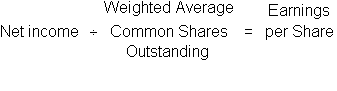
(S.O. 6) Earnings per share
(EPS) indicates the net income earned by each share of outstanding common stock.
a.
The formula for computing earnings per share is:
b.
Most companies are required to report earnings per share on the income
statement.
c.
When the income statement contains any of the sections for material
nontypical items, earnings per share should be disclosed for each component.
d.
When there has been a change in the number of shares outstanding during
the year, the denominator in the formula becomes the weighted average shares
outstanding.
20. When a
corporation has both preferred and common stock outstanding, dividends declared
on preferred stock are subtracted from net income in determining earnings per
share. If the preferred stock is
cumulative, the dividend for the current year is deducted whether or not it is
declared.
