29-February-2004
Sunday, February 22, 2004 Posted: 6:21 PM EST (2321 GMT)
JERUSALEM (AP) -- An ancient, dying language gets a new life on American movie screens this week.
Some linguists, who fear the language spoken by Jesus could vanish within a few decades, hope for a boost from Mel Gibson's new film, "The Passion of the Christ," opening Wednesday in U.S. theaters. The dialogue is entirely in Aramaic and Latin.
Among the few places in the world where Aramaic is still familiar is a small Syrian Orthodox church in Jerusalem, though even here it is little more than an echo these days.
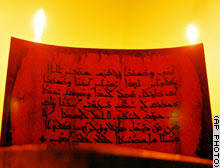
A card with the Lord's Prayer written in Aramaic sits in a Syrian Orthodox Church in Jerusalem, one of the few places in the world the ancient language is still spoken.
A church elder laments that he has few people to speak to in Aramaic besides the monks. Parts of the liturgy have to be said in Arabic. A nun who sings the Lord's Prayer says the words are just about the only ones she can recite in Aramaic.
Aramaic was once the lingua franca of the Middle East and parts of Asia. Today, the Syrian Orthodox community in Jerusalem offers Aramaic summer school classes, but there is little interest and fewer than half the 600 members speak the language.
"Maybe the new generation will wake up and continue," said Sami Barsoum, 69, a community leader and fluent Aramaic speaker.
Just a half-million people around the world, mostly Christians, still speak Aramaic at home.
"Undoubtedly, Aramaic is in danger of disappearing," said Moshe Bar-Asher, president of the Academy of the Hebrew Language in Jerusalem.
Aramaic is one of the few languages that has been spoken continuously for thousands of years. It first appeared in written records around the 10th century B.C., though it was likely spoken earlier.
It is a Semitic language and has similarities with Hebrew and Arabic. Carpenter, for instance, is "nagouro" in Aramaic, "nagar" in Hebrew and "najar" in Arabic.
Aramaic reached its widest influence when it was adopted by the Persian empire about 500 B.C. Written in a 22-letter alphabet -- similar in form to Hebrew -- it was a relatively simple language, and scribes and intellectuals helped spread it in a largely illiterate world, Bar-Asher said.
Aramaic texts have turned up as far apart as India and Egypt. Jews returning from exile in Babylon around 500 B.C. helped spread the language to the eastern Mediterranean, where it largely supplanted Hebrew.
Scholars believe Jesus might have known Hebrew -- which by that time was reserved mainly for use in synagogues and by upper classes -- and some Greek, but Aramaic was the language of his native Galilee.
The New Testament records Jesus' last words on the cross in Aramaic: "Eloi, Eloi, lama sabachthani?" The Gospel of Mark, most likely written in Greek, adds, "... which means, 'My God, my God, why hast thou forsaken me?' "
Michael Sokoloff, a professor of Hebrew and Semitic languages at Bar-Ilan University near Tel Aviv, Israel, said it is believed that parts of the Gospels were originally written in Aramaic, but only Greek writings have been found.
Aramaic was largely replaced by Arabic during the Islamic conquest of the 7th century.
Today, a few people speak it in parts of Iraq, Syria, Turkey, Lebanon, India, Europe, Australia and some U.S. cities, including Chicago, Illinois.
In Syria, once the core of indigenous Christian Aramaic speakers, the language is still heard among 10,000 people in three villages perched on cliff sides in the Qalamoun Mountains north of Damascus.
But it is dwindling as the older generation dies, said George Rizkallah, a 63-year-old retired Syrian teacher. Rizkallah has appealed to the Syrian government and international organizations to help save the language.
A few thousand Israelis who emigrated from other Middle East countries still speak Aramaic, but few pass it on to their children.
However, the Talmud and other Jewish religious texts are written in Aramaic. It appears in the Kaddish, the Jewish prayer for the dead, and in Israeli marriage and divorce contracts.
Sokoloff, the Semitic languages professor, is helping write an Aramaic dictionary.
Gibson's film, depicting Christ's final hours, uses subtitles. The script was translated into first-century Aramaic for the Jewish characters and "street Latin" for the Roman characters by the Rev. William Fulco, director of ancient Mediterranean studies at Loyola Marymount University in Los Angeles, California.
Lovers of Aramaic language hope new film sparks rebirth
27.02.2004 16:25:47
Daily News,
Tuesday, February 24, 2004
- 7:16:13 PM PST
By Susan Abram, Staff Writer
Across the nation today, thousands of moviegoers will hear the words of Aramaic, an ancient language spoken by Jesus and his disciples and one that wars, assimilation and time have almost silenced.
It is exciting for local
priests and scholars, who hope Mel Gibson's "The Passion of the Christ" -- which
is entirely in Aramaic and Latin -- will cast new light on the Semitic language,
which has largely been confined to church walls and archaeological circles.
"It gives the public a chance to hear the language Jesus spoke," said the Rev.
Joseph Tarzi, who has taught Aramaic classes at St. Ephraim's Syrian Orthodox
Church in Burbank.
"This is the first time in the history of the entertainment industry that it is
used for the public at large. To hear the language this way, I'm very excited."
Once the language of the Middle East and beyond, Aramaic can still be heard in villages of Northern Iraq, Eastern Turkey and Syria and also in the United States, where Assyrians, Chaldeans and Arameans still use the language as part of their liturgy.
Though Aramaic is still taught, many linguists believe its very existence hangs by a fragile thread.
"After 9-11, we definitely saw a rise in students who wanted to take Arabic, so there was a positive there," said Yona Sabar, professor of Hebrew and Aramaic languages at the University of California, Los Angeles, who also is a native speaker of the language.
"If one student comes to me and says, 'I'm here because I want to learn Aramaic,' then I will say the film is successful in that way."
About a half-dozen students learn Aramaic each year, Sabar said.
"Aramaic is still in a precarious state," he said. "I doubt if the movie will change its progress. Maybe we can prolong it, but I doubt it will really last 30, 40, 50 years as a spoken language but will remain as a cultural language.
"Languages sometimes die in one way, but come back in other forms."
But Estiphen Panoussi, a Palmdale resident who teaches philosophy at Antelope Valley College and who has taught Aramaic in universities across Europe, said the film will undoubtedly pique the interest of those interested in cultures.
"Symbolically it will be very interesting, to see the language Jesus spoke," said Panoussi, a Chaldean from Iran. "The film will bring cultural attention to Latin and Aramaic. My hope is that it will stimulate people to learn Aramaic."
Gibson uses subtitles in his film, which depicts Christ's final 12 hours. The script was translated into first-century Aramaic for the Jewish characters and "street Latin" for the Roman characters by the Rev. William Fulco, director of ancient Mediterranean studies at Loyola Marymount University in Los Angeles.
Fulco said he had to reconstruct the language, but he hopes it will be familiar to those who still read, write and speak it.
"They will likely recognize
it," he said. "I'm kind of glad, if nothing else, that the film is raising the
interest of the language. One thing that I noticed with the press, is that they
are asking me about Aramaic. Just to tell them what it is is a big step for the
language."
Local religious leaders said they are encouraging their congregations to see the
film. About half of those who attend St. Paul's Chaldean Assyrian Catholic
Church in North Hollywood will likely understand much of the movie, said the
Rev. Noel Gorgis.
"I myself, I cannot speak it, but I will understand it," Gorgis said. "This big movie will not only let us hear our language, but will maybe bring attention to our people who have been forgotten by the world. With all that happened to us, we are still here."
The Rev. George Bet-Rasho of St. Mary's Holy Apostolic Catholic Assyrian Church of the East in Tarzana said Gibson's choice to tell the story in Aramaic has brought pride among his parishioners.
"We're hoping it will revive the interest of scholars and universities," he said. "Now we feel we have not been alone, that our struggle to keep this language is not in vain. All of a sudden, the whole world will hear this."
The Words of Jesus in Aramaic and the Syrian Orthodox Church
12.11.2003 13:53:46:
The Words of Jesus:
'It was Christ's language and the language of the disciples. Christ gave us the
Lord's praise in Aramaic, so that is the language we use to give him praise,'
says a member of a new Syrian Orthodox congregation in Corpus Christi
By Venessa Santos-Garza
Caller-Times
June 15, 2003
Joseph Afram left
Syria
28 years ago but refused to leave behind its traditions. Each weekend he joins
the congregation of St. James of Nisibin Church to pray in Aramaic, a language
spoken by Jesus and passed down from generation to generation for centuries.
"It was Christ's language and the language of the disciples," he said. "Christ
gave us the Lord's praise in Aramaic, so that is the language we use to give him
praise."
St. James, one of only 20
parishes in the Archdiocese of the Syrian Orthodox Church of the Eastern United
States and the only one in Texas (other Syrian Orthodox dioceses have churches
elsewhere in the state), began celebrating Mass with five families in a small
shopping center in Flour Bluff in January. Since then the church attendance has
grown to 17 families, with some coming from as far as the
Rio Grande
Valley
and Houston, Afram said.
"At first we were taking turns having services at different people's homes,"
said Afram, church council president and founding member. "God willing, we will
have a permanent building soon."
The diocese got its start in the United States in the late 1800s and consecrated its first church in 1923 in New York. Over the years, more and more members of Syrian Orthodox Christianity have relocated in the United States.
According to the archdiocese, members of the Antiochian Syrian Church represent the direct descendants of the original inhabitants of Syria, Lebanon, Palestine, Asia Minor, as well as Upper and Lower Mesopotamia - today's Iraq. Their language, Syriac-Aramaic - Aramaic for short - was the language of ancient Syria and the language of Jesus Christ.
During the Fourth Ecumenical Council in 431 A.D., a fiery debate about the nature of Jesus caused a split between the Christian churches. Members of the Syrian Orthodox Church believed that Jesus had only one divine nature. Others such as the Roman Catholics and Greek Orthodox argued that Jesus had two natures: human and divine. There were arguments over the definition of the word "nature" and the Syriac church believed that the term "two natures" implied that Jesus had two personalities, one a divine individual and another a human individual.
For the Roman Catholics and
Greek Orthodox, the term nature was defined more as essence, meaning that both
characteristics were present in the incarnate Jesus Christ.
The Syrians, who refused to accept the canon of the Fourth Ecumenical Council,
were persecuted by the
Byzantine Empire
and forced to endure years of bans, killings and incarceration. Many fled to the
Persian Empire in south Mesopotamia but were persecuted there because of their
faith and because their spiritual leadership resided in the hostile Byzantine
Empire. In the centuries since, Christians of all kinds have suffered prejudice
and persecution that continues today.
"It has been difficult we have been persecuted by Greeks, and then when Islam arrived the Mongols who moved through killed thousands we did our best to survive as a community and as a faith," said Archbishop Cyril Aphrem Karim of the Archdiocese of the Syrian Orthodox Church for the Eastern United States. "Many died to preserve our customs, language and our beliefs because they were everything to us. They still are."
Seeking religious freedom
Alexander Rentel, who teaches church history and canon law at St. Vladimir's Orthodox Theological Seminary in Crestwood, N.J., said it was that constant abuse that forced many Christians to leave their homelands in search of religious freedom and settle in places such as Western Europe and North America. That the people and the religion have survived is a great display of faith and resilience, he said.
"They don't necessarily have a homeland but their religion and their language, above all, are inseparable," Rentel said. "It is their identity."
Rentel said today's Christians in the Middle East, especially in Syria, have really been caught in the crossfire. With Saudi Arabia at one border and Iraq at the other, the country that some consider a safe haven for many different faiths is sitting in the middle of controversy and war.
He expects that as the situation continues to escalate more people will flee, creating a more noticeable presence of Syrian Orthodox churches in the United States. While the reasons for the upsurge are unfortunate, he said, Americans will have the opportunity to be exposed to another form of Christianity.
"To be able to see a church that stretches back that far and has held onto its traditions and liturgy is amazing," Rentel said.
Trying to preserve a culture
But the Syrian Orthodox Church faces its share of obstacles in the United States as well. With few churches in the diocese and little money to support them, congregations are forced to share priests and pay for much of the day-to-day operational costs on their own. St. James, for example, has two priests who celebrate Mass for them on alternating weekends, one commuting from New Jersey and the other from Chicago.
But the bigger issue, Karim
said, is one that all churches of all nations seem to be battling.
"How do we keep the younger generation, many who were born in the United States,
interested in the old ways and the old language? We have lived a life of misery,
moving from one place to another because of persecution. Now we have to try to
figure out how to preserve our culture, identity and language in the U.S. They
don't call it the melting pot for nothing."
The diocese hosts a youth
camp each year and holds Sunday school classes in bigger churches to help boost
interest. But more and more churches are incorporating English into their
services. St. James celebrates Mass in Aramaic, Arabic and English.
Raising children in the faith
Egyptian-born Dr. Maged George, a pediatrician who relocated from Corpus Christi to San Antonio, tries to make the drive here once a month to attend services at St. James. He said the Syrian Orthodox Church has close ties to the Coptic Christian church he was raised in. He has put a lot of miles on his car for his faith, first driving from Corpus Christi to the Coptic church in San Antonio and then from San Antonio to Corpus Christi to show support for his friends here. He said he wants his children, Fadi and Sandra, to know about the old Coptic and Aramaic languages and their ties to each other.
"It is extremely important that I raise my children in the same faith and the same church as I used to attend back home," he said.
Afram said that before St. James, he and his family attended St. Nicholas Greek Orthodox Church because it was the closest to his childhood faith. While the church opened its doors to them and did its best to make them feel welcome, he said he never quite felt at home. Afram missed the dialect and traditions of his own church.
The building St. James is using, he said, is small and except for the icons that adorn the walls, doesn't look much like a church.
"The location, the building is not as important to us as our faith and keeping our heritage alive," he said.
Contact Venessa Santos-Garza
at 886-3752 or
[email protected]
in: Corpus Christi Caller-Times
Other related links: