In 1951, G. P. Kuiper , noting that Oort's cloud of comets did not adequately account for the population of short-period
comets
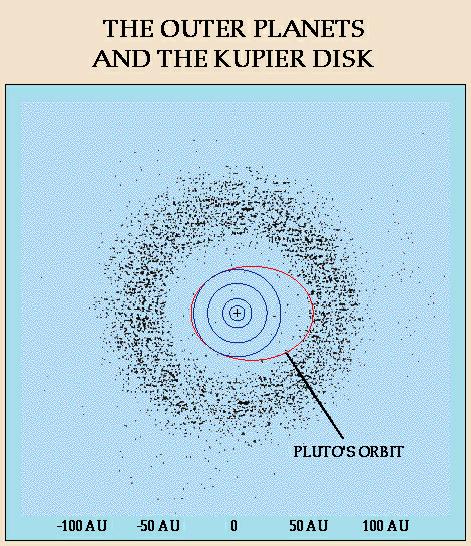
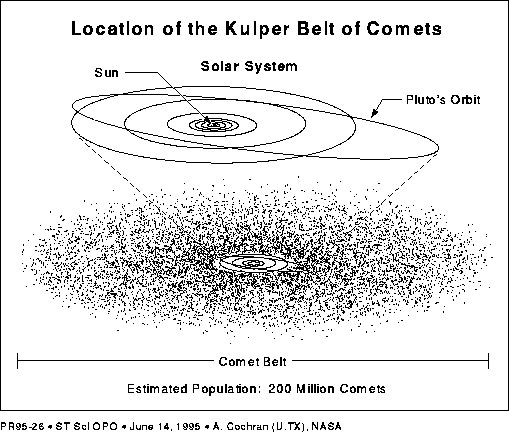
(those making complete orbits around the sun in less than 200 years), proposed the existence of a disk-shaped region of minor planets outside the orbit of Neptune, now called the Kuiper belt*, as a source for such comets. The Kuiper belt acts as a reservoir for these in the same way that the
Oort cloud acts as a reservoir for the long-period comets. *This
theory was validated in 1992 with the discovery of the first of the more than 70,000 so-called trans-Neptunian objects, bodies more than 100 km in diameter in an orbit 30-50 AU from the sun. Many astronomers
believe that Pluto is not a planet but rather a member of the Kuiper belt. The discoveries of several Kuiper belt objects have bolstered this view. 2002 LM60 (Quaoar) is more than half the size of Pluto, and
(20000) Varuna is almost half the size of Pluto, and like Pluto, has a satellite; and four Kuiper belt objects, called Plutinos, have an orbital synchrony with Neptune like that of Pluto (Neptune completes
three orbits around the sun in the same time that Pluto and the Plutinos complete two orbits). |