HOLY BIBLE

It's Accuracy


Christians have no problem believing the Christian Holy Bible is historically reliable. However, conflictive commentaries from the varying sects of the populace, along with the claims from various denominations that their Bible is the right Bible, instills in one's mind, a tinge of doubt; doubts stemming from seemingly logical statements flung into society every day in an attempt to discredit the reliability of the written Word. An off-the-cuff remark may not mean much at first, but let it simmer on the back-burner of the mind and add further assertions to it over a short span of time and before long there is a pot of confusion and disbelief. There are just too many falsehoods nurturing an already ambivalent population; misconceptions that place a stumbling block in the way of many a good person hindering them from not only understanding but acknowledging the Bible as the Word of God.
The world is in agreement with the definitions of the classical approaches that dampen the belief in the Bible: evolutionism, the humanistic concept or atheism, liberalism, modernism, legalism, and denominationalism; each of which must be defined to show their influence upon world thought patterns.
This unbelief in the Bible is very prevalent today and, coupled with the fact that this generation has generally accepted evolutionism, many are now questioning the relevancy of the Scriptures and their accuracy.
Understanding the Holy Bible
An overall, but general, understanding of why the sixty-six books within the composition of our Bible were the only ones chosen helps to clarify its accuracy and authenticity.
In our English Bibles, the Old Testament consists of thirty-nine books; the New Testament consists of twenty-seven books. The Old Testament books fall into four categories, History, Poetry, the Major Prophets, and the Minor Prophets; the New Testament into four categories: History, sub-divided into the Gospels and Acts, Paul�s Epistles, General Epistles, and the Apocalypse. The Old Testament is further divided, as is the New Testament. Both are a history complete in itself. Whereas the Old Testament writes about the future coming of a Messiah, the New Testament writes of His existence and a promise for eternal life.
The Gospels, although they could be classified as biographies, record verifiable events of great importance to human history. Luke records in the book of Acts the history of the early church recounting the spread of the good news throughout Judea, to Samaria, and to Rome; recounting the persecutions of the early disciples and the constant danger to their lives. Paul�s Epistles are separated into two groups: the first nine are directed to Christian churches from which each epistle takes its name; the last four are addressed to individuals: two to Timothy, one each to Titus and Philemon. The remaining epistles of the New Testament, from Hebrews to Jude, are referred to as general because they are addressed to all the churches or a group of people in a specific area as opposed to individual persons or churches. The final book of the New Testament is Revelation, a chapter that gives closure to a Biblical era. The book of Revelation is often viewed in a fearful way, but the connotations of many are unfounded.
It is amazing the number of cunning tactics critics use to create controversy in an attempt to dampen the spiritual Word of God. These people are grasping at straws to put doubt in the minds of the unwary.
The reason for choosing the books that comprise the Holy Bible must be addressed first and then their accuracy examined. By whose authority were these books, the Hebrew writings of the Old Testament and the Greek writings of the New Testament, selected and why only these books when we know there are several other books of antiquity? Each manuscript was examined and judged according to an accepted standard conforming to the same criteria. It took many centuries with great debates before the final canon was adopted.
The Books now included within the pages of our Holy Bible were circulated and agreed upon unanimously for inclusion. Those books not accepted � 1Esdras, 2Esdras, Tobit, Judith, Esther (additional chapters), the Wisdom of Solomon, Ecclesiasticus (otherwise known as the Wisdom of Jesus the Son of Sirach), Baruch, the Letter of Jeremiah, the Prayer of Azariah and the Song of the Three Young Men, Susanna, Bell and the Dragon, the Prayer of Manasseh, 1 Maccabees, and 2 Maccabees � are ancient books that possess much literary, philosophical, and historical significance, and which are considered by many to be religiously helpful. There are only fragments of these ancient books written in Hebrew, the original language; most of these books come to us through Greek translations made for the Septuagint. Depending upon the geographical area determined the importance placed upon these books, and because debates were never resolved, mutual agreement designated the Bible be adopted as it now is.
The decision not to give these books a place in the Old Testament canon was not that they were regarded as fabrications or as trivial commentaries, but rather that they were considered to be less inspiring than those books making up the Law, the Prophets, and the Writings. In affirmation to the Council�s decision to not include these fifteen books with the other sacred writings, Jewish scholars down to the present time have continued to uphold that decision. It is, therefore, the publisher�s prerogative to include them in the Old Testament or as an appendix to the Old Testament or to omit them completely.
When we read of a particular account or version of a story to which the term �apocryphal� has been added, we label it as legendary or, at the very least, unhistorical. There was a time, however, that Apocrypha simply meant �secret�. They were not for use by the general public and, thus, were exploited by early church leaders who had been properly initiated into the mysteries of the Scriptures. This initiation gave a precedent power to the clergy; a power, based on the belief those books held secret meanings. This power inevitably led to far-fetched symbolic interpretations that ultimately kept the populace under their control. However, this, in turn, brought the study of the Apocrypha and the Apocrypha itself into a haze of discredit.
It would do well to mention here that there are a considerable number of other ancient books classified as the Pseudepigrapha; that is, the �false writings�; writings to which authorship has been wrongly given to Enoch, Moses or some other renowned patriarch. Some of these fraudulent books take the form of prophecies or �apocalypses�; others are simply fables with a note of mysticism attached. Evidence points to a difference in writing style that does not conform to the style of he whose name has been attached to it. There is no evidence of authenticity or of true spiritual insight. Unfortunately, spurred on by a few firm believers, many consider them a vital part of biblical history. This belief arouses suspicion and places the Holy Bible itself in a controversial light. The use of a famous name was merely a dishonest device to give the writing an undeserved authority. These books were excluded even from the Apocrypha.
Thus we can be assured that the canon of the Scriptures was not arrived at in any nonchalant manner. Neither was it determined by any official decree even though The King James Version was first prepared and published under the authorization of King James, (1611) the head of the Anglican Church.
Can we then state that the Holy Bible is reliable, preserving and maintaining His Word in all its purity and truth as the Word of God given by inspiration (cf. 2 Tim. 3:16-17)? What is known is that we have sixty-six books, all of them essential to the full revelation of Jesus, all of them withstanding the test of time, all of them giving substantial proof for the existence of God.
How can there be certainty that the same words in our modern-day Bibles are the same as those written by the authors of the books of the New Testament? With ancient manuscripts and fragments of manuscripts that have been found, there is the assurance that the words in our Bible are those of the original writings. Twentieth century scholars with the aid of several more archaeological discoveries in the last decade, have translated the words of the Scriptures in the languages used in the world today. Footnotes were added where the meaning of the text was doubtful or difficult to understand. We are witnesses to the vocabulary of a people changing over a period of time; the words used by the original writer of the first century, therefore, might not mean the same today. To keep in line with the intended meaning of the original text, the present day word is incorporated. This does not make the Bible any less authentic, only easier to understand. When studying the Christian Holy Bible � the King James, the Standard Revised, or the New International Version � we need only keep in sight the ancient world and not lose sight of our own, keeping things in the proper context.
Considering that there are Bibles in circulation today, which either contain material that has been proven inaccurate , or quotes that have been deliberately added to justify one�s own ends , a word of caution must be exercised. Beware also of footnotes that interpret the meanings of archaic words, which sometimes describe personal opinions created by the evolution movement rather than correlating the definition according to creation or the interpretation may be tainted with viewpoints based upon the nationalism or liberalism of the day.
Is our Holy Bible reliable historically? Yes. There will always be someone who, under Satan�s lead, will attack the validity of the Holy Bible. There will always be those people who will believe only portions of what they read. There will always be those who interpret the Word to justify their own actions. There will always be those who believe what was written, but state that it does not apply to man today, and there will always be those who believe the Scriptures through faith because their ancestors did.
The Bible in Its Many Versions
These days, since very few can read Hebrew or Greek, learned men have labored long and conscientiously to translate the words of the Scriptures in the languages used in the world today. But, how can there be certainty that the same words in our modern-day Bibles are the same as those written by the authors of the books of the New Testament? Twentieth century scholars are more knowledgeable than were those from the fifteenth and sixteenth century. Many more archeological discoveries of artifacts and of written manuscripts have been found and correspond to the history recorded in the Holy Bible. With these ancient manuscripts and fragments of manuscripts comes an assurance that the words in our Holy Bible � New Revised Standard Version, and New International Version � are those of the original writers. Spoken languages are bound to continue to change from generation to generation and, therefore, translators will continue to update these changes in newly revised Bibles in keeping with the meanings of ancient times with those of modern. We can be certain of continued readability throughout vernacular changes.
Each century, definitely our own, notwithstanding, has its many and diversified scholars who dredge up controversy surrounding the events recorded in the Scriptures. Some debates never change even though new discoveries, mostly from archeological finds, have proven their claims are wrong. This is still very much an issue surrounding the Gospels of the New Testament even though most scholars agree with the main theme or purpose of each gospel.
The Gospel Writers
Toward the close of the Old Testament period, Aramaic, closely related to Hebrew and Chaldean, came into general use throughout Palestine and Syria; it was the everyday speech of the common people and the language spoken by Jesus during His ministry. However, during the first century AD, Greek became the universal language of culture throughout the Roman Empire, even in Judea where the people spoke their native tongue. All treatises and letters intended for wide circulation and general reading were written in Greek. Thus the Gospel writers, without regard to their own language, set the Gospels down in Greek so that all may read the Good News. This is especially evident in the Gospel of Matthew where his Hebrew background colors his style of writing.
There has to be an understanding of the world in which they lived and the way the disciples spoke. Whereas the majority of our learning is communicated through the written word, theirs was through the spoken word often recited in poetic verse for easy memorization. There must be some understanding of what was happening in the Roman world, otherwise the customs and culture of the people are lost, and then to, the many idioms used by the prophets when they communicate the Will of God to the people. To understand is to experience the vivid reality of the times given in a specific time with specific people and events. To feel the mood swings between the classes of people, to feel the full impact of emotions, to carry the sadness of the hour in the heart is to envelop one�s self completely into the historical moment.
The four Gospels written by four men that lived among humble people differ slightly, and yet all are truthful, reliable, and authentic. Why so few manuscripts? Not everyone during this time period received a formal education with pen and chalkboard and depending upon family heritage few could read or write. The memory of these people advanced to a high art form. Whereas we can allow ourselves to rely on encyclopedias and computer memory banks, the disciples of a teacher were taught as children to listen and learn his words by heart. Remembering made easier with words founded on rhythm in mimicry, swaying and gesturing. The use of parallels and parables cemented the accuracy of memorization. Their testimony is still worthy of acceptance.
It is difficult to see beyond our own experiences. Today we hear God�s Word being read from the pulpit as we sit on the wood pews, in a dry, warm or air-conditioned building we call our churches. We hear the words, but do we always listen. Do we hear what the early Christians heard? We have to span the centuries and transport our thought patterns to parallel those of the early Christian communities. We no longer face those same hardships -- secretly meeting in private homes or in catacombs and caves. These people received the Word eagerly and with great hunger. Some of these followers of Christ had walked and talked with Him. Many walked and talked with those who had sat at the feet of Him. So fresh was the memory of Calvary and the culmination of events that led to the Crucifixion and Resurrection. They could not come forth in public nor did they dare to carry written works on their person because of fear of persecution for their beliefs. And yet Jesus� teachings survived. There were enough who heard the Good News of Jesus, his miracles, his sayings, all his good works, and how he had raised himself from the dead to live among them with the promise to again return. They never tired of hearing the Gospel. If anyone said something in error, it would immediately be pointed out and corrected. It was the fundamental role of these communities to preserve this Gospel, this living tradition of the Church, through the testimony of Matthew, Luke, Mark, and John, eyewitnesses to the event. The events set down in the Gospel record were never embroidered by fables. That came much later when people tried to place their own interpretation onto the Words to pacify their own consciences. Soon commentaries and personal �bibles� were printed and flooded the markets.
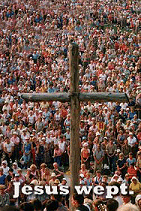
We need to reflect upon the guiding instinct of those who recopied the twenty-seven Books of the New Testament from which the full story of Jesus emerges; an instinct that was neither a scientific curiosity nor an historical postulation, but an ardent faith that demanded accuracy.
Critics Attack the Holy Scriptures
For centuries, scholars, who cannot believe that Jesus is the Son of God, search the text of our Holy Bible; looking for anything they can call errors to discredit its reliability. For instance, it is immediately assumed that because similar sayings spoken by Jesus appear in the works of the early Fathers of the Church and the apologists of the first century, these quotes must have been interpolated into the biblical text. Jesus� ministry spanned three and one-half years plus forty days, and in that time he must have taught by many variations of His quotes. In the works of Origen we find the quote, �Who is near me is by the hearth and far from me is far from the kingdom�. Critics love to use reverse psychology and demand that we must accept the quote from Jesus in Acts 20:35 as an interpolation into the text by those who studied under the early Church Fathers. �It is better to give than to receive�, echoes Jesus� voice and His teachings. One cannot doubt that Origen is reiterating the teaching of Jesus. It is common practice for people who want to destroy Christianity and all that it stands for to interpret and interpolate their own theories into biblical text making it fit the pattern they want it to follow.
Often when no historical proof can be found to authenticate a section of biblical text, assumptions are voiced that fiction is interwoven within the biblical stories. For decades, one of their favourites was the account of the Hittites. In the late 1800�s evolutionists and atheists pointed out the Hittite civilization never was. They declared the entry in error because no information from any ancient source could be found to corroborate the statement. The original version of the Bible was set in print in 1611 AD. The settlement of the Hittites was not discovered until the early 1900�s. This discovery was not readily publicized, but over the centuries this particular dispute has been conveniently dropped.
Today, those who pick apart the Holy Bible love to use the New Testament, and in particular the four Gospels to destroy the authenticity of Matthew, Mark, Luke, and John.
After Jesus� Resurrection: the bribing of the guards is only mentioned in Matthew. Jesus appeared to the two men on the road to Emmaus in Mark and Luke, but not in Matthew and John. Jesus appears to the disciples twice, but this is mentioned only in John. Jesus appearance on the mountain in Galilee is mentioned in Matthew and Mark, but not in the other two. In Matthew, Mark, and Luke, two Mary�s are at the empty tomb. In John there is mention of only one. These �so-called� discrepancies come from minds that do not read for content, but read only to find what might be construed as error to further their cause. For the sake of explanation, let�s direct attention to the case of the �missing� Mary. First of all, it doesn�t matter how many �Mary�s� there are or for that matter how many people were at the empty tomb first. Perhaps John knew only the one Mary, perhaps the people he was addressing were familiar with the Mary he mentioned and the mentioning of her alone would bring about greater understanding of his words. Or perhaps he knew the people he was addressing did not know the other Mary and it would be of no consequence if she were omitted from the account of the event. Does that make the incident any less true? Regardless of his reason for not mentioning the other Mary, his Gospel has the same beginning, middle, and ending which really counts. But these �fault-finders� insist anyway that it is an error, and if there is one there is more.
But it is the many unauthorized sources that places doubt upon the twenty-seven Books. There is the Gospel of St. Peter, which is suspect of Docetism, that is, the heresy that Christ was not man incarnate, but took on the appearance of man. Another is the Gospel of the Ebionites, a sect of Judaising followers of Christ who were vegetarian and given to ascetic practices. There are the Gospels credited to Thomas, to Philip, and even one to Eve, borne out of the mass of Gnostic speculation, which came out of the Alexandrian Jewry with its strange metaphysics introducing legions of supernatural powers, that critics use to place suspicion on our Holy Bible. It is not only the written word, but also the art made popular during the Middle Ages that nourished a desire to know the smallest details of Jesus� life on earth. Though touching with such tenderness, they gave rise to such fantastic compilations as the Gospel of the Holy Childhood, the Gospel of Pilate, the Gospel of Nicodemus, and the Protgospel of St. James. By virtue of medieval art they have passed into history as the desire to know all still flourishes in Christian hearts. Nowhere in the biblical writings do we find an entry that describes a scene where the infant Jesus by his very presence causes the idols of an Egyptian temple to fall; nor is there mention of the Star of Bethlehem being supported by an angel; nor of an ox and ass warming the infant Christ in the manger. These all come from apocryphal text.
Much emphasis is placed on the miracles.
This page is lovingly dedicated to my LORD.
Sign Guestbook
 View Guestbook
View my old guestbook
Topics of InterestMakarismos Page of Introduction ...And Then SomeMAIN Contents