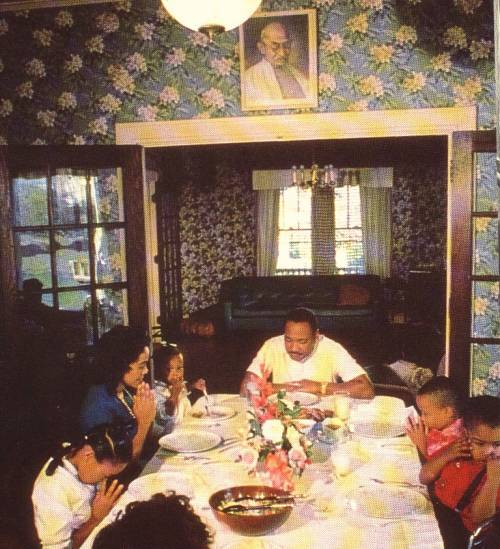
Martin Luther King Jr
King adopted Gandhian principles for the Struggle of the Black people in the United States, not to show anyone, but based on firm convictions. In the beginning King never thought that Gandhian principles had any practical value. In Kings own words: "One Sunday afternoon I traveled to Philadelphia to hear a sermon by Dr. Mordecai Johnson, president of Howard University. Dr. Johnson had just returned from a trip to India, and, to my great interest, he spoke of the life and teachings of Mahatma Gandhi. His message was so profound and electrifying that I left the meeting and bought a half-dozen books on Gandhi's life and works. Like most people, I had heard of Gandhi, but I had never studied him seriously. As I read I became deeply fascinated by his campaigns nonviolent resistance. I was particularly moved by his Salt March to the Sea and his numerous fasts. The whole concept of Satyagraha (Satya is truth which equals love, and agraha is force; Satyagraha, therefore, means truth force or love force) was profoundly significant to me. As I delved deeper into the philosophy of Gandhi, my skepticism concerning the power of love gradually diminished, and I came to see for the first time its potency in the area of social reform. Prior to reading Gandhi, I had about concluded that the ethics of Jesus were only effective in individual relationships. The "turn the other cheek" philosophy and the "love your enemies" philosophy were only valid, I felt, when individuals were in conflict with other individuals; when racial groups and nations were in conflict a more realistics approach seemed necessary. But after reading Gandhi, I saw how utterly mistaken I was." [Autobiography of Martin Luther King Jr] |