EARLY DAYS
This land was opened to colonisation in 1785 as the "Western Reserve", that was surveyed and settled in the "township" manner. New roads were traced: the "Zane road" and the National Road (US Route 40). New states were incorporated to the Union: Ohio, Indiana, Michigan, Illinois, Kentucky, West Virginia (separed from Virginia after the Civil War). After the battle of Tippecanoe (1811) near the beautiful city of Lafayette (Indiana), the Indian tribes were no longer a problem for the settlers, that came in great number from New England, Pennsylvania, New York, Virginia and Europe (mainly from Germany). Of course was a land of freedom. Many religious communities founded new towns like the "Moravians" (New Philadelphia, Schoenbrunn) or the "zoarites" (Zoar) in Ohio, the "harmonists" (New Harmony) in Indiana, or the more successful Mennonites communities that still survive across Ohio and Indiana.
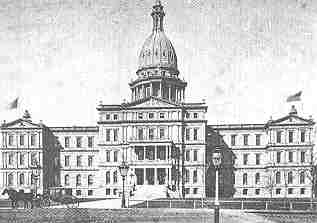 Michigan State Capitol. Lansing (XIX c.) |
The land was
fertile, with corn, wheat, orchards (remember this is the land Johny Applessed called home after leave Massachusetts) and the Ohio river provided the necessary transportation joined by a network of roads and canals (Ohio & Erie, Miami & Erie) between the Great Lakes and the Ohio river. Cities grew up along the river: Pittsburgh, Steubenville, Wheeling, Marietta, Gallipolis, Portsmouth, Cincinnati, Louisville, Evansville. The railroad in the XIX century came to design a new pattern in development and commerce along the region. After the 1850´s many companies (New York Central, Pennsylvania Railroad, Baltimore & Ohio, Chesapeake & Ohio) owned and controlled the main lines and spanded his tracks from the Atlantic coast to Chicago and Saint Louis. New cities grew up in between: Columbus, Indianapolis. |
                                                                                                                                                                    Next chapter >>>>

---------------------------------------------------------------------------------------------------------------------------------------------------------
©  MAINSQUARE  USA  Geography Project.   Texts and graphic designs by Juan Vicente Santamaría Gil  2004
 Back to index