| Dick Nevel - page 4 |
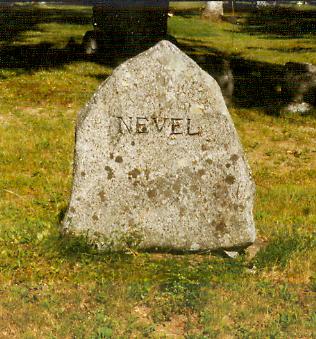 |
| Grave of Wallace Dickerson Nevel at South Andover, Maine |
Life of Dick Nevel Details of Dick Nevel's early life are missing. Although he undoubtedly lived with his mother, at first, he is generally remembered as a ward of Edmund Bailey of Andover. He may have resided with several foster families and, for a while, Dick may have been mostly raised by Edmund Bailey. It is undoubtedly Bailey's influence as a miner and mineral collector which steered Dick towards his mining career. Dick attended Andover, ME high school in 1908, but did not graduate (Robert Spidell, personal communication, 1999). When Nevel was young, he was sometimes called "Dippy Dick" after a then current newspaper cartoon character of the same title. Dick was frequently seen in the area with a collecting bag and mineral hammer. After he began working toward raising the funds necessary to pay the expense of getting electric services installed in Andover, he was always "Mr. Nevel", after that. (Charles F. Marble, taped interview, 1958). Andover Town Annual Reports do not indicate the participation of any particular citizen concerning the electrification of the town. W. D. Nevel married Verna Susan "Susie" Farrington (b. November 27, 1896 d. August 28, 1969) on June 21, 1922. Nevel first met his future wife at Pleasant Island Camps on the shore of Cupsuptic Lake. His only son, Paul Nevel, was born on March 27, 1926. Paul's career included operating a successful fishing camp in the Greenville, Maine area, on the shores of Moosehead Lake, the largest lake in the State. Dick Nevel's second wife was Marjorie Nichols and they were married in the early spring of 1936, while in Florida, but were separated during the summer of 1938 (Paul Nevel, personal communication, 1999). One technique Nevel may have learned from Bailey for mineral "cruising" was to travel along roads and try to identify pegmatite in far away ledges. Nevel owned a pair of "powerful" binoculars which he would use to help identify rocks (Paul Nevel, personal communication, 1997). He would frequently travel with his half-brother, Francis Otignon and when a series of interesting ledges would be spotted, they would inspect the ledges for their mineral content. This method was particularly effective during a time in Maine's history when farming and cleared land were at their maximum. Early Dunton Pegmatite Mining The mineralized Dunton Pegmatite outcrop was first noticed, probably in 1898, by Henry S. Hall (b. July 20, 1833). The tiny summit on the south side of Plumbago Mountain is frequently called Hall's Ridge in recognition of the discoverer. The Dunton Pegmatite ledge was quite precipitous and probably stood about 10 meters in relief from the surrounding slope. There was undoubtedly colored tourmaline showing in the ledge which attracted Hall's attention. In 1898, Edmund Bailey of Andover blasted in the ledge that was later to become the Dunton quarry. Edgar D. Andrews, of Stow, also prospected at Newry during this time (Thurston Cole, taped interview with Ben Shaub, November 19, 1958) |