| Elijah Livermore Hamlin |
| Elijah Livermore Hamlin (b. March 29, 1800 Livermore, ME d. July 16, 1872 Bangor; m. Elizabeth Bradley Choate b. August 20, 1798 Ipswich, MA d. August 28, 1886) children: 1. Adeline; 2. Elizabeth A. 3. Augustus Choate 4. Julia H. Elijah's grandfather was Eleazer Hamlin (b. ~1730). Eleazer had many children, four of whom were named for continents: Asia, Betty, Alice, Africa, Europe, America, Lydia, Eleazer, Molly, Cyrus (b. July 21, 1769 Livermore, ME d. February 2, 1829 Paris, ME), and Hannibal. Cyrus Hamlin married Anna Livermore and the object of this study was second born of that union: Elijah L. (b. December 30, 1798 Livermore, ME d. April 6, 1799 Livermore, ME), Elijah L. (b. March 29, 1800 Livermore, ME d. July 16, 1872 Bangor), Cyrus (b. July 16, 1802), Eliza (b. April 4, 1804, died unmarried), Anna (b. July 11, 1805), Vesta (June 6, 1808), Hannibal (b. August 27, 1809), and Hannah L. (b. October 10, 1814). |
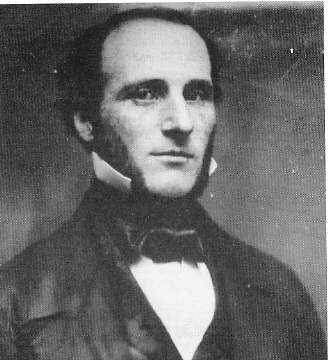 |
| Elijah L. Hamlin from a daguerreotype c. 1848 courtesy Phil Scalisi |
| "The first school house in the district was built in 1814, on the farm then owned by Merrill Chase - now by Alden Chase. ... The first teacher was Elijah Hamlin, then quite young, and living in Paris." (April 3, 1883, Oxford Democrat). After Elijah returned to Paris, he was elected to the Superintending School Committee for 1822 (Lapham, 1884). It is not precisely established what years Elijah Hamlin attended Brown University in Providence, Rhode Island. Family tradition holds that Elijah entered college in 1814 and graduated in 1818. There is an inconsistency in this date. Elijah probably enrolled in a standard four year program, but if he entered in the fall of 1814, the records of teachers in the Paris school district would have indicated an additional teacher in the first year in addition to Hamlin. Of course, Hamlin may have been a short term teacher, who was soon replaced by a more mature instructor, and he may have entered the fall term of 1814 at Bowdoin, but Elijah would have been only 14. Elijah transferred to Brown in 1817 and graduated in 1819. Day (1968) indicated that Ezekiel Holmes entered Brown University "in the fall of 1817" and he graduted in the class of 1821. On July 17, 1818, Holmes organized The Philophusian Society with seven original members, and on August 4, the club constitution was approved with Elijah Hamlin as vice-president and Holmes on the prudential committee. The object of the club was to promote "the investigation of scientific subjects". During the regular course of study, students could study medicine and Holmes and Hamlin did study for that profession. Holmes did not take a post-graduate period in medicine at Brown. The confusion which arises involves the length of the actual course of study. It was not necessary for Doctors to be liscensed in the time period and medical studies may have a character more akin to elective study rather than today's professional preparation. In Europe, there arose an informal anti-religious movement called the Hell Fire Club, or similar title depending on the group, and the movement seemed to have crossed the Atlantic. As many schools had strong religious backing, the Hell Fire enthusiasts may have really been anti-establishment rather than being anti-religion. The Hell Fire Club at Brown went into the chapel/cafeteria, in the Spring of 1819, and "They carried off the doors and furniture from the dining hall and seats and even the pulpit from the chapel. Not content with that they removed the gates and bars from the college yard and some of the blinds from the building. The next morning the faculty discovered a notice that had probably been posted the previous day, 'Hell Fire rummaging club at half past twelve this night," it read. The poster proved to be the work of a Philophusian and chum of Ezekiel, Elijah L. Hamlin, brother of Hannibal Hamlin, vice-president under Lincoln. He was 'sent away' for a few weeks into the country to contemplate the enormity of his offense." Day (1968). Mount Mica The Mount Mica tourmalines were discovered during Christmas break, 1820 when only Holmes was a student. Sturtevant (1948) reasoned that the date was in error. The famous Christmas break, when the companions made their discovery, was most certainly during the winter of 1820-1821, and therefore in December, 1820. According to the Brown University school catalog of the school year 1822-1823, the earliest seen by the author, Christmas break began on Christmas Eve and it was a punishable offense to be away from campus when school was in session. By modern standards, we would take this to mean that Christmas break began on December 24, possibly allowing students to take an evening stage or ship out of Providence after classes on December 23. However, Christmas traditions have changed dramtically since 1820. If Christmas "eve" was a time period before Christmas, and not literally December 24, the break may have started as early as the day before St. Nicolas' Day or St. Lucy's Day, etc. and would have allowed a very leisurely trip back to Maine. If the timing was literal, the walk that resulted in discovering Mount Mica tourmalines would have possibly been on New Year's eve or just before. The timing exactly on New Year's Eve for the walk would perhaps have been memorable enough to hand down as a tradition, so the question remains when the walk occurred. An attempt has been made to locate weather records for Paris in December of 1820, but the only reliable records seen are those collected by Parker Cleaveland in the coastal town of Brunswick, Maine. As Brunswick's weather is greatly moderated compared to inland Paris' weather, only a general comparison is possible. This has been done by King (2000). As Holmes graduated in the late Spring of 1821, neither of the men would not have been students when they returned to explore Mount Mica after the end of the Brown University term and, thus, reduces the effectiveness of Sturtevant's reasonings as to what year the discovery occurred in. Sturtevant (1948) suggested that the discovery was actually made in the winter of 1821-1822 and the return to explore the ledge occurred in the Spring of 1822. The problem was that if Holmes left Brown on "Christmas eve", 1820, he couldn't have had much chance to reach Paris before New Years Day, although it was physically possible. If Sturtevant (1948) is correct,, there was the entire Winter of 1821-1822 for the legendary discovery walk. There are other reasons in favor of the 1820 discovery date. |
| Localities |