| The Queer Amethyst Quarrel |
| The Murch boys had trapped a bear in their sheep pasture that night, and came round in haste early next morning, to raise a party to run the animal down. The bear, evidently a good-sized one, had gone off with the trap, making for the Great Woods, dragging after him a heavy green beech clog, attached to the trap by a strong chain. Nothing, except a fire, will bring out a party quicker than the prospect of hunting down a bear. Several men and ten or a dozen boys� among the latter my cousin Addison and myself�set off with guns and two hounds. But there was no need of dogs; the trail made by the beech clog was as plain to follow as a cow path. At every leap the bear had taken, the heavy log had torn up the turf, moss, and dead leaves. We expected that the creature would soon get "hung up" from the clog catching under roots or between tree trunks. But that did not happen, and the bear hunters had a long chase�first over the pasture lands, then through woods and across swamps and brooks, for four or five miles, to the foot of Birchboard Mountain. Now and again the clog had caught fast, but judging from the tracks, the bear had cast it loose with paws or mouth. Apparently he was heading for a densely wooded valley on the other side of Birchboard Mountain which here sloped gradually upward for a mile or more and was wooded with a noble growth of yellow birch. A long gully, formed by a small brook, extended up the slope, and the bear had followed the bed of it; we could see where the trap and clog had torn a little furrow among the small stones and gravel of the now dry watercourse. The Murch boys and two or three of the men were some distance ahead�we could hear them calling out to each other�but Addison and I had fallen behind. It was a warm May morning, and we had begun to reflect that it was not our bear, exactly, and would not be ours when caught. We had run for much of the way, and beside being hot we were nearly out of breath. The Old Squire, in fact, had laughingly advised us not to go, and now we were beginning to wish that we had stayed at home. We were toiling on up that watercourse, when Addison caught sight of something that interested him far more than the chase; anything in the way of minerals, indeed, always enlisted his attention. Where the clog had dragged among the little stones, brought down by the water, lay a purple crystal as large as a hen's egg. Addison caught it up. "Amethyst!" he exclaimed and examined it curiously. It was a crystal having hexahedral facets, but had been much battered, and worn by contact with stones in the brook bed. Yet in some places one could still look into the clear heart of it where the rich deep purple tint shone forth. "Amethyst, sure," Addison repeated. "The finest I ever saw!" He turned it over slowly, then handed it to me. "Wonder if there's more!" he said, and began pawing over the stones and gravel. We got some strong sticks and for half an hour or so dug up the pebbles and gravel in the bed of the gully, first for a little way below, then above the place where the crystal was found, following the gully upward for several hundred yards. |
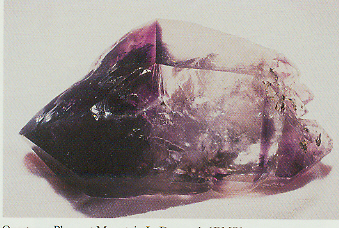 |
| Amethyst Pleasant Mountain, Denmark, Maine Found by George R. Howe of Norway, Maine, May 1-9, 1894 Boston Museum of Science specimen size about 12 x 6 cm |
| by Charles Asbury Stephens |