| Wallace Dickerson Nevel b. June 25, 1887 d. September 7, 1938 Newry, ME |
| Wallace Dickerson Nevel Dick Nevel is the miner who re-opened the Dunton Gem Quarry in Newry, Maine in the 1920's. His name is associated with several other Maine mines and is one of Maine Mining History's folk heros. The following is an account of his family and his exploits. "Dick" Nevel was born in Hudson, Michigan according to his passport, although he is universally "remembered" as a resident of Andover, Maine.. (There are occasional references that he spelled his name "Neville", but there seems to be no good reason for using this spelling except that that spelling is the most common homophone and therefore represents someone's misconception. W. D. Nevel's birth does not appear to have been registered in Lenawee County or nearby Hillsdale County in Michigan. A search of the 1900 Federal Census "soundex indexed" records indicate no Nevel, Neville, etc. lived in the Maine at that date, at least as "head of household". A page-by-page search of Maine census records for 1900 failed to reveal his or his mother's living in Andover, Upton, or Adamstown, as well as several unlikely small nearby census districts. William "Billy" Soule (b. May 2, 1860 Phillips, ME d. September 2, 1934 Oxbow, ME), operator of the Pleasant Island sporting camps in Cupsuptic, northwest of Oquossoc, Maine, was Dick Nevel's father (personal communication, Paul Nevel, 1997; see also Ellis, 1983). Dick had a half-sister, Grace Soule (b. June 20, 1907 d. September 30, 1996 Ashland, ME) and two half-brothers, one of whom was Francis Ottignon (b. November 23, 1880 d. June 5, 1927) and the other half-brother was also an Ottignon (Shirley Adams, personal communication, 1999). Dick Nevel's mother was Addie A. Small Ottignon (b. February 3, 1857, born in Vermont, but lived in Upton, Maine d. December 18, 1915 Andover, of a crebral hemorrhage) and she was a milliner. (Addie A. Small Ottignon is listed as the third child, of six, of Joshua Small Jr. (1806 - August, 1890, age 84) and Sarah J. Scribner (http:// members.aol.com/ andoverme/ brthdth95s.html).) There were no Ottignon's listed in the 1880 Federal census for the entire Andover-Oquossuc area, but a Mrs. C. H. Ottignon was a milliner in Andover in 1884 (April 8, 1884, Oxford Democrat ) and her name appears in many personals as an active merchant, although shortly after the above cited announcement, there followed "Mrs. C. H. Ottignon has taken rooms at Mr. Stone's and is closing out at cost (May 27, 1884, Oxford Democrat). Shortly afterwards, the change of business was revealed: "Mr. and Mrs. C. H. Ottignon go to Indian Rock to take charge of a camp at that place." (June 10, 1884, Oxford Democrat ). That winter, further activity took place at this area as her father also moved to Indian Rock (January 13, 1885, Oxford Democrat ): "Joshua Small, jr., who a few weeks ago pitched his tent at Indian Rock, to take charge of Camps Kennebago, is much missed by those accustomed to send for Joshua at every emergency. Always genial and kind, willing and able to turn his hand to anything, he has for a long time been the village's [Andover] man-of-all-work. Mr. Small is also an uncompromising temperance advocate which, in connection with the fact that King Alcohol has been the cause of recent trouble at Camps Kennebago, calls out the following lines from Steve Gustin, a local rhymist: To Camp Kennebago Small has gone, With his daughter Ottignon; Each wrong to right, and to appall The present reign of Alcohol! ..." Camp Kennebago was built in 1869 and was the main domatory building of the then recently organized Oquossoc Angling Assiciation at Indian Rock (Ellis, 1983). Addie Ottignon visited Paris during the fishing season: "Mrs. C. H. Ottignon of Indian Rock was in town last week." (July 14, 1885, Oxford Democrat). At that time, Paris was the one of the nearest large towns. After a gap in reporting, Addie's return is noted: "Mrs. C. H. Ottignon is in town and will probably spend the winter here." (January 25, 1887, Oxford Democrat) and another personal suggested that Joshua Small also spent the winter in Andover: "Joshua Small has gone to the lakes to work the coming season." (April 12, 1887, Oxford Democrat). Addie Ottignon was apparently in Andover in mid-May, 1887: "Andover has been 'taken' by an invasion of milliners from neighboring towns." (May 24, 1887, Oxford Democrat).). Apparently, the nature of camp work was as ephemeral in the nineteenth century as is is in the twenty-first century and Small and the Ottignons had changed their allegience, perhaps in pursuit of more money: "J. Small, Jr., of Pleasant Island Camp was in town last Friday." (July 12, 1887) and family tradition holds that Addie Ottignon worked at Pleasant Island Camps (Paul Nevel, personal communication, 1997). It is possible that Addie Ottignon had returned to Andover as well: "Andover is suffering from both photographic and millinery invasions. Many have been taken by the knight of the camera and more have surrendered to the embellishment of head gear." (September 27, 1887, Oxford Democrat) although the fact that Addie Ottignon was one, or, probably the only, milliner discussed is a conjecture. Even though he was about 81 years old, one had to admire Joshua Small: "Joshua Small is reshingling his house." (April 15, 1888, Oxford Democrat ) and we might believe that Small's active nature included doing his own work, rather than hiring it out. |

|
 |
| Additional particulars of Dick Nevel's mining activities can be found in Mineralogy of Maine, Volume 2. |
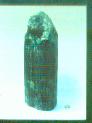 |
| Green tourmaline "Jolly Green Giant" Dunton Gem Quarry Newry, Maine Found 1972 size: 45 x 14 cm |
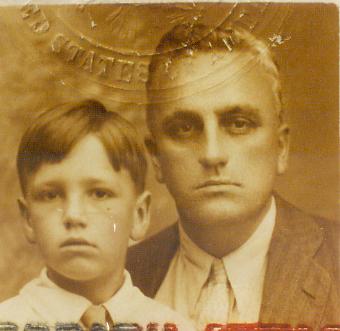
| Paul Nevel, Dick Nevel c. 1933 |