| Home | Mero Photo | Mero Country | Feedback | Chat |
I am a citizen of Nepal. I am very proud to be an Nepalese.
As Nepal, officially Kingdom of Nepal, constitutional monarchy in South
Asia. Locked within the rugged ranges of the Himalayas, Nepal is bounded by
the Tibet region of China on the north and India on the south, east, and west.
It was cut off from the rest of the world until the early 1950s, when a palace
revolution and the subsequent overthrow of the autocratic Rana dynasty marked
the beginning of Nepal�s emergence into the modern world. Kathmandu is the
capital and largest city
Although Nepal emerged in history in the first millennium bc, it was only in
the 18th century that Nepal developed as a country of the present size.
Archaeological remains suggest that areas of Nepal have been inhabited for
more than 10,000 years. The Kirant hill tribe people are thought to be the
first rulers of the Kathmandu area. The earliest undisputed Nepali dynasty is
the Licchavi dynasty, which was established in about ad 400. The Licchavi
dynasty, which probably migrated from present-day Vaishāli, India, was
centered in the Kathmandu Valley. The Licchavi dynasty expanded its influence
to the Kali Gandaki River in the west and Sun Kosi River in the east. The
Licchavi period, as well as the Malla period that followed, was deeply
influenced by Indian culture.
The Licchavi dynasty came to an end in the late 9th century and was followed
by the medieval period. The early medieval era was unstable and poorly
documented. It culminated in the Malla period (1200 to 1769) when three
separate dynasties, divided into three kingdoms in the late 15th century, were
conquered by the Shah dynasty in 1769, led by King Prithvi Narayan Shah.
Nepal�s southward expansion under the Shah dynasty resulted in a clash with
the English East India Company. The Anglo-Nepalese War (1814-1816) reduced the
country to its current size, although Nepal retained its independence.
In the first half of the 19th century, Nepal entered a short period of
instability that culminated in the Kot Massacre, in which fighting broke out
among military personnel and administrators after the assassination of a
high-powered favorite of the queen. Jung Bahadur, a strong pro-British leader,
prevailed during the massacre and seized control of the country. He declared
himself prime minister and began the Rana line of rulers. The Rana rulers
monopolized power by making the king a nominal figure. They also made the
office of the prime minister hereditary. Nepal gave valuable assistance to the
British during the Sepoy Rebellion (1857-1859) and during World War I
(1914-1918). The British government reaffirmed the independence of Nepal
through a treaty in 1923. A British resident (colonial official acting as an
adviser to the ruler of a protected state), stationed in Kathmandu, controlled
Nepal�s foreign relations. Nepal supported the Allied cause, with the
contribution of Gurkha soldiers, during World War II (1939-1945). Nepal and
the United States established diplomatic relations in 1948.
The Rana autocracy was increasingly criticized in the late 1940s, particularly
by dissidents residing in India. The political-reform movement, which was
approved by the Indian government and directed by the newly created Nepali
Congress Party, won the support of King Bir Bikram Tribhuvana. Like his
predecessors under the Ranas, he possessed purely nominal powers. His
intervention in domestic politics deepened the crisis, however, and he was
removed from the throne in 1950 by Prime Minister Maharaja Mohan Shumsher Rana.
A few days later the king fled to India and Nepali Congress insurgents began
military operations along the southern frontier. In 1951 Prime Minister Rana
allowed a reorganization of the Nepalese government along democratic lines and
the king was reinstalled. Friction between the Rana and Congress Party
factions culminated in November 1951 when Prime Minister Rana was removed from
power and the Congress Party formed a government headed by Matrika Prasad
Koirala.
After the Rana autocracy ended, Nepal embarked on a mission of economic and
social development. However, political parties organizing the government
during the 1950s were not effective. King Mahendra, crowned in 1955, seized
absolute control of the government in 1960 after a decade of political unrest.
King Mahendra dismissed the government and suspended parliament, calling it
corrupt and inefficient. Considering a parliamentary system unsuited to Nepal,
the king proclaimed a new constitution in 1962 that banned the formation of
political parties and allowed for the autocratic rule of the king through a
nonparty system of councils, or panchayats. The government then instituted
social reforms, including land reforms and modernization of the legal code,
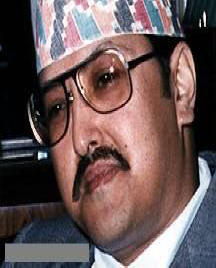
which helped alleviate some caste discrimination.Birendra Bir Bikram Shah Dev
Birendra Bir Bikram Shah Dev became king of Nepal in 1972. He allowed a
democratic, multiparty system of government to be instituted in 1990. He was
killed in a shooting incident in 2001.
When the king died in 1972, he was succeeded by his son Birendra Bir Bikram,
who was formally crowned in 1975. The young king initially exercised strong
control over the government, attempting to repress the reform movement led by
former prime minister Bisheswar Prasad Koirala. As antimonarchist sentiments
grew in the late 1970s and serious riots challenged his authority, the king
relaxed his control.
In a 1980 referendum on the form of government, the voters decided to retain
the nonparty panchayat system with certain modifications. Elections under the
new provisions were held in 1981 and 1986. After a wave of pro-democracy
protests in early 1990, a new constitution providing for a multiparty system
was adopted in 1990.
In 1991 the Nepali Congress Party (NCP) won the country�s first democratic
election in 32 years, and the party�s general secretary, Girija Prasad Koirala,
became prime minister. Koirala resigned in July 1994, and the king
subsequently dissolved parliament and set new elections, in which the
Communist Party of Nepal (Unified Marxist-Leninist), or CPN-UML, won the
majority of seats. Man Mohan Adhikary was sworn in as prime minister. In 1996
the Communist government was dissolved by the parliament and Adhikary resigned
his position under allegations of corruption. The king swore in Sher Bahadur
Deuba of the NCP as prime minister. That same year, a radical leftist party
called the Nepal Communist Party (Maoist), or NCP-M, unhappy with the pace and
direction of change, launched a �people�s war� aimed at overthrowing the
government, abolishing the monarchy, and establishing a people�s republic.
Incidents of violence were at first confined to remote mountain regions but by
the late 1990s had spread to more than half of the country.
Political stability remained out of reach, and in March 1997 Deuba
unexpectedly lost a vote of confidence and was forced to resign. King Birendra
then named Lakendra Bahadur Chand, a member of the pro-royal National
Democratic Party (NDP), as prime minister; Chand was backed by a
royalist-Communist parliamentary coalition in which the CPN-UML had the
largest bloc of seats. Chand was forced to resign in October as the NDP split
into two factions, one headed by Chand and the other by NDP president Surya
Bahadur Thapa. Thapa was named prime minister later that month, heading a
coalition government that excluded the CPN-UML. In March 1998 the CPN-UML
split, with the smaller faction taking the name Communist Party of Nepal
(Marxist-Leninist), or CPN-ML. The split left the NCP with the largest bloc in
parliament. In April 1998 Thapa resigned, and Girija Prasad Koirala of the NCP
again became prime minister. Koirala briefly won the support of the CPN-ML in
a majority coalition, but when the party withdrew from the coalition in
December, he was forced to resign. Koirala immediately was reappointed prime
minister at the head of a center-left coalition that incorporated the CPN-UML.
Parliamentary elections held in May 1999 ended the need for a coalition
government by awarding a majority of seats to the NCP. The legislature elected
Krishna Prasad Bhattarai, a former prime minister, to lead the government.
Bhattarai stepped down in March 2000 and was replaced by former prime minister
Girija Prasad Koirala.
In early June 2001 King Birendra and eight other members of the royal family,
including Queen Aiswarya, were fatally shot in the royal palace in Kathmandu,
allegedly at the hands of Crown Prince Dipendra, who then reportedly attempted
suicide. Dipendra initially survived his gunshot wounds in a coma. His
subsequent death officially made his uncle Gyanendra Bir Bikram Shah the new
regent of Nepal. An official investigation of the massacre confirmed earlier
reports that Dipendra had killed his family members in a drunken rage. The
Maoist insurgency intensified following the massacre, fueled in part by
unsubstantiated conspiracy theories surrounding the incident. Koirala,
meanwhile, was widely criticized for embarrassing setbacks at the hands of the
rebels and for a perceived failure to provide adequate protection for the
royal family. His government was also mired in a bribery scandal involving the
national airline.. Koirala stepped down in July amid demands for his
resignation by several groups, including the CPN-ML, the main opposition
party. Sher Bahadur Deuba, a former prime minister known for his willingness
to work with opposition parties, was chosen by the ruling NCP to head Nepal�s
ninth government since 1990. Deuba announced his first priority would be to
seek peace talks with the Maoist rebels.