
Entertainment
Night life
was unknown to many people in Beijing 20 years ago, and the word wasn't
even used. But nowadays it is very common, especially for young people, to
go out in the evenings and spend their time at cinemas, theatres,
nightclubs, song and dance halls, Karaoke clubs, restaurants or bars.
Compared to people in south China, Beijing people are more conservative.
Most of them, married people in particular, like to stay at home watching
TV or chatting with friends, which is why the streets are quite deserted
after nine o'clock at night, when most of the shops are closed.
Don't despair, you can find places to spend your evenings if you are not
tired after the day's sightseeing. Almost every four- or five-star hotel
has facilities for entertainment. Apart from hotels, night life venues are
mostly in the city centre. You can see the Peking Opera, acrobatics,
dramas, local ballad singing, song and dance performances, or attend a
music concert, or drop in at a roadside disco. But be careful, there do
exit nightclubs where tourists are charged an unbelievable price for a
drink and where trouble can breakout. It's best to stick to places which
have been recommended by other tourists or Chinese friends, and beware if
prices of drinks are not displayed.
Now the city has witnessed a mushrooming of foreign theme pubs, new exotic
bars and locally-run techno-clubs. Foreign pubs, bars, cafes and disco
clubs attract foreign residents and tourists as well as young Chinese. The
admission fee is usually about 50-80 yuan and beer is 15-20 yuan.
top!
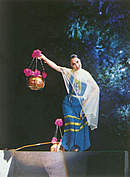
Peking Opera
Originally a form of local theatre, it spread all over the country and has
become the national opera of China. About 200 years ago, the Qing Emperor
Qianlong toured in southern China and developed an interest in the local operas.
On his 80th birthday, he had local opera troupes to come to Beijing to perform
for him. Some remained in Beijing after the celebration. The ones from Anhui and
Hubei were incorporated the palace opera -Kunqu Opera- and became the Peking
Opera.
Peking Opera combines stylized acting with singing, dancing, musical dialogue,
martial arts, colorful facial make up and fantastic costumes. Female roles are
called dan, male roles are sheng, clowns are chou. Each role, according to their
sex, age and disposition, is characterized by different designs of facial
make-up, such as jing representing a rough, frank character and hua lian
representing a cruel or sinister character. So the audience can easily tell what
kind of characters the actors are portraying. Facial make-up, costumes and head
- dresses are wonderful works of traditiional art.
In the past, both dan and sheng roles were played by male actors, but now they
are played separately by females and males.
It is a must to see a Peking Opera while you are in Beijing, equivalent to
seeing an opera if
you go to Italy.
There are also some other types of operas staged in Beijing, such as Kunqu
Opera, Pingju Opera and Hebei Bangzi as well as other operas from different
places.
top!
Puppet shows
Puppet shows in China have an amazing history stretching back two thousand years.
Puppetry combines the different art forms of drama, singing, dancing, music,
painting and sculpture. Like Peking Opera, the shows are based on folk tales and
the like, and are very charming to watch, even if you don't speak Chinese. There
are shadow puppet shows as well as marionette type puppets. The main keepers of
the ancient art of puppetry are the members of the China Puppet Show Artistic
Troupe.
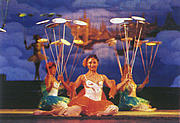
Acrobatics
Chinese acrobatic troupes have traveled to many countries around the world and
have amazed audiences everywhere. The usual tourist reaction to a Chinese
acrobatics show is something like "whoa! that was so...." You are not
sure what to say. The contortions and balancing acts are quite incredible and
sometimes seem almost superhuman, or super rubber human. You will be at the edge
of your seat through most of the show saying "don't fall, don't drop it!"
And incredibly, they never do.
Symphony
Founded in1951, the Central Symphony Orchestra is one of the few orchestras
which can offer a full repertoire from George F. Handel to Peter Tchaikovsky.
The orchestra performs symphony concerts in Beijing Concert Hall every week. In
addition, the Beijing Symphony Orchestra is a rising star in the field of
western music. There are now several special orchestras and chamber groups (i.e.
the Youth Symphony and the China All-Women Orchestra), which offer a rich
variety of classical western music. The Beijing Concert Hall holds many
world-level concerts all year round. For listings, dial 6605-7006.
Ballet and Opera
Foreign visitors may be surprised to find that they can find the Sleeping
Beauty, Madame Butterfly or Carmen in Beijing. The Central Ballet and Opera
Theater is renowned for the quality and talent of its ballet dancers, its
symphony orchestra and Western opera shows. The China Opera Theater is another
well-known art troupe who puts on Chinese operas with a mixed singing method of
Italian bel canto and traditional Chinese singing.
Song and Dance
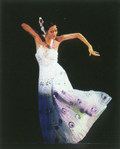
There are a couple of national-class troupes that perform music and dance from
various parts of China. In recent years, overseas visitors have been impressed
by the Royal Song and Dance performed by the Beijing Song and Dance Troupe.
Drama
Unlike other art forms, modern drama has only a 70-year history in China. The
most famous theater in Beijing is the People's Art Theater. This theater puts on
plays based on ancient Chinese stories as well as Chinese adaptations of Western
drama. The Experimental Theater in Mao'er Hutong is also an excellent place to
watch plays. There are now some very good plays written by Chinese playwrights.
Nightclubs
Big hotels usually provide night spots for your entertainment. They mainly open
at 8-9 p.m. and close at midnight-3 a.m. All charge admission.
Teahouse
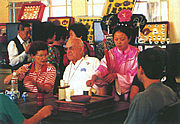
Teahouse used to
be public places where people came to relax, enjoy tea, talk about their
business, kill their time, exchange information, or listen to ballads or
story-telling. They equate, to some extent, to pubs on the West. Teahouse
disappeared for about two decades when they were regarded as places for idle
people who did not want to work. Now a few traditional teahouses are open,
mainly for tourists to enjoy the experience of traditional Chinese teahouse.
They are open every night, but you have to book a table beforehand since they
are very crowded. The teahouse is set with hardwood tables and a stage at one
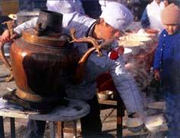
end. Customers are served various snacks and tea from copper pots with long
spouts while traditional performances are staged. It is a really good experience
if you can find time to fit it into your busy schedule.

top!