Corina
The
name Corina comes from the ancient Greek name Κοριννα (Korinna), which was derived from κορη (kore)
"maiden".
In then
ancient
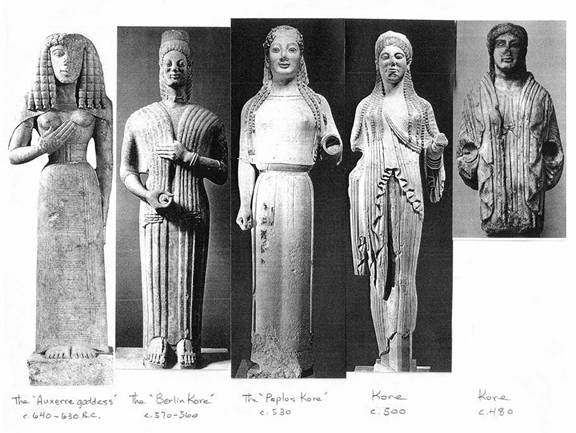
The
cultural revival of
A stock
number of poses are repeated over a period of two hundred years or more. Such
consistency over a long period of time would suggest that these figures had
special trans-temporal significance. All stand bolt
upright, their bodies covered from head to toe in finely styled clothing.
The
earliest examples show a woman standing with one hand held palm-in, fingers
extended to her chest, looking very much like some American school child ready
to pledge allegiance to the flag. As in the American custom, the gesture would
appear to carry some ritual significance.
In later
examples, with elbow still held to the side, the open hand is extended out
before her. This gesture could be interpreted as her presenting an offering, or
perhaps, like the hand-to-the chest, some prayerful attitude. However, the hand
could be extended in order to accept an offering.
The other
hand is usually shown at her side, in many cases grasping her skirts and
pulling them slightly up, as if she were about to mount a stair
. Artistically the gesture does interesting visual things with the
drapery creating linear patterns and cascading folds. The gesture, though, one
feels was not merely some aesthetic motif but had some other, more serious
meaning.
Who are
these women whose similar poses and gestures link them together? The word kore, or maiden, used to identify these women means virgin,
although one should bear in mind that virgin in ancient Greece seems to have
meant unmarried rather than denoting an intact maidenhead.
The words
'virgin' and 'maiden' tend to conjure up in the modern male imagination the
image of an unsullied, nubile, young woman, delightfully innocent of the ways
of sex. A maiden's body is the stuff of male fantasy. Maidenly innocence also
connotes a certain empty-headedness, a vapid intellectuality.
This might predispose one to view these women as little more than as some
well-dressed early Greek type of sex object.
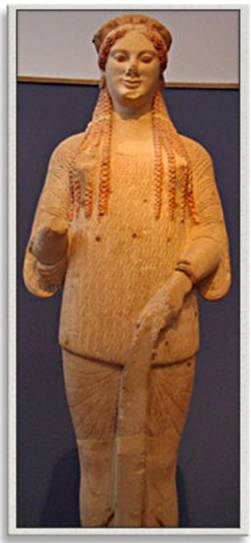
This is
belied, however, by the faces of these women which reveal not gentle innocence
but a singular self-awareness, confidence, and pride of a kind that one would
not expect of women in ancient Greek society, and in fact is quickly lost, as
we shall see, after 500 BCE when male-centred
"democracy" effectively eliminates women from positions of power.
The
faces and postures of the Kore figures strongly
suggest women who recognize their own power , or
perhaps recognize themselves as representatives of a female power which, in the
Archaic period, Greek society still acknowledged. The power they feel or embody
may be that of some ancient female Mother goddess.
These
women stand as the final visual embodiment of ancient female forces. Hereafter,
it will be conceived in male terms and female power will be understood to
reside only in woman's sexuality, or in her lack
thereof in the form of a virgin.


Kore(the maiden) was an
epithet of the goddess Persephone.Kore was the maiden
aspect of Persephone, an young innocent goddess of spring, the partenogenetic daughter of Demeter, the goddess of
agriculture.
Kore, the maiden, was abducted (at the
suggestion of Zeus) and raped by Hades and forced to be his wife. In the myth
of Persephone, young Kore was plucking flowers in a
field when Hades, her uncle and god of the Underworld, abducted her to be his
Queen in the dark world below. The goddess, Hecate,
strongly associated with the dark side of the moon and with witchcraft - was
the only one to witness Kore’s abduction. She hears
Persephone’s cries but does nothing, herself, to help and, furthermore, does
not seek help from others.
Kore was extremely unhappy in the
darkness of the Underworld. She also missed her mother, Demeter, terribly, as
they had such a close mother-daughter bond. Kore was
ultimately allowed to rejoin her mother, who had arranged Persephone’s release.
However, Persephone was obligated to return each Fall
to spend four months of each year in the underworld as consort to Hades because
she had eaten four pomegranates. It is thought that Kore
as ‘maiden’, Demeter as ‘mother’ and Hecate as ‘wise
crone’ represent, in more ancient times, the three-fold nature of Persephone in
the various life cycles of a woman.
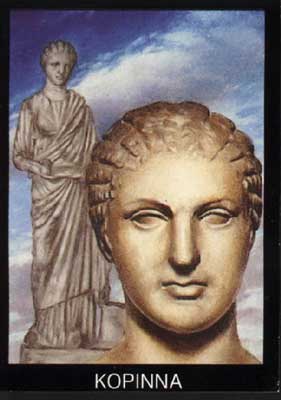
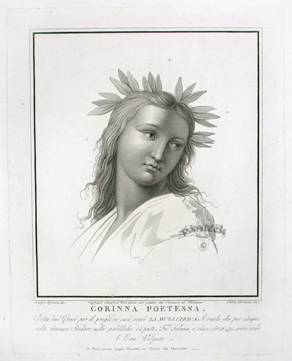
Corinna was the name of a Greek lyric poet of the 5th
century BC
Corinna(Κοριννα) was a poet from Tanagra in Boeotia, in ancient
Several legends connect
them: she instructed him in composition.
She told him he didn't mention mythological figures enough in one poem, and in his next
he overdid. Her reply, that one should sow by handfuls,
not by the whole sack, became proverbial. She beat him in poetry competitions
five times.
Corinna wrote lyric
poetry in her native Boeotian dialect, and this
presents the dating problem. Before 1906 only fragments of hers were known,
quoted in much later writers to illustrate metrical
points. But in that year a papyrus
in
That she was a woman
contributed to her subsequent neglect.
As with Sappho, ill-natured stories clung to her. One, which I
can no longer find my source for so I'm going by memory, is that critics
accused her of using her beauty to sway the judges when she beat Pindar.
Here is an example of
her style. The translation is by L.R. Palmer.
tân de pé:do:n
trîs men ekhi
Deus pateír, pánto:n basiléus,
trîs de pónto: gâme médo:n
Potidáo:n, tân de douîn
Phûbos léktra kratoúni,
tan d' ían Mé:as agathos
pês Hermâs. hoúto: gar Éro:s
ke: Koúpris pithétan, tio:s
en dómo:s bántas krouphádan
kó:ras enní' helésthe:.
Of the daughters Father Zeus, the
King of all, has three
And three were wed by Poseidon,
ruler of the sea,
Of two Phoebus has mastery of their bed,
One, Hermes,
goodly son of Maia (possesses)
. For thus did Eros and the Cyprian
persuade them,
Going secretly into your house, to take the nine girls.
Ovid used
the name Corinna for the heroine of many of his love
poems, the Amores. This Corinna is unlikely to have really lived; it seems
she is Ovid's poetical creation, loosely based on a Greek poet of the same
name; or generalised motif of female Roman mistresses. The name Corinna may
also have been a typically Ovidian pun based on the Greek word for "maiden",
"kore".