
- Childhood
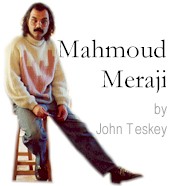
- Mahmoud Meraji was born in Tehran in 1958. He describes the first years of his life as idyllic, lyrical, and protected. He spent most of his time in a small, enchanting garden in his backyard where he played among the wild roses and luscious growth. Being cloistered from the real world outside, he created his own imaginary world and made his own toys. "I think it was the close limits of this world that stimulated the development of my imagination and made it grow like the flowers around me."
- Petgar's Atelier
- The earliest and most decisive influence in Meraji's life came from the famous Iranian artist Petgar, who was a friend of his family. It was Petgar who recognized Meraji's talent and encouraged him to become an artist. During the next few years, Meraji was a student and then an assistant in Petgar's atelier. His approach to painting and drawing was influenced by Petgar's realism, but it was also deeply affected by Petgar's scepticism regarding academic art, and by his enthusiasm for the masters such as Michelangelo, Da Vinci, Raphael, Rubens, and Velasquez. Petgar was a renaissance man whose inquisitive approach to life left a permanent impression on the young Meraji. "Petgar taught me to think about everything, not just painting."
- The Studio in Tehran
- In 1976, Meraji formed his own studio where, between periods of teaching his own students, he began to experiment more freely. He also began his search for a vision and style that would reflect his inner self and his feelings about the increasingly turbulent world around him. These were the years of political upheaval and uncertainty marked by the Iranian Islamic Revolution and the war with Iraq. A strong element of protest against intolerance and violence began to appear in his work, despite the censorship in effect at the time. Meraji was naturally drawn to the politically conscious social realism of Courbet and to the work of Flemish painters such Breughel. But he also became an admirer of the striking mural styles that emerged in Mexico in the wake of its political revolution.
- Recognition
- Meraji held his first solo exhibition in Tehran in 1982, and his reputation in Iran grew rapidly from this moment on. This was a period of confirmation, hard work, and commitment. Between exhibitions, Meraji continued to fill a plethora of commissions for portraits and still lifes--and to pursue the development of his personal artistic vision.
- Canada
- With his success and growing reputation, Meraji had begun, in a sense, to rediscover the secure garden of his childhood. And yet his vision of art as an endless expedition into the unknown led him to command his own expulsion from the garden. He chose to leave the comfort of being a reputed artist in Iran and move to Canada.
- His first feeling in Canada was one of freedom from conflicting ideologies and political turmoil. And there was no official censorship. The specter of a gloomy, disapproving moral surveillance disappeared. It was this sudden freedom that now overwhelmed him, like the vast spaces and countless lakes of the Canadian landscape.
The Paintings
 |
 |
 |
 |
 |
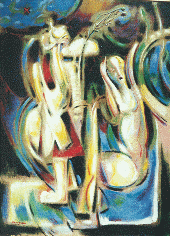 |
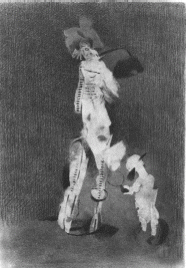
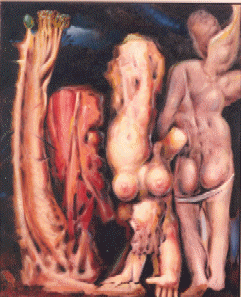
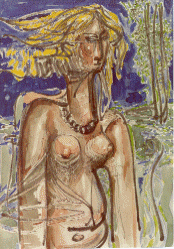
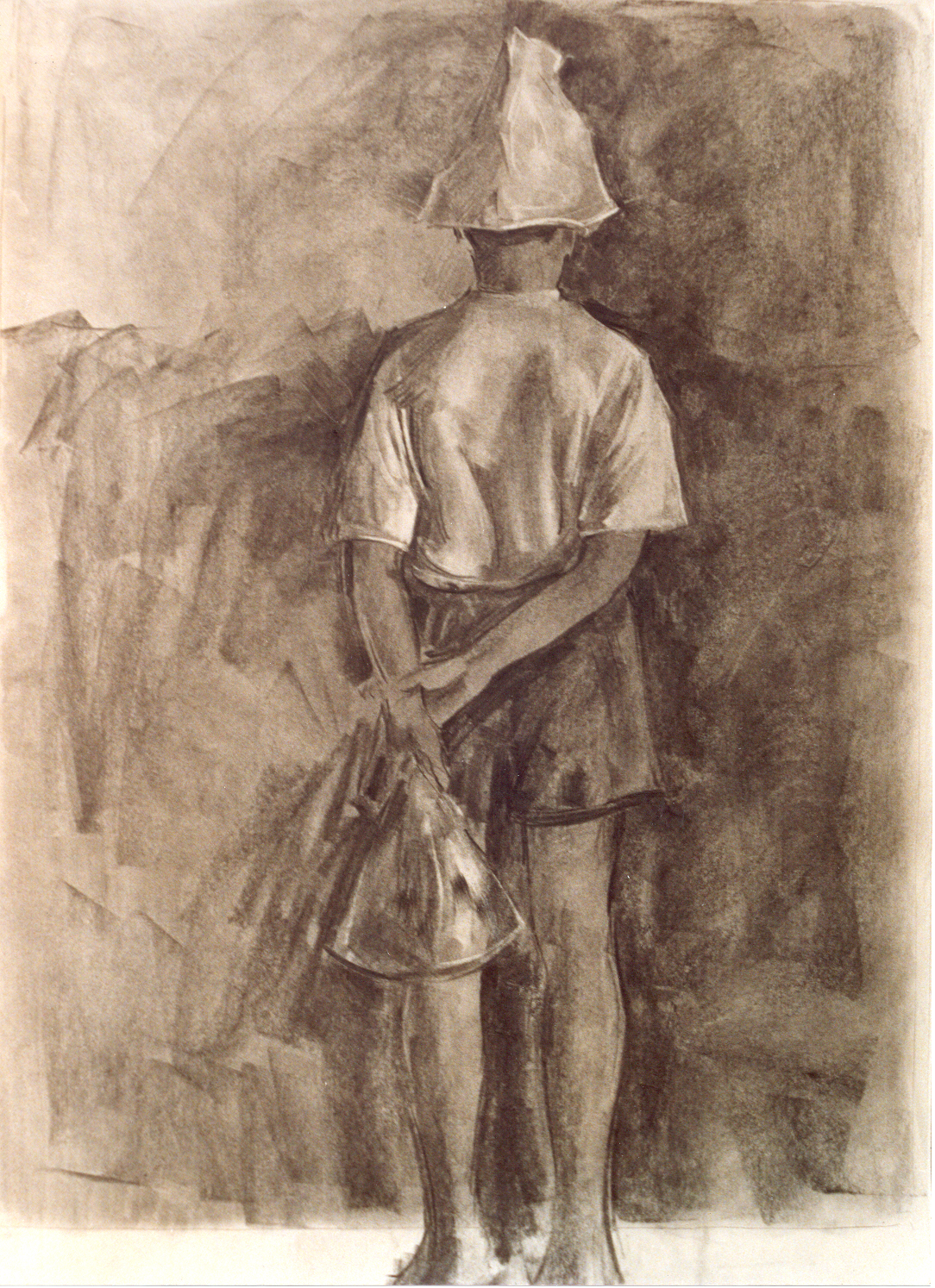
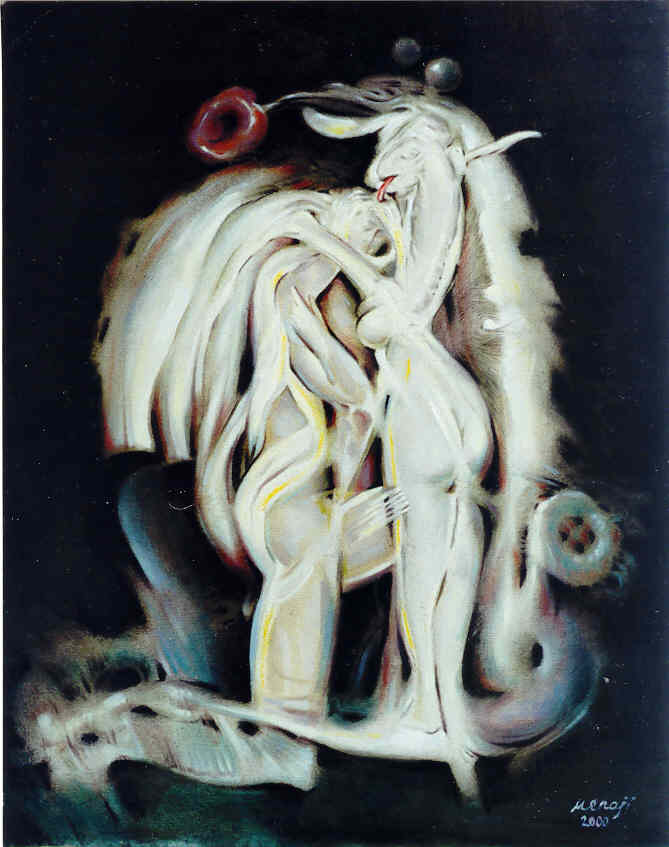
| Bloom | Reconciliation | Emergence | Regrese | Resort | Reunion |
Uncertainty
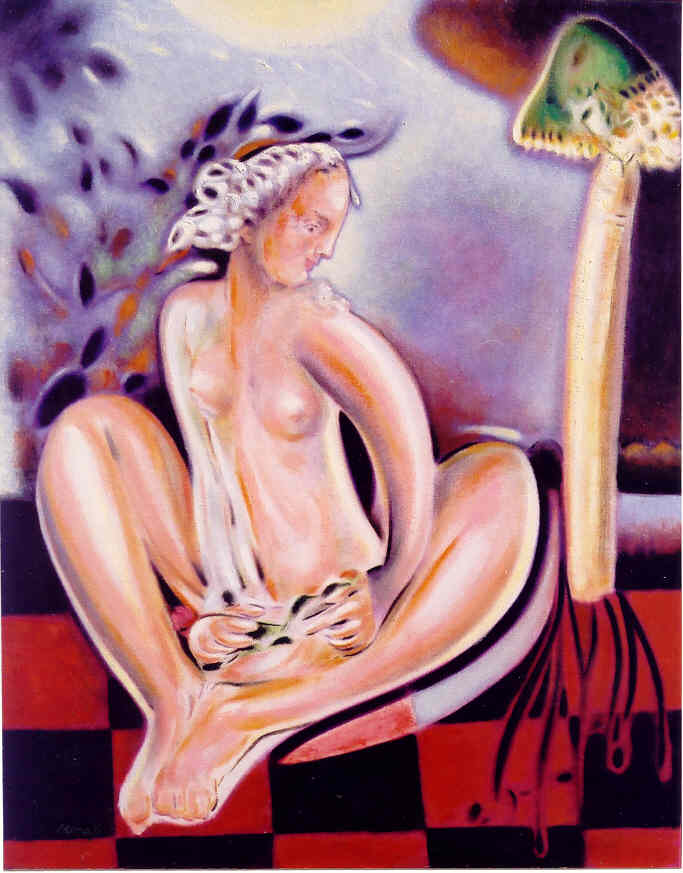
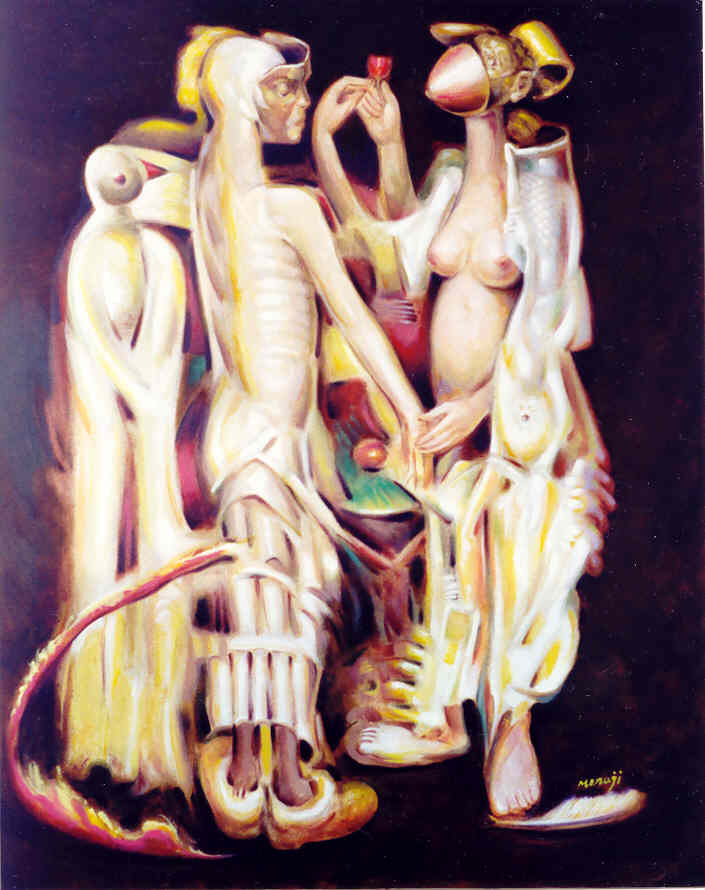
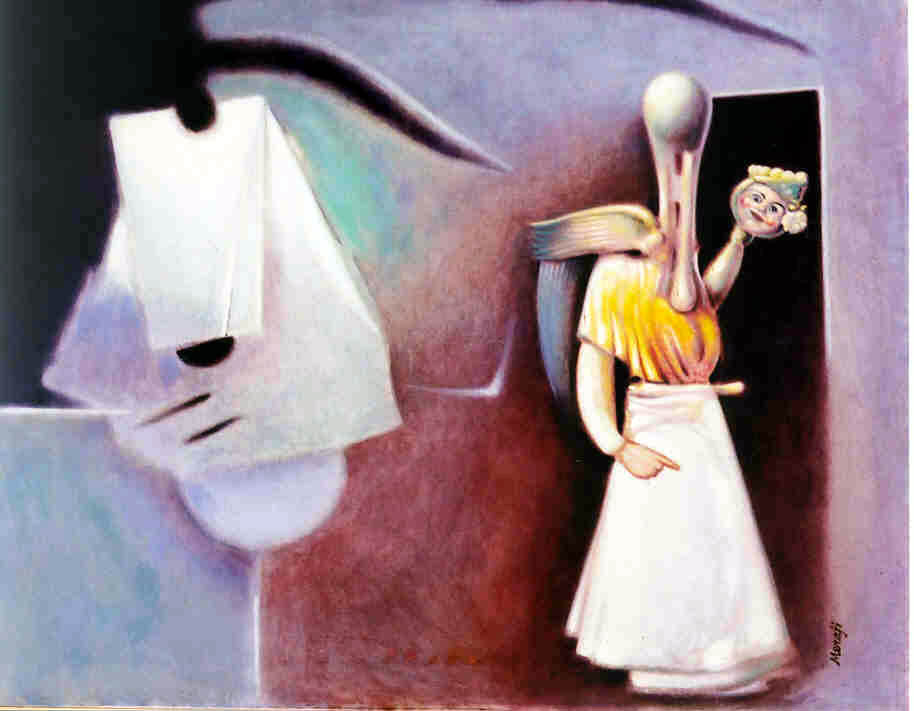
The paintings in this show represent, to me, a new,
unexpected struggle�that of coming to terms with this new freedom.
It is Meraji�s freedom to explore his feelings about the political
and cultural unrest that he lived through in Iran. The strange,
dreamlike figures in paintings like Reunion,
Emergence, Reconciliation,
and Resort all evoke the
sense of confusion and uncertainty that the artist said he experienced
during the Revolution: �Something
was different every day. You never knew where you stood, what was
considered right or wrong. The familiar world I grew up in suddenly
became strange, troubled, and uncertain. It was as if the very ground
beneath my feet was constantly shifting.�
Reconciliation
But they also evoke
the hope for a reconciliation: all of the paintings, with perhaps the
exception of the lyrical Bloom, contain 2 or more figures that seem to be moving toward some
sort of enigmatic, as yet undefined union or concord with each other.
It is as if the artist is imagining not only a reconciliation in the
conflict-ridden social and political reality of his past; he is also
seeking an inner reconciliation of himself with that troubled past. In
this sense, the paintings are like moments on the stage of an inner
drama that has reached its crisis and is now seeking its conclusion,
its final moments of reflection and understanding.
Metamorphosis
This effect of a movement toward some as yet unknown reconciliation is manifest in the very form of the figures: they all seem to be in a process of change, of metamorphosis. They are envisioned not in the static certainty of a stable form, but rather in the process of transition, of moving toward the unknown form and being that they have not yet embodied. And yet we feel that this will be a form and a being that will truly belong to a world that is reconciled unto itself through compassion and understanding, a world that recalls the enchanting garden where a child once played.

