 |
|
|
|
|
|
|
|
|
|
|
|
|
|
|
|
|
|
|
|
|
|
|
|
|
|
|
|
|
|
|
|
|
|
|
|
|
|
|
|
|
|
|
|
|
|
|
|
|
|
|
|
|
|
|
|
|
|
|
|
|
|
|
|
|
|
Home |
|
|
|
 |
|
|
|
|
|
Indian Military Academy Through the Ages |
|
|
|
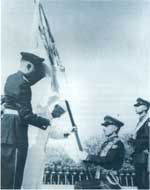
The origin of the Indian Military Academy (IMA), Dehra Dun dates back to the growing demand for Indians as officers into the Army. By the end of the 19th century, the demand for an increasing participation by Indians in the governance of their homeland had taken firm roots. The persistent efforts of Gopal Krishna Gokhale resulted in the setting up of a Commission in 1912 in which he represented the national aspiration. Lord curzon set up the Imperial Cadet Corps to which only selected Indians of proven loyalty from among the princes and landed aristocracy were admitted. The Indians proved their mettle during the first world war. In 1917, Montague Chelmsford Plan was introduced which afforded greater involvement opportunities to Indians in administering their country. Indianisation of Army started with the grant of King's Commission to 31 trusted Indians including KM Cariappa who later became the first Indian Commander-in-Chief of the Indian Army. As feeder institution, the Prince of Wales Royal Indian Military College was set up at Debra Dun in 1922 with a view to providing necessary preliminary training to Indian boys for entry into the Military College in England. |
|
|
 |
|
|
|
|
|
|
The Indian leadership was not content with meager measures so far taken towards the Indianisation of the Indian Army. In 1923, the issue was clinched by TV Sheshagiri Ayyar, a former judge of Madras High Court, in the first Central Assembly. |
|
|
|
|
|
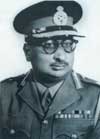
Later, Sir Tej Bahadur Sapru also voiced similar sentiments. The same year Lord Rawlins, the then Commander-in-Chief, announced his scheme under which 8 Infantry and cavalry units were to be exclusively officered by Indians. This was followed by the formation of the Indian Sandhurst Committee consisting of fourteen members including amongst others Pandit Moti Lal Nehru and MA Jinnah under the chairmanship of Lt Gen Sir Andrew Skeen. The committee Jecornrnended an increased admission of Indians to Sandhurst as well as the establishment of a similar institution in India by 1933. |
|
|
 |
|
|
|
|
|
|
Inspite of the pressing demand of national leaders, the pace of Indianisation remained slow. Only 29 Indian cadets were being trained, annually in England during the early thirties-20 at Sandhurst, 6 at Woolwich and 3 at Cranwell. The Indian leaders then took their battle to the first Round Table Conference held in London in 1930 where a sub committee for defence having 30 members under the chairmanship of JH Thomas recommended that a committee of experts, both British and Indian, be set up to work out the details of the establishment of such a college. As a result, the Indian Military College Committee was constituted consisting of 18 experts under the chairmanship of the third Commander-in-Chief of India, Gen Sir Philip Chetwode. In 1931, the committee drew up the comprehensive scheme for setting up a military college capable of producing 60 commissioned officers per year. The Chetwode Committee, as it was popularly known, selected Debra Dun for locating the proposed military college. |
|
|
|
|
|
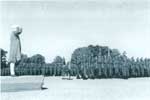
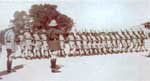
The final curtain on the first act of the drama of the Indianisation of the officer cadre of the Indian Army was rung down in January 1932 when Brig LP Collins after whom the present Collins Block has been named, was appointed as the first Commandant of the Indian Military Academy. It took him eight months to prepare the college for Military College. The first batch of forty cadets the 'Pioneers,' arrived by the end of September 1932 and the course commenced its training on October 1, 1932. The Academy was formally inaugurated on December 1, 1932 by Field Marshal Sir Philip Chetwode, the then Commander-in- Chief in India, after whom the Chetwode Building and the Chetwode Hall have been named. The Pioneers included 15 '0' cadets (direct entry) 15' A' cadets (from Army ranks) and 10 'S' cadets (from the Indian states). Those who rose to prominence among the 'Pioneers' included Field Marshal SHFJ Manekshaw, Gen Mohd Musa who subsequently became Chief of the Pakistan Army and Lt Gen Smith Dun who later became Chief of the Burmese Army. So far only two cadet companies had been functioning. With the expected intake of the cadets reaching 160, it was planned to have two more companies. Thus in 1934, four companies -A, B, C and D were formed. |
|
|
 |
|
|
|
|
|
|
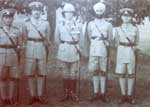
Initially, the Academy was designed to cater for 200 gentlemen cadets with 40 cadets passing out every six months. Three hundred and twentyone officers were commissioned until the outbreak of the second world war. During the war the courses were cut short to the emergent need for officers and a few special courses were also run besides the regular courses. In all, 4278 officers got their commission including 710 British officers during the period. Thus, besides training officers for the Indian Army, the Academy was also chosen as the training ground for officers for the British regiments during the war. Brig Thakur Mahadeo Singh took over as the first Indian Cornrnandant in 1947. In August 1947, the gentlemen cadets who opted for Pakistan left the IMA to join the Pakistan Military Academy, Kabul. The fourth regular course joined the IMA in January 1948 and it was the first batch to be wholly trained in independent India. |
|
|
 |
|
|
|
|
|
|
During the second world war the importance of inter-dependence of the three Services was realised. The Government of India, therefore, approved the creation of an inter-services wing for training cadets for the Army, Navy and the Air Force together. The training period would be three years after which cadets would go to the respective service institutions for further training and commissioning. Thus, in January 1949, the Academy was redesignated as the Armed Forces Academy with the military wing remaining in the present campus at Prem Nagar and the inter-services wing was established in Clement Town. In consonance with national aspirations, the Indian Military Academy was redesignated as the National Defence Academy in January 1950. The inter-services wing became Joint Services Wing (JSW). The first JSW course passed out in 1950. |
|
|
 |
|
|
|
|
|
|
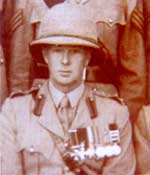
In December 1954, the Joint Services Wing moved to Khadakvasla in a new campus and alongwith it went its name, formation sign and also the Commandant. The military wing which remained in Dehra Dun was redesignated as Military College and Brig Apji Randir Singh took over as its Commandant. The new company was formed to cope up with the increased strength of cadets. The companies in the meanwhile had been redesignated as Alamein, Sangro, Cassino, Imphal and Meiktila. By the end of 1956, the command of the Indian Military Academy passed from Sandhurst trained officers to IMA trained officers when Brig MM Khanna took over from Brig Apji Randhir Singh. In January 1958, a ontingent of Military College took part in the Republic Day parade in Delhi for the first time. In 1960, the Military College was renamed as the Indian Military Academy. The same year, the new wing was opened to cope up with the increased strength of the gentlemen cadets in Clement Town. In 1961, three companies-Panipat, Singarh and Chittor-were formed. Two more companies, Keren and Kangaw, were introduced a year later. In 1963, the appointment of the commandant was upgraded to Major General and Maj Gen SC Pandit took over. |
|
|
|
|
 |
|
|
|
|
|
|
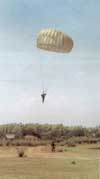
In 1974, the qualification for entry to the Indian Military Academy for regular courses was raised to degree level and the duration of training was reduced from two years to one-and-a-half years. In the following year parachute training was introduced during the summer break at Agra for volunteer cadets. The four battalions were named Carriappa, Thimayya, Manekshaw and Bhagat with two companies each. In 1980, the appointment of commandant was upgraded to the rank of Lieutenant General and Lt Gen M Thomas took over as the first Commandant in this rank in December 1980. In 1992, all four battalions had three companies each namely Kohima, Naushera, Poonch, Alamein, Sangro, Meiktila, Imphal, Zojila, Jessore, Singarh, Keran and Cassino. One company named Dograi was added to Thimayya Battalion with an increasing strength of GCs in 2000. |
|
|
|
|
|
The Academy has a proud record of having 551 decorated officers including 12 Ashok Chakra, 2 Sarvottam Yudh Seva Medals, 84 Mahavir Chakra, 37 Kirti Chakra and 25 Ut tam Yudh Seva Medals. The Indian Military Academy continues to serve the nation by producing leaders of exceptional ability for its Army- leaders who have proved on many occasions that they are second to none. |
|
|
|
|
|
Progressive Training at IMA |
|
|
|
 |
|
|
|
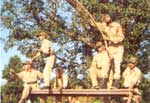
The training for future officers at the Indian Military Academy (IMA) is divided into three terms. This ensures a gradual development of a gentleman cadet from a civilian to an effective platoon commander. In the first term, the stress is more on physical and military training and intellectual development. This aims at a high standard of physical fitness, military bearing, discipline and drill. In the second term, the emphasis is gradually shifted from physical training to service training which includes tactical training, weapon training, field engineering, radio telephony, map reading, iintelligence and security, organisation and administration along with an integrated character and leadership training. In addition to the conventional training capsule, platoon battalion support weapons, mountain warfare, desert warfare, commando tactics, counter-insurgency, jungle warfare, internal security, fighting in built-up area and biological, chemical, nuclear warfare and protective measures are also covered in a simila sequence. |
|
|
|
|
|
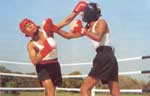
Being physically fit is the foremost requirement of all ranks in the Army. Physical training hence, forms the vital part of the pre-commission training at the Indian Military Academy. A gentleman cadet (GC) is required to achieve a laid down minimum physical fitness standard before passing out from the Academy. To attain the desired standard, gentlemen cadets are put through a very systematic and progressive physical training. The training exercises aim to improve basic fitness, endurance and swimming by conducting tests at various stages of training. |
|
|
|
 |
|
|
|
|
Regular participation in games also forms part of the curriculum. All gentlemen cadets are encouraged and provided the best of facilities to learn games. A large number of etitions are conducted to make games more interesting and competitive and also to inculcate qualities that are essential for a junior leader. Those already proficient are given an opportunity to improve and excel in sports of their choice. |
|
|
|
|
|
|
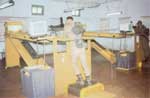
The weapon training section of IMA is performing a specialised role of training the gentlemen cadets of Indian Military Academy and cadets of the Army Cadet College to gain proficiency in the highly professional field of weapon training. This is gaining greater importance as the majority of young officers is experiencing combat situation in operational counter-insurgency or field areas immediately on being commissioned. The section imparts training in handling and firing of different rifles and carbines, handling and firing of live grenades, realistic battle inoculation with Artillery guns, jungle lane shooting with INSAS rifles and AK 47 rifles, and urban insurgency. To impart an effective and meaningful weapon training, modern and scientific methods are applied using small arms simulators (SATS) for rifles and LMGs, INSAS rifles, realistic jungle lanes with moving and POP up targets and grenades simulators firing. The cadets undergo the weapon training in a capsule form. |
|
|
 |
|
|
|
|
|
|
The academic training at the Indian Military Academy aims at broadening the mental horizons of the GCs keeping in view their busy routine and physical fatigue. Infact, it is the mental prowess which enhances the leadership qualities of future leaders of any army. The academic training also act as a balancing factor and contributes a great deal in moulding the GCs to acquire a perfect personality. The subjects which are taught include English, service writing, military geography, science and warfare, military psychology, military history, information technology, current affairs and international relations. |
|
|
|
 |
|
|
|
 |
|
|
|
In addition, the Indian Military Academy runs various outdoor clubs for the overall development of the gentlemen cadets. |
|
|
|
|
|
|
|
The IMA riding and polo team reached the pinnacle of success in the equestrian season in 1999-2000. The team was pitted against the best equestrian talent in the country and it acquitted itself most creditably by being overall first team in junior national championship winning medals in various events at Chennai. The team also bagged two placings in the Indian national team for the international tournament and was a proud recipient of two national colours. The IMA organised an international riding event at Debra Dun in which foreigners from the US, Canadian, German and Egyptian embassies alongwith the leading members of the equestrian fraternity participated and the event was a tremendous success. |
|
|
|
|
|
|
|
|
|
The profession of arms places them in unique situations and the men have to tackle each unique situation with quick thinking, prompt action and enormous courage. To develop these qualities, the Indian Military Academy conducts adventure training in aerosports, paramotor-flying, parasailing, para- jumps, para-gliding, white-water rafting, mountaineering, rock climbing, motor-cycle expeditions, cycling hikes, camel safari and hot air ballooning. |
|