Water and Sanitation for all:
practical ways to improve accessibility for disabled people
Mahesh Chandrasekar, India, June 2006
Abstract
The needs for access to water and sanitation facilities especially for the vulnerable groups who could include children, disabled children and adults, elderly people, people living with HIV/AIDS, ethnically marginalised group is a subject that is most often neglected or forgotten especially in developing countries.
The general feeling is, people from the vulnerable groups mentioned above are not considered to be productive citizens and hence most often there are either no provisions or investments made to ensure universal access.
On the contrary, investments made to build inclusive access to water and sanitation facilities promotes self-reliance, enhances the self-confidence of people especially from the vulnerable groups, reduces the physical strain and the demand of time of the care-givers, promotes an environment that is safe, respects differences and creates space for greater productivity amongst the individual, family and the community.
In my presentation, I am sharing my personal experience as a case study illustrating the benefits of creating equal access to water and sanitation. Although the practical issues and the ways of overcoming barriers could be perceived as unique, never the less creating equitable access to water and sanitation should not in any way discount the needs of disabled persons, the elderly and members from other vulnerable groups.
Introduction
The needs for access to water and sanitation facilities especially for the vulnerable groups who could include children, disabled children and adults, elderly people, people living with HIV/AIDS, ethnically marginalised group is a subject that is most often neglected or forgotten.
The general feeling is, people from the vulnerable groups mentioned above are not considered to be productive citizens and hence most often there are either no provisions or investments made to ensure universal access.
On the contrary, investments made to build inclusive access to water and sanitation facilities promotes self-reliance, enhances the self-confidence of people especially from the vulnerable groups, reduces the physical strain and the demand of time of the care-givers, promotes an environment that is safe, respects differences and creates space for greater productivity amongst the individual, family and the community.
The following is a case study illustrating the benefits of the creating equal access to water and sanitation.
Case study - My personal experience (C. Mahesh)
I am 37 years, married and have a son who is 8 years. I am coming from a middle class family. I had to relocate to Bangalore city, Karnataka, India as I found a suitable job here.
I have a walking disability, I use a pair of elbow crutches to walk short distances or use a wheelchair. One of the main challenges I face is standing up from any chair/ seat. I can stand up if the chair is 6 to 8 inches more than the standard height of the chair which is usually around 17 inches. In the absence of this high chair I need physical assistance.
With a lot of scouting around I was lucky to find a rented house that fits my budget, near my place of work and most importantly a house that is fairly accessible in the ground floor.
However, the major challenge that I had to face was in adapting the house to meet my needs, especially creating independent access to water and sanitation. As it was a rented house, the structural adjustments had to be limited.
The Challenges
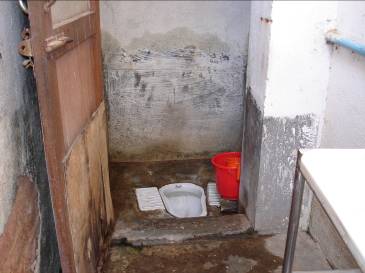
As you see in the picture above, the toilet is small and is one step lower from the ground level.
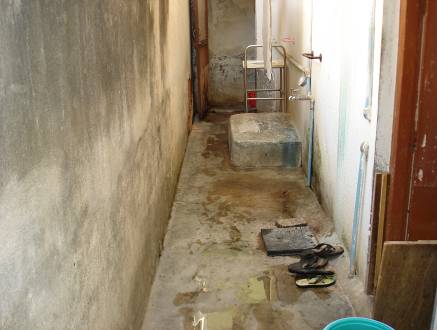
A narrow passage behind the house is the only access to the toilet. Please note the stone that is cemented on the ground – this is a washing stone to wash clothes.
Ways in which the challenge have been overcome
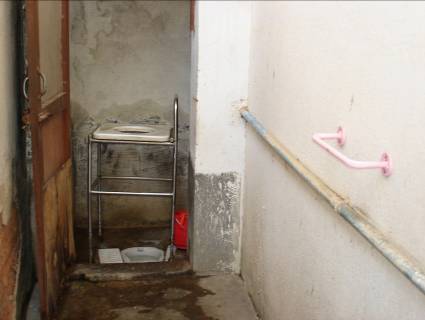
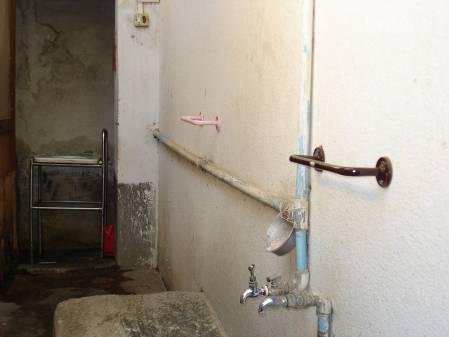
As shown in the picture above the hand rails nailed on the wall helps in giving greater support to cross this narrow passage to the toilet.
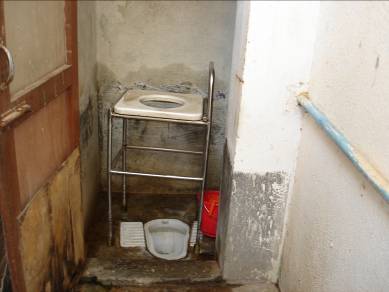
A toilet commode seat has been suitable designed so that the seat is extra high to compensate the dept in the toilet and this height also enables me to sit and stand independently.
Access to the water in the bathroom
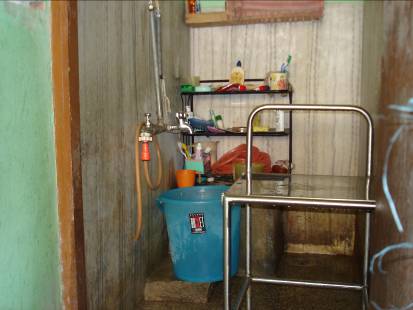
The picture above shows the bathroom which is rather small. A simple hose that is attached to the tap assists me to wash and flush water in the desired direction.
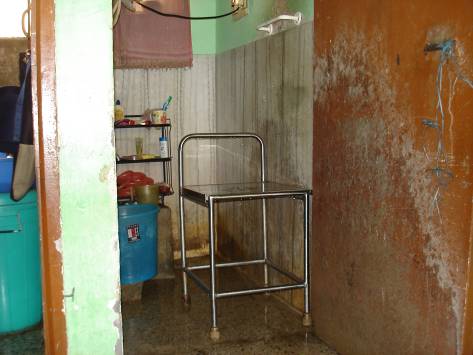
The picture above shows a bathing chair, the height of which is adjusted to enable me to sit and get up without assistance. The grab bars on the walls are fixed at appropriate height to prevent slipping on a wet floor when I enter or leave the bathroom.
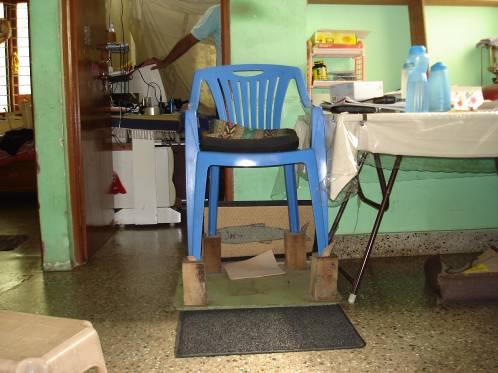
The picture above is the chair which I sit on to wear my dress. Please note that the chair is placed on a raised wooden platform which has increased the height of the regular chair by 6 inches. In addition a rubber mat is placed on the floor to provide the necessary grip for me to get up on my own.
The benefits of such simple modifications
Conclusions
C. Mahesh