
God accepts
Achieving Allah's acceptance must be a b
eliever's priority and is not easy.
wa•iža sa•alaka `ibādī `annī fa•innī qarībun ujību da`wata addā`ī iža da`ānī falyastajībū lī walyu•minū bī la`allahum yarshudūna
When My servants ask thee concerning Me, I am indeed close (to them): I listen to the prayer of every suppliant when he calleth on Me: Let them also, with a will, Listen to My call, and believe in Me: That they may walk in the right way. 2:186
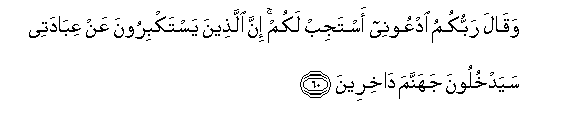
waqala rabbukum ad`ūnī astajib lakum inna allažīna yastakbirūna `an `ibādatī sayadķhulūna jahannama dāķhirīn
And your Lord says: "Call on Me; I will answer your (Prayer): but those who are too arrogant to serve Me will surely find themselves in Hell - in humiliation!"
As this life is not the end of all things, and we are to have its fulfilment in the Hereafter: we have only to pray to the Lord of the Present and the Hereafter, and He will hear us, forgive us, guide us, and make our Path smooth. But Pride will have its fall,-and its humiliating Punishment: Cf. xxxvii. 18.
Knowledge comes before Ibadah and regulates it, so no Ibadah is accepted unless it is based upon correct knowledge. For this reason, the prophet (S.A.W.) considered the person of knowledge to have much higher status than the worshipper. The prophet Muhammad (S.A.W.) elevated the one who has knowledge over the worshiper, He (S.A.W.) said in a good hadith reported by Imam At-Tirmithi, "An ‘Aalim (learned person in the deen) is as much superior to an ‘Aabid (Worshiper) as I am superior to the lowest among you." In another hadith reported by Imam Abu-Dawoud and At-Tirmithi, that the prophet Muhammad (S.A.W.) said: "An ‘Aalim (learned person in the deen) is as much superior to an ‘Aabid (Worshiper) as the full moon is superior to all stars."
"Indeed, Allah only accepts from the righteous [who fear him - al muttaqoon]." [Qur'an 5:27]
Make sure that our food, our drink and our clothing are from halal means, in order that our actions be accepted, and our supplications answered.
Imam Ibn Taymyyah said his book titled "Al-O’bodyyah": "The "ibadah" is a collective noun that includes every thing that Allah (S.W.T.) loves and accepts from sayings and the physical acts; the hidden (acts by heart) and the openly (acts by limbs). The acts by limbs include the prayer, zakah, fasting, hajj, straight talk, loyalty (returning someone’s possessions to them), kindness with parents, having good accord with relatives, keeping promises and treaties, enjoining what is good and forbidding what is evil, fighting against the kuffar and the hypocrites, kindness with the neighbor, with the orphan, with the poor, with the wayfarer, with the animals, supplication, remembering Allah (S.W.T.), reciting Qur’an, and things of this nature are from "ibadah".
The acts by heart include the love for Allah (S.W.T.) and His messenger, fear of Allah, asking Him for forgiveness, Having sincerity to Him alone in deen, being patient, thanking for his blessings, accepting His judgment, depending on Him, hoping for His mercy, fear from his punishment, and things of this nature are all from of ibadah worship." All this is supported by an abundant number of evidences from the book of Allah and the sunnah of His messenger (S.A.W.).
When we talk about obeying Allah (S.W.T.), it always implies obeying the prophet Muhammad (S.A.W.). Obedience to the prophet (S.A.W.) is part of obedience to Allah (S.W.T.) because He is the one who sent him. Allah (S.W.T.) says in surat An-Nesa’, (verse 80), what can be translated as, "He who obeys the messenger (Muhammad), has in indeed obeyed Allah."
When we talk about ibadah (acts of worship) of Allah (S.W.T.), we have to fulfill two conditions so that ibadah will be accepted from us by Allah, beneficial to the worshipers in this life and in the Hereafter.
1- The first condition is that ibadah should be performed exclusively for Allah (S.W.T.) with a pure and sincere intention; not for reputation or to show off. Allah (S.W.T.) says in surat Al-Kahf, (verse 110), what can be translated as, "So whoever hopes for the meeting with his Lord, let him work righteousness and associate none as a partner in the worship of his Lord." The prophet (S.A.W.) used to supplicate, "O Allah, I ask you a hajj free of showing off and reputation."
2- The second condition is that ibadah must be performed exactly as described by the prophet (S.A.W.). Because ibadah is to be followed and not to be invented. So, Allah (S.W.T.) is not worshipped except with what he ordered and the way he dictated. For this reason, ibadah orders came in the Qur'an in a general form and were detailed and clearly explained by the sunnah of the prophet (S.A.W.) so that there is no room for innovation, an addition of something to it or taking something out of it.
Today, we see many Muslims performing the worship acts, but we do not see any positive effects of this worship to achieve taqwah in their lives.
This is only due to the fact that these acts of worship became merely symbolic, lifeless movements and were not performed exactly like Allah (S.W.T.) dictates (either because of a shortage of sincerity, or a shortage following the way these acts were described by the prophet (S.A.W.).
About this, Imams Abu Dawud and An-Nisai reported an authentic hadith, that the prophet (S.A.W.) said, "A person may pray a prayer, but he is rewarded for it its one tenth, one ninth, one eight, one seventh, one sixth, one fifth, one fourth, one third, one half."
In another authentic hadith, reported by Imams An-Nisai, Ibn Majah, Al-Hakem that the prophet (S.A.W.) said, "There may be a fasting person who does not get from his fasting except hunger, and there may be a night prayer person who does not get from his praying except staying up."
Actions are judged by motives
It is narrated on the authority of Amirul Mu'minin, Abu Hafs 'Umar bin al-Khattab, radiyallahu 'anhu, who said: I heard the Messenger of Allah, sallallahu 'alayhi wasallam, say:
"Actions are (judged) by motives (niyyah), so each man will have what he intended. Thus, he whose migration (hijrah) was to Allah and His Messenger, his migration is to Allah and His Messenger; but he whose migration was for some worldly thing he might gain, or for a wife he might marry, his migration is to that for which he migrated."
[Al-Bukhari & Muslim
This hadith emphasises ikhlas (sincerity - to be truthful and honest to Allah alone, performing an act solely for Allah's sake whereby no other witness except Allah is sought). Ikhlas is one of the conditions of accepting good deeds. The other condition is that the actions must be done in accordance with the Shariah as it will be explained in the fifth hadith.
Ways to obtain ikhlas:

Ibnu al-Qayyim says: Any action we do is subject to three defects:
Examples:
What happens if we were to change our niyyah while performing an action? Ibn Rajab says according to the ulama' if the niyyah at the end of the action matches the beginning (i.e. doing the action for the sake of Allah), then any changes in the middle of the action will be forgiven or does not matter, insha Allah. However, if the niyyah at the end does not match the beginning, i.e. we do the action for other than the sake of Allah, then we must repent (taubah).
There are four things that contradict ikhlas:
conclusion
Our actions are undermined by our intentions - whether they are good intentions or bad intentions. Therefore we should always check our intentions before we do or say anything. We must make sure that the action is for the sake of Allah so that it is accepted by Allah and that we will be rewarded for it, insha Allah.

It is narrated on the authority of the Mother of the Believers, Umm 'Abdullah 'Aishah, radiyallahu 'anha, that the Messenger of Allah, sallallahu 'alayhi wasallam, said:
"Whosoever introduces into this affair of ours (i.e. into Islam) something that does not belong to it, it is to be rejected."
[Al-Bukhari & Muslim]
According to the version in Muslim, (it reads): "Whosoever works a work which has for it no command of ours is to be rejected."
background
Like Hadith 1, this hadith is one of the most important hadiths. Imam Nawawi said it should be memorised by every Muslim.
This hadith is used as a criterion for judging external actions or performance of Ibadah. If an action is not done in accordance with the Shariah or the Sunnah of the Prophet, sallallahu 'alayhi wasallam, it will be rejected and not accepted by Allah based on text of this hadith. This hadith complements Hadith 1, which was a criterion for judging the intentions or the internal actions of the heart. The Scholars say that the acceptance of actions of Ibadah is based on the above two conditions:
Apart from Hadith 1 and Hadith 5, the acceptance of actions can also be found in Surah Al-Kahf (18): ayat 110:
Whoever looks forward to meeting his Sustainer (on Day of Judgement), let him do righteous deeds, and let him not ascribe unto anyone or anything a share in the worship due to his Sustainer.
Emulating and following the Prophet, sallallahu 'alayhi wasallam, is a Qur'anic obligation. Allah, the Almighty says:
Verily, in the apostle of God you have the best example to emulate for everyone who looks forward (with hope and awe) to Allah and the Last Day, and remembers Allah unceasingly. [Surah Al-Ahzab (33): ayat 21].
Say (O Prophet): "If you love Allah, follow me, (and) Allah will love you and forgive you your sins.
lessons
This hadith is related to a very important concept which is following the Sunnah and violating this concept will lead to bida'ah [which will be discussed in detail, insha Allah, in Hadith 28].
Scholars classify actions of the Prophet, sallallahu 'alayhi wasallam, into actions done for the purpose of Ibadah (worshiping Allah) and actions which are not done for that purpose (i.e. customs, actions done haphazardly, etc.). There are clear indicators for actions done for the purpose of Ibadah such as commands to do or not to do something, warnings for not doing something, etc.
Muslims are only obliged to follow the first kind of Sunnah.
Looking at it in a positive way, the actions (i.e.forms of ibadah) that we do should be done in accordance with the Shariah or the Sunnah of the Prophet, sallallahu 'alayhi wasallam, and to ensure this there is a criterion consisting of five aspects that will keep our actions in check:
A clear distinction should be made about the actions of the Prophet, sallallahu 'alayhi wasallam - whether they were done only from time to time or whether they were done continuously on a regular basis. For example, some of the nawafil are things which he, sallallahu 'alayhi wasallam, would do from time to time. We should observe this. E.g. Certain Surahs being recited on certain days - it is narrated that the Prophet, sallallahu 'alayhi wasallam, would sometimes recite Surah As-Sajdah (32) and Surah Al-Insan (76) on Fridays. But some Muslims would recite these two Surahs every Friday. We should be aware of this because if we do something regularly people will think that it is wajib even though it is not.
If the Prophet, sallallahu 'alayhi wasallam, did something only from time to time, then we too should do it from time to time, especially when we do it in congregation.
As it has been mentioned above, the actions of the Prophet, sallallahu 'alayhi wasallam, were done for different purposes. There were actions which he, sallallahu 'alayhi wasallam, would do haphazardly. There are things he, sallallahu 'alayhi wasallam, would do because of the custom of that time. These actions were not done by the Prophet, sallallahu 'alayhi wasallam, for the purpose of ibadah. We too should not do these actions for ibadah - our intentions should match the intentions of the Prophet, sallallahu 'alayhi wasallam. The following are some examples:
We should not follow these examples of the Prophet, sallallahu 'alayhi wasallam, for the purpose of ibadah.
How do we differentiate between the actions of the Prophet, sallallahu 'alayhi wasallam, which were done for the purpose of ibadah and those which were not? The Scholars say if the Prophet, sallallahu 'alayhi wasallam, commanded us to do an action or commanded us not to do something, then this is considered an ibadah. Or if the Prophet, sallallahu 'alayhi wasallam, mentioned that the doer will receive certain rewards if an action is done, then it is an ibadah. Or if the failure for doing a certain action would result in punishment, then the action is an ibadah.
This issue of introducing something which doesn't belong to the Shariah is associated with the concept that Islam is a complete religion [Surah Al-Ma'idah (5): ayat 3]:
Today have I perfected your religion for you, and have bestowed upon you the full measure of My blessings, and willed that Islam shall be your Religion.
Since it is complete, there is no need for additions or deletions to the religion. Therefore to introduce some new matter into Islam or to delete/omit something from it is an affront to Allah and the Prophet, sallallahu 'alayhi wasallam.
Al-Imam al-Shatibi mentions that if certain actions are taken as ibadah where in reality they are not, this will lead to bid'ah. There is a hadith which tells the story of three men who only wanted to do 'good deeds' all the time - one said he will not get married, the second one said he will pray all night and not sleep, and the third said he will fast every day. When the Prophet, sallallahu 'alayhi wasallam, heard this, he said that he, sallallahu 'alayhi wasallam, was the most pious and righteous amongst the people and yet he did not do the things the way the men wanted to do them. This shows that the actions that the three men thought were ibadah would have resulted in bid'ah as they weren't practiced by the Prophet, sallallahu 'alayhi wasallam.
Al-Shatibi also mentions that avoiding eating certain types of food for the purpose of ibadah should not be done. We can avoid these foods for health or other good reasons but not for the purpose of ibadah.
He also says that if there are two ways of fulfilling an obligation, we should follow the easier way. E.g. If the weather is cold and if we have the choice of using warm or cold water (for wudu'), we should use warm water. We shouldn't use cold water and inflict discomfort on ourselves, trying to show that we are stronger Muslims and hoping for extra rewards. Or if there is choice of going to two masjids (mosques) of different distances, we should go to the nearer one.
The Prophet, sallallahu 'alayhi wasallam, was passing through a place when he noticed someone standing in the middle of the street in the sun. The Prophet, sallallahu 'alayhi wasallam, asked the Sahabahs what this man was doing. They said that he made a commitment to fast while standing in the sun. The Prophet, sallallahu 'alayhi wasallam, told them to tell the man to continue his fasting (because this was a good thing to do anyway and fulfilling a commitment is an obligation) but to get out of the sun.
Scholars deduce that we should not attach any hardship to our ibadah hoping that it will make it more rewardable. Shariah is based on ease. Therefore we should always choose the easier way when performing an ibadah because this will enable us to do it properly - if we were to choose the difficult route then we may, after a while, find difficulty in keeping to our commitment in performing this ibadah. An attached hardship to an ibadah, which has not been specified by the Shariah, should be avoided - we should not place any hardship in performing any ibadah.
The Scholars say if someone violates the Shariah by adding something new to an ibadah, the ibadah is rejected depending on what kind of violation has been done. For example, in prayer if someone violates its conditions, then his ibadah will definitely not be accepted.
If an action is any kind of bid'ah, then it is subject to being rejected and the person who performed that action will be asked about it and might be subject to be punished. But if there is a valid excuse for doing that action, the action will not be rewarded but the person may be excused and not punished by Allah.
In worldly dealings and transactions (e.g. Al-Mu'amalat), if someone changes/modifies the principles of the dealings and this violates the Shariah law, then that dealing or transaction is rejected. E.g. changing trading based on haram principles, etc.
Ibnu Rajab mentions that there are certain actions, which violate the Shariah, but the Scholars have differing views about them. For example, if a man wears natural silk while performing his prayer, is his prayer acceptable? Or if someone prays in a house which is stolen, taken by force from the owner. Most Scholars say the action is acceptable but the person will be asked about his wrongdoing (wearing silk, praying in a stolen place).
conclusion
These hadiths selected by al-Imam al-Nawawi are more of principles and criteria that help the Muslim practice easily and fulfil his/her daily religious obligations.
Hadith 5 sets a criterion for the Muslim by which he can assess and evaluate his actions to ensure their rightness and acceptability.
Repentance
By
A Student of Darul Uloom, Bury
Contents
The Benefits Of Sincere Repentance
What Should I Do After I Have Sinned & The Result
Committing A Sin Against Another
The Last Word
Frequently Asked Questions Regarding Repentance
see also: Which Language?
Requesting Duas from others
The Benefits Of Sincere Repentance
Imaam Ibn Qayyim rahmatullahi alaihe mentions certain benefits:
1. Repentance is the most noble and beloved form of obedience in the eyes of Allah Ta'ala. He loves those who repent and it is because of His love for His creation that He tests them with sins so that He may shower His blessings and favours upon them after they repent.
2. Repentance has a status that no other form of worship has. This is why Allah is extremely happy when a servant repents just as a traveller is happy when he finds his lost mount in the desert.
This pleasure (of Allah) has a great impact on the heart of the one repenting. Hence, the repenting person reaches the status of being amongst the beloved through his repentance.
3. Repentance brings about humbleness and a sense of helplessness that is not easily acquired through other forms of worship.
4. Allah’s statement, "Except those who repent, have faith and good deeds, those Allah will charge their sins for good deeds. Certainly Allah is most forgiving and merciful."
(Qur'aan 25:70)
This is a greatest glad tiding for those who repent and combine their repentance with faith and good deeds.
Repentance breeds good deeds, whilst sinning (without repentance) can cause deprivation of obedience altogether. It has been said that committing sins regularly will darken and harden the heart. It may even lead a person to reject Allah completely (Allah forbid) or lead him to commit a bigger sin. There is no recourse for a sinner except to ask Allah for forgiveness and to feel great regret for his actions.
Repentance is to repent from the heart, to train the heart into obedience and to make a firm resolution never to commit the sin again.
The repenting person should remember three facts:
1. The grave consequence of sins.
2. The painful punishment for sins and
3. The helplessness of the servant with regards to these two things.
Return To Contents
What Should I Do After I Have Sinned?
Someone may ask, "How do I go about repenting from a sin?" Do I just say, "I repent." and that’s it, or is there anything to be done after that?
Two things should immediately be done. The first is an act of the heart, to sincerely regret the sins of the past. The second is an act of the body, to bring up some good deeds, starting two cycles of prayer of repentance. The following is a hadith in support:
Hazrat Abu Bakr radiyallahu anhu, says, "I heard the Holy Prophet sallallahu alaihe wasallam say, ‘There isn’t a man who, when he commits a sin, rises, makes ablution, and offers two rak’ats of prayers, but Allah forgives his sins.’ Then the Holy Prophet sallallahu alaihe wasallam recited the verse, ‘Those (are the true believers) who, when they commit an evil deed, or wrong their souls, remember Allah, and seek forgiveness for their sins - and who but Allah forgives sins? They do not insist upon the sins they have committed, and they know (that Allah is forgiving)."
(Qur'aan 3:135)
There are other reports that describe more in detail how these two cycles of prayers of repentance must be offered.
For instance:
1. There isn’t a man who makes ablution (and does it well, but sins fall off the limbs of the body with the last drop of water. And doing the ablution well includes saying the Bismillah in the beginning, and some other prayer words after it such as:
"I bear witness that there is no deity save Allah , the one, and I also bear witness that Muhammad is his slave and messenger."
"O’ Allah! make me of the repenting, and make me of the purified."
"O’ Allah! with praises to you I bear witness that there is no deity but you. I seek your forgiveness and turn to you in repentance."
2. Offer two rak’ats of prayer. Performs them in full presence of mind and heart. Commits no mistake within the prayers. Does not speak to himself within them. Recites the prayer-words in them well and in humility. Then seeks Allah’s forgiveness.
Return To Contents
The Result
1. His past sins are forgiven.
2. He is assured paradise.
Then, as these things have been achieved he should now increase his good deeds to the extent possible. Don’t you see what Umar radiyallahu anhu did when he had committed the mistake of arguing with the Prophet sallallahu alaihe wasallam, at Hudaibiyya. He used to offer special acts of worship, (like fasting, almsgiving, etc.), to atone for that sin. The following hadith should also be considered.
"He who commits some evil deeds, and then turns to doing good deeds is like the man who had on him a tight-fitting coat of mail made of steel, so tight, it would almost choke him. Then he did a good deed and it opened up a little more until it became so loose as to fall off to the ground."
So you see how good deeds release a man from the clutches of past sins and liberate him from the tension that they cause. Let me at this point offer you the abridged version of an incident, which is laden with lessons.
Ibn Mas’ood radiyallahu anhu says a man came to the Prophet sallallahu alaihe wasallam and said, "O Apostle of Allah. I found a woman in a garden and did everything to her except having intercourse: I kissed her and hugged her and so on, but I didn’t go beyond this. So judge me as you wish." The Prophet of Allah sallallahu alaihe wasallam said nothing in reply and the man went away. Upon this Umar radiyallahu anhu remarked, "Allah would have kept it a secret if he had kept it a secret." The Prophet sallallahu alaihe wasallam in the direction the man had gone and said, "Call him back." When they called him back, he recited to him the following verse, "Establish Prayers at the two ends of the day and early part of the night. Indeed good deeds wipe out evil ones. And this (Qur’aan) is a reminder unto the mindful."
(Qur'aan 11:114)
Upon hearing this, Mu’adh radiyallahu anhu (and according to another report Umar radiyallahu anhu) said, "O’ Apostle of Allah sallallahu alaihe wasallam, is this for him alone or is it (this ruling) common?" he replied: "No, it is common."
Return To Contents
Committing A Sin Against Another
In case a sin related to Allah, which does not involve anyone else, is committed there are three conditions for the repentance of the sinner to be accepted:
1. That he refrain from committing the same sin again.
2. That he feel ashamed at what he has done.
3. That he makes a firm intention of not committing that sin again.
Repentance of a person will be imperfect even if a single condition is omitted.
Now, in case a sin which is connected to a person is committed the theologians have added one more condition to the three stated above. That is if one has taken something that does not belong to him he should return it, if he has committed backbiting regarding someone or he has hurt someone’s feelings or even sworn at someone he will have to ask for forgiveness from the person first and then from Allah. There is no way these sins can be forgiven without the forgiveness of the person concerned, because these are the rights of human beings. May Allah Ta’ala safeguard us, Aameen.
Man is a social being and is in need of certain rules and regulations if he lives in society. Here I would like to discuss those rules and regulations which are to be observed by a Muslim while dealing with other people in the Muslim Ummah so that we may be safeguarded from being tangled up in not carrying out the necessary duties towards others.
It is narrated in Sahih Muslim, "There are six rights upon a Muslim."
The Holy Prophet sallallahu alaihe wasallam was once asked, "What are these (six rights) O’ Prophet of Allah sallallahu alaihe wasallam" The Prophet sallallahu alaihe wasallam replied, "When you meet him, greet him with salaam; when he invites you (to a meal), accept his invitation; when he seeks counselling from you advise him; when he sneezes and says Alhamdulillah, reply with Yarhamukallah; when he falls ill, visit him and when he dies attend his funeral."
Now let us go into a little more detail regarding what the Holy Prophet sallallahu alaihe wasallam has said about mutual brotherhood.
One should love for the believers what one loves from oneself and dislike for the believers what one dislikes for oneself. The Holy Prophet sallallahu alaihe wasallam has said, "The Muslim society is like a body in respect of mutual love and sympathy. If a limb of the body suffers pain then the whole body responds to it by sleeplessness and fever." The Holy Prophet sallallahu alaihe wasallam has also said, "One believer is like a building to another believer, a portion of which strengthens a portion."
It is also stated in another hadith, "All Muslims are like one man, if he has pain in his eye then his whole body suffers and if he has pain in his head then his whole body suffers."
(Muslim)
From the aforementioned Ahaadith, we may deduce that a Muslim cannot be an individual. To be a strong and firm believer one has to be part of the Ummah, one has to share their feelings whether in happiness or sadness, be it in the day or in the night, be it in this country or on the other side of the world.
O’ Muslims, bear in mind that what I am transferring to you is not a petty matter I am giving you a taste of your duties upon other believers without which one cannot truly believe.
Troubling others is another matter which should be discussed.
One should never give trouble to another by words or by action. The Holy Prophet sallallahu alaihe wasallam has said, "A Muslim is he from whose tongue and hands other Muslims remain safe."
(Bukhari)
In another hadith it is stated, "The best Muslim is he from whose tongue and hands other Muslims remain safe."
Troubling others has also been mentioned in the Holy Qur’aan, "And those who annoy believing men and women undeservedly, bear on themselves the crime of slander and plain sin."
(Qur’aan 33:58)
"O’ you who believe! Let not a group scoff at another group, it may be that the latter are better than the former; nor let (some) women scoff at other women, it may be that the latter are better than the former; nor defame one another, nor insult one another by nicknames. How bad is it, to insult one’s brother after having faith. And whoever does not repent, then such are indeed wrong-doers."
(Qur’aan 49:11)
Firstly, the aim was to restrain differences and quarrels between the Muslims. Then it was told that if by chance differences did arise, they should be exterminated with force and effective ways. However, until the dispute is over, efforts should be made that at least the sentiments of hatred and opposition should not become sharper and provocative. It is commonly seen that when differences arise between two persons or parties they resort to scoff at one another even at the most insignificant matters, whereas he does not know that the scoffed one may be better with Allah, rather he himself considered him better before the dispute arose. In corruptness and self-will the minor evils of the other party are seen, and the major evils of his own are not visible to himself. In this way the gulf of adversity and opposition, hatred and malice, widens day by day, and the hearts get so far distant from one another, that no hope of peace and harmony is left. In the present verse (49:11) Allah, the Most Holy has forbidden such things i.e. neither one party should scoff at the other party, nor should one insult the other with bad names, nor should one try to find faults with the other because by such things hatred and enmity multiply, and the fire of opposition, disagreement and corruption spreads rapidly.
Glory to Allah! What good and excellent directions does Allah give! If only the Muslims were to understand this single Surah (Surah Hujurat). They would find it contains the perfect remedy for their worst disease.
(Tafseer al Uthmani)
The consideration of other Muslims’ feelings and property is so important that without this one cannot be a firm believer as the Holy Prophet sallallahu alaihe wasallam has said, "A Muslim is he from whose tongue and hands Muslims remain safe."
(Bukhari)
The same way Islam discourages the annoying of our Muslim brethren. It has encouraged the helping of each other as can be clearly understood from the following hadith.
Hazrat Abu Hurairah radiyallahu anhu once asked the Holy Prophet sallallahu alaihe wasallam, "Give me some advice which will benefit me." He replied, "Remove injurious things from the path of Muslims." The Holy Prophet sallallahu alaihe wasallam said, "If a man removes an injurious thing from the path of Muslims, Allah writes a virtue for him. Paradise is sure for one for whom Allah writes a virtue."
Hakeemul Ummat Hazrat Maulana Ashraf Ali Thanwi rahmatullahi alaihe writes in his book Bahishti Zewar that the Holy Prophet sallallahu alaihe wasallam is reported to have said, "There are more than seventy requisites of Imaan, the most important of them being La-ilaha-illallah i.e. the kalimah and the least is to remove an offensive thing from the path like stones, thorns, etc., which cause inconvenience to the passers-by. Modesty and shyness are also important requisites of faith." This hadith means that a complete Muslim is one who possesses all these merits, and if one lacks in any of these, he will be imperfect to that extent.
Another important matter which plays a great role in Muslim society is helping the distressed. Many times we pass a Muslim brother who is distressed, disturbed and worried. We understand from the expression on his face that he is in trouble, but how do we react? We walk straight past him without giving him a thought, thinking, "Oh I don’t know him." or "He doesn’t help me when I’m in trouble, so why should I?" Brothers! For Allah’s sake keep in mind that he is a Muslim, he is a part of us. If we do not assist him, who will? His distress should be our distress, his happiness should be our happiness and his success should be our success.
Once a man abused another in front of the Holy Prophet sallallahu alaihe wasallam to which a third man protested. Upon this the Holy Prophet sallallahu alaihe wasallam said, "If a man saves the honour of his brother, it will stand as a screen from Hell." In another hadith it is stated, "Whosoever removes a worldly grief from a believer, Allah Ta’ala will remove a grief from him on the Day of Judgement."
These are just some of the duties we should fulfil towards our Muslim Brethren. It is the fulfilment of these duties that will unite us, make us a strong body and a powerful party. Upon the fulfilment of these duties, no power on Earth will be able to divide us and we will live in peace and tranquillity, worshipping Allah as an inseparable society.
Return To Contents
The Last Word
It is reported in a hadith that a person who repents constantly and is determined not to commit the sin again but still commits it, such a person will not be counted among the persistent and stubborn.
Remember: We may tire committing sin but Allah does not tire forgiving us.
Dear brother! O’ slave of Allah! Allah has opened the door of repentance, so why should you not enter?
"Repentance has a door whose span is the distance between East and West," says a hadith (and in another version, its span is the distance travelled in 70 years). "It will not be closed until the sun rises from the west." Listen to the call of Allah, "O’ my slaves! You sin morning and evening and I forgive all your sins. So call on Me, I’ll forgive you all your sins."
Allah extends His hands in the night to forgive the sinner of the day and extends His hands in the day to forgive the sinner of the night. Moreover, He loves to hear excuses. Therefore, why don’t you turn to Him.
How beautiful are the words of the repenting man who says, "I beseech you O’ Lord, in the name of your honour, and (by) my ignominy that you have mercy on me. I beseech you in the name of your Strength and my weaknesses, Your self-sufficiency and my dependence. To you I submit my sinning, guilty forelock. You have many slaves apart from me. But I have no master save you. There is no refuge but with you, nor escape from you except to you. I plead to you O’ Lord, in the manner of the pleading of a destitute, and entreat you in the manner of a broken, down trodden man. I beseech You in the manner of a blind man in fear. This is a supplication, O’ Lord, from one whose head is bowed down before your majesty, whose nose is in the dust, whose eyes are filled with tears and whose heart has submitted."
STRIVING IN WORSHIP
The Salaf have understood the Deen of Allah as well as the essence of this life and its inescapable leading to the Hereafter, so they felt aversion for the distractions and the tribulations of the world. They found no sleep and their heart kept away from desires. They kept above the insignificant concerns of life. Their biographies abound with stories that show their striving in righteousness, repentance and their strong will in worship and humbleness.
Al-Hasan al-Basri said, "Whoever competes with you in the Deen then try to surpass him, and whoever competes with you in the matters of this life then throw it back at him." Whenever he missed a Salah in congregation, ibn `Umar radhiallahu `anhu used to fast one day, pray for one whole night and free a slave.
Abu Musa al-Ash`ari used to apply himself so much in worship at the end of his life that he was told, "Why don't you slow down and be gentle with yourself?" He replied, "When the horses are released for a race and are close to the finish line, they give all the strength they have. What is left of my life is less than that." He maintained the same level of devotion and worship until he died.
Mawriq al-`Ajli said, "I did not find an example, for the believer in this life, better than a man on a plank in the sea, imploring, 'O Lord, O Lord', hoping that Allah would save him." Usamah said, "Whenever you see Sufyan ath-Thawri, it is as if you see someone in a ship fearing to drown. One would often hear him say, 'O Lord save me, save me!"
Fatimah bint Abdil Malik, the wife of the Khalifah `Umar ibn `Abdil-Aziz said, "I have never seen a person offering a salah or fasting more than he did, or a person fearing the Lord more than him. After offering Salat-ul-Isha, he would sit down and cry until he becomes sleepy, then he would wake up again and continue crying until sleep overtakes him."
Amir ibn Abdullah was once asked, "How can you tolerate being awake all night, and thirsty in the intense heat of the day?" He replied, "Is it anything more than postponing the food of the day to nighttime, and the sleep of the night to daytime? This is not a big matter." When the night came, he would say, "Remembrance of the heat of hellfire has taken sleepiness from me." And he would not sleep until dawn.
Ahmad ibn Harb said, "I wonder how the one who knows that above him, paradise is being embellished, and below him, the hell-fire is being kindled, and yet sleeps between them!"
Waqi` said, "Al Amash was almost seventy years old and he never missed the first takbirah (for salah in the masjid). I used to visit him frequently for more than two years and never saw him make up for even one rakah."
Abu Hayan related that his father said, "Ar-Rabi` ibn Khuthaym was crippled and used to be carried to the congregational salah. So people told him, "You have an excuse (for not coming)." He said, "I hear 'hayya `alas-salah', the call to salah; so if you can come to it even by crawling, do so", paraphrasing a hadith.
Abull-Mawahib ibn Sarsari said concerning Imam Abul-Qasim ibn Asakir, "I have never seen the like of him, and none had encompassed as many good characteristics as he did concerning his adherence to one way for forty years, making salah in the first row unless he had an excuse, i`tikaf during Ramadan and the ten days of Thul-Hijjah, and the lack of desire to accumulate properties and build houses, as he forbade himself these. He turned away any position of imam or speaker, though they were offered to him, and he devoted himself to enjoin good and forbid evil, and he would not fear anyone in that."
The Signs of Fear
Know! Dear Muslim brothers and sisters. We can find out whether we fear Allah or are oblivious of him through some simple tests. Here are some of them:
The Reasons For Fearing Allah:
O servants of Allah, there are many reasons why we should fear. The following is a list of a number of them;
The jurist of Samarkand says that the person who does one good deed should be weary of four things (imagine what a person who commits a sin should be afraid of):
The Fruits of Fear:
Ghazali (rahmatullahi `alayhi) sais: ‘Fear rips away desires and muddens luxuries so that cherished sins become reprehensible, just as a honey lover is repelled by it when he learns that it has poison in it. This is how fear burns desires; disciplines the organs; subordinates the heart and gives it tranquility. It also enables the heart to rid itself of pride, hatred, and envy; and it leaves it absorbed in it (fear). Hence, the heart becomes preoccupied with its own worries and looks towards its best interest in the long run. It is then engaged in only matters like meditation, self-analysis and struggle. It cherishes its time and moments.’ [Ihya: 4/160]
Poems:
Abdullah ibn Mubarak (rahimahullah) said about fear:
When night befalls, they endure it
and see it through bowing in ruku.
Fear has released their sleep, so they stand
and acquire security in vigilance.
Hasan ibn Hani (rahimahullah) composed the following (it has been credited to Imam Shafi`ee (rahimahullah)):
Fear Allah and hope for every good thing from Him;
Don’t follow your adamant self, lest you regret it;
Remain in between hope and fear
and you will rejoice with the Pardon of Allah if you submit.
[Muajjamul Udaba: 17/303 credited to Imam Shafi`ee and also in the Divan of
Hasan.]