|
|





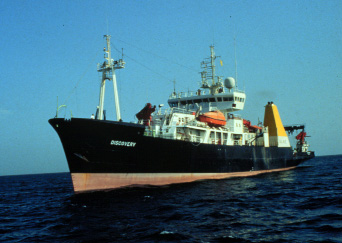
RV Discovery
The main objective of my Ph.D. was to investigate vision in mesopelagic (i.e. mid-water) shrimps. To collect my samples I took part in a cruise on board the British research vessel Discovery. In contrast to the Akademik Mstislev Keldysh the Discovery has a total complement of around 30 officers, crew and scientists.
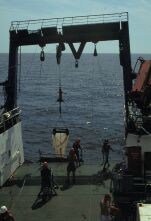
In order to catch our samples we used a 'Rectangular Mid-water Trawl' (RMT for short) with a closing cod-end. This fishing net can be opened and closed remotely and allowed us to sample at a specific depth. This piece of equipment is helping scientists to understand the daily cycles and ecology of mesopelagic species by providing 'snapshots' of mid-water communities at specific times and depths.
|
|
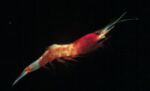 |
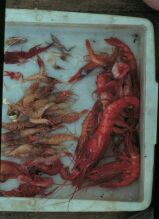
Some species, such as Systellaspis debilis (above) are highly migrant. At night they may be found close to the surface of the water feeding on smaller crustacea. During the day they sink to perhaps 1000 meters to the relative safety of the dark. Because these species prefer to live in the dark, it is difficult to closely and unobtrusively observe their behaviour (See Jon Copely's recent article in New Scientist). I have been studying these species in the hope that we can glean some information on their life-style from the design and capabilities of their eyes.
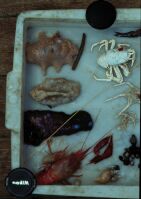
Other scientists on board the discovery were studying benthic (bottom-dwelling) organisms. To catch these they used a trawl very similar to an ordinary otter trawl as used by fishermen. Each time the net was brought back to the surface it contained a selection of weird and wonderful unusual specimens. However, it was slightly depressing that, even in the mid-Atlantic hundreds of miles from the shore and outside normal shipping routes, occassionally, amongst the specimens we would find a piece of mono-filament netting or some other piece of plastic rubbish.
|
|
 |
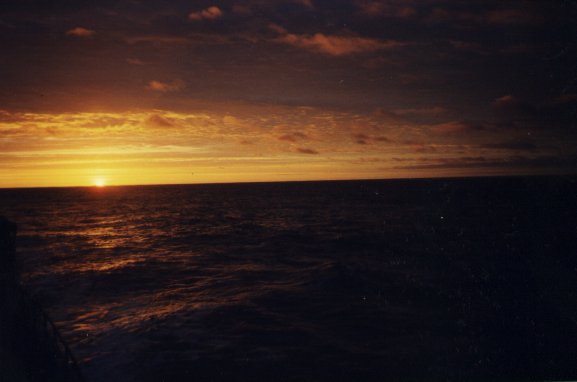
Sending a fishing net down to 3500 meters and then bringing it up again can take a long time; sometimes more than 12 hours! We had plenty of time to read, chat and loll around in the tropical sun. The highlight of every day was to sit and watch the sun going down and watch the green flash as it dissappeared over the horizon.