|
|





Marine life in the Seychelles
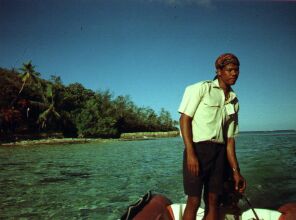 |
The marine life in the Seychelles Marine Parks (such as around the islands of Ste Anne and Curieuse) is protected and monitored by the Marine Parks Authority Rangers. Unfortunately the funding received by the Marine Parks Authority allows them to do little more than patrol the parks and prevent poaching of fish and turtles. While the management and staff would love to participate in monitoring and public education programmes in reality they are little more than an environmental police-force. Such programmes are crucial to the future of the Seychelles because of the heavy dependence of the islands on tourism as a foreign revenue earner.
| Coral bleaching is of major concern in the Seychelles. This is a photograph (taken by Dr. David Richardson of Sheffield University) that shows a turtle lurking beneath a piece of newly bleached branching coral. Although freshly bleached coral looks beautiful, it is a sign that it is dead. Corals take a long time to grow, maybe only mm a year in some species, and the loss of over 95% of coral cover in many areas of the Seychelles could spell ecological (and economical) disaster. Around 11% of all tourists coming to visit the Seychelles come primarily to see the marine life. The loss of coral means the loss of a whole ecosystem in some areas, and could spell disaster for local fishermen. It could possibly even lead to large changes in the erosion patterns of the coast. Barrier reefs make great sea-defence structures. If the coral is no longer growing the first good tropical storm could reduce what remains of the natural sea walls to rubble | 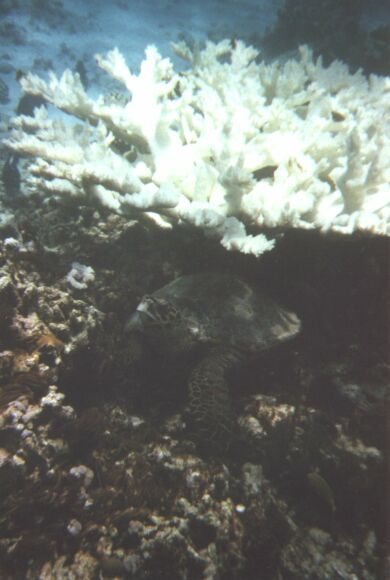 |
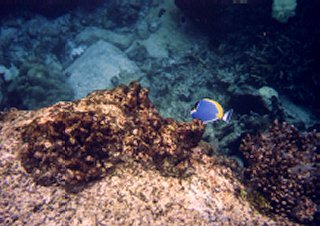 |
beds that offer little physical protection and no refuge for reef invertebrates and fish. In this picture a lone powder-blue surgeon-fish lurks amongst dead coral heads just off the coast of Ste Anne. The fact that this coral does not look freshly bleached, and appears to have a thick algal growth on it suggest that these particular corals died at least a few months ago. At the moment because the structure of the reef. that is made up of dead coral, remains relatively intact there is still plenty of space for many of the inhabitants and superficially it appears that there has been no dramatic change in fish abundance. But, the big question is - |
What happens next ???