|
|





Working as a Fisheries Observer in the South Atlantic
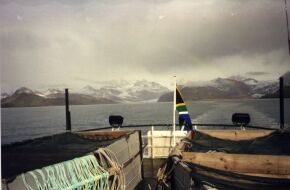 |
As we left Grytvikken (the station where the South Georgia harbourmaster, a doctor and 20 Ghurkas live) I could see a rainbow and thought of Nelson Mandelas' famous speech where he referred to South Africa as the 'Rainbow Nation'. Given the varied nationalities of the crew and the nominal South African flag, the rainbow seemed like an apt sending off for us. |
We had called in at South Georgia to pick up our fishing license. For toothfish longliners licenses are granted for a fixed term or until the total allowable catch for the season has been taken. It is a condition of the license that the Captain of the vessel reports his catch to South Georgia Fisheries on a daily baisis. Quite often the Fisheries Observer will help the captain (who may be Japanese, Spanish etc.) by reading his statistics over the radio for him. This daily reporting allows the Fisheries Authorities to keep a close eye on catches.
| One of the more tedious tasks for the fisheries observer is to do "hook counts". This involves sitting motionless three times a day, for an hour at a time, making a note of what is on each of the hooks coming in and how the fishermen dealt with it. Since the hooks come in at the rate of around 80 a minute the concentration required is intense. The worst thing however is the cold. I remember the day this photograph was taken. | 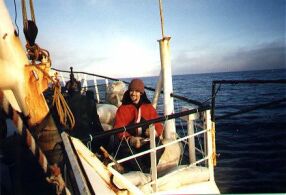 |
It was a relatively nice day, the sky was clear and wind was minimal. When the temperature is hovering around zero though it doesnt take long for the cold to seep through your protective clothing. 'Protective clothing' = woolly hat, balaclava, thermal underwear, trousers, shirt, fleece jacket, thermal overalls, survival suit, 3 pairs of gloves, 2 pairs of socks and thermal insoles. If the weather was a bit wet and windy, there was also a set of oilskins to go over the top. It took me about 15 minutes to get dressed to go outside , by the end of which I was drenched in sweat.
Toothfish were not the only things caught on the hooks. Perhaps the main reason for the presence of observers on vessels working around South Georgia is the danger that fishing gear presents to birds. Fortunately the vessel that I was on followed all of the proceedures reccommended by CCAMLAR and caught very few albatross or skuas. Two things that caused a little excitement when they were brought aboard were a Porbeagle and a penguin that managed to get itself caught while trying to steal bait from the hooks. The Porbeagle was a welcome victim since the steaks provided a rare break from the monotony of ships food. The penguin, despite what was probably a mortal wound, proved to be aggressive and fast.
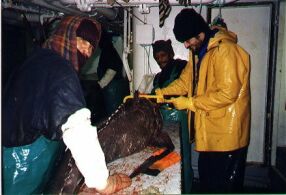 |
I found the work to be done in the processing area more interesting (and less cold). Each day that we were fishing I had to measure weigh and extract the otoliths from 30 or more fish. Otoliths are the earbones of fish and analogous to tree trunks in that a new ring is laid down on the bone each year. With smaller specimens the extraction of otoliths is fairly straightforward but for the larger fish, perhaps weighing over 100 kg, the process was more involved. For bigger specimens, if the weather was rough, even getting |
the fish onto the scales and then the table was sometimes tricky. At these times I depended very much on the goodwill and assistance of the crew.
Tell me More - - - - - - - - - - - Enough Already!