- The North pole of a magnet is the one that aligns itself with geographic north (magnetic south.)
- Poles of magnets come in pairs- there is always a south AND a north pole. You cannot have one without the other.
- Magnetic field: A force field that fills the space around every magnet or current-carrying wire.
- Another magnet or current carrying wire introduced into this region will experience a magnetic force.
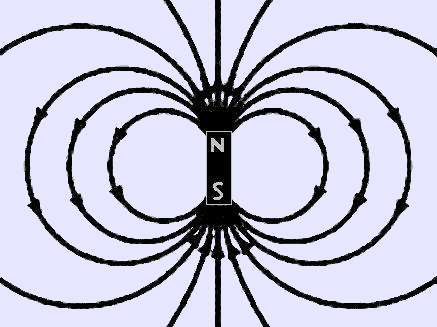
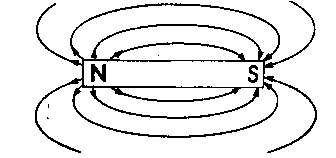
- Magnetic fields are strongest at the poles.
- Wherever there is a magnetic field, there is also an electric field. Wherever there is an electric field, there is also a magnetic field.
- Magnetic field lines show the direction of the magnetic field, which goes from the north pole to the south pole.
- Conventional current: positive charge flow
- Increasing the current will increase the force from the magnetic field.
- Increasing the distance from the magnetic field will decrease the force from the magnetic field.
- Changing the direction of the current will change the direction of the magnetic field.
- Point your thumb in the direction of the conventional current.
- The direction your fingers wrap around is the direction of the magnetic field.
- Use the right hand rules to determine the force on a current carrying wire.
- Point your thumb in the direction of the conventional current.
- Point your fingers in the direction of the external B field.
- Your palm will face the direction of the force.
- If the problem involves elections, USE YOUR LEFT HAND!
F: Force B: Strength of magnetic field i: Current l: Length of wire
The strength of a magnetic field is measured in Teslas. (T)
- The equation Emf=Bqv
Emf: potential voltage B: Strength of magnetic field q: charge v: velocity
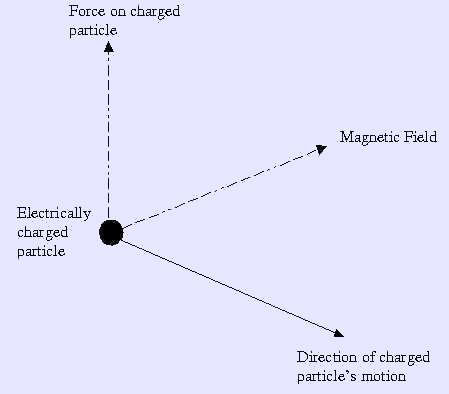
- The equation F=Bqv
F: Force B: Strength of magnetic field q: charge v: velocity
- The force is greatest when a charge is moving perpendicular to the field.
a) is no longer a magnet.
b) has one pole.
c) has a north and a south pole.
2. Current induces...
a) a magnetic field.
b) an electric field.
c) both.
d) neither.
3. The force on a moving charge is greatest when it's moving __________ to the magnetic field.
a) parallel
b) perpendicular
c) at a 45* angle
d) at the same speed
4. A magnetic force is going into the page, and a proton is moving to the right. What direction is the force on the proton?
a) down
b) up
c) to the right
d) to the left
5. An electron moving to the left is forced up by a magnetic field. What is the direction of the B field?
a) into the page
b) out of the page
c) clockwise
d) counter clockwise
6. The strength of a magnetic field is 1 Tesla. A proton is moving at 1.5 X 10^6 m/s and experiences a force of .0005 N. What is the charge on the proton?
a) 4.5 x 10^-20 C
b) 3.0 x 10^-20 C
c) 3.3 x 10^-10 C
d) 4.6 x 10^.10 C
7. A wire 20 cm long carries a current of 4A and experiences a force of .4N. What is the strength of the B field?
a) .02T
b) 8T
c) 5T
d) 1.3T
8. Changing the intensity of a magnetic field around a wire induces:
a) current
b) voltage
c) both
d) neither