Discovery of "Magnetic carbon" in Rhombohedral C60 polymer was only result of long list of "undeliberate mistakes". As well as discovery of metallic conductivity in Rh polymers which appeared to be result of 6 mistakes in calculation of Celsius to Kelvin (see below). Some of the most spectacular and most suspicious "mistakes" are described in more detail below. Anyone can decide for himself was it possible to make these mistakes undeliberately or they can be considered as a data manipulation. Special experts appointed in Sweden investigated questions and considered all of them as "minor mistakes" and not even suspicious for scientific dishonesty.
Now, after retraction of the original "Nature" paper, let’s see what was written wrong there:
- Number of studied samples (only 3 (!) were studied by SQUID to the moment of paper submission), reading paper one may think about at least 20 samples.
- Number of ferromagnetic samples (5 in the paper), only two were proven ferromagnetic by SQUID measurements. (Dr.Makarova claimed to make more experiments by other method, not mentioned in the paper, results never published and not shown to other co-authors).
- Structure of ferromagnetic sampleswas described incorrectly: only one of above mentioned two samples was Rhombohedral polymer, second was mostly collapsed fullerite, not consisted of fullerenes.
- Temperature and pressure of synthesis given incorrectly. Temperature interval of 1025-1050K (synthesis temperature of ferromagnetic samples) was wrong. In five different occasions 700+273 was calculated to be 1025-1050 as Dr.Makarova claimed. Error in calculation of Celsius to Kelvin. Anyone need calculator? For one sample even pressure was wrong (2.5 GPa instead of 6 GPa in the paper). Explained by Dr.Makarova as a mistake with labeling of this sample (which resulted in wrong pressure of synthesis)
- “Narrow interval of temperatures” where ferromagnetism was observed is simply bad joke: how can we talk about interval if only two samples were proved ferromagnetic by SQUID measurements? Samples synthesized at lower (975K for one sample) and higher temperature (1123K) were not studied on magnetisation prior to publication. Why Corrigendum published in 2005 again states some "interval" of 975K-1023K (??)
- Reproducibility: three sets are mentiond in the paper (1996,1998, 2000), in fact both ferromagnetic samples were from 1998 set, none of the samples from the 2000 set was ferromagnetic, none of 1996 samples was tested by SQUID on magnetic properties.
- All samples were synthesized before “occasional discovery” without Any care about contaminations. Samples were operated by metallic tools, split by metallic tools prior to beginning of studies and prior to “discovery”. The paper states “great care” about impurities.
- “specially synthesized set of samples” mentioned in the paper never existed. As explained by Dr.Makarova this was the set made in 2000 while first observation of ferromagnetism was made in March 2001 (written statement by Prof. Esquinazi)
- Level of contamination: given only for pristine C60 powder as 20 ppm for all ferromagnetic impurities. In fact, 20 ppm was only Fe, 30 ppm Ni were “forgotten”.
- Level of magnetization calculated from impurity content (0.003 emu/g in the paper) , 0.006 emu/g taking Ni into account.
- Level of ferromagnetism not stated openly, reading from the graph gives 12 times lower values (exactly the same as magnetisation calculated from impurities).
- Level of contamination for polymeric samples: was never properly checked. The sample with ferromagnetic loops shown in the paper was NEVER studied on impurities by the method described (Dr.Makarova pretend to have other impurity analyses, not mentioned in the paper and never published).
- Ferromagnetism was reported to disappear after depolymerisation (heated to 700K). How these data were obtained nobody knows until now. The SAME piece as the one for which magnetisation data were shown in "Nature" was later tested by SQUID in Germany (Prof. Esquinazi) and showed that ferromagnetsim preserved even after heating at 840K. At the same time other piece of this sample was depolymerized in earlier paper (Carbon 2001) ...at 473K!. So, even magnetisation run shown in Nature paper (up to 640K) was sufficient to break polymeric structure completely.
- Purity of pristineC60 powder: 99.99% in the paper. 99.9% for first two sets made in 1996 and 1998 (as follows from previously published papers).
So what was correct in this paper? Final conclusion: the paper was based on magnetisation measurements for single Rh-polymer sample which was never checked for impurities and prepared 3 years prior "discovery" without any precausions for contamination.
Some people believe these were all “minor mistakes”… well…. Personally, I will not believe to any future papers by Dr.Makarova weither her mistakes were deliberate or not, what is the difference for reader in the end if correct data can not be extracted?
What was contribution of Dr.Makarova to this study? The samples were synthesized by
other people (Prof. Davydov's group), XRD made by other person (not included as co-author), magnetic
properties (SQUID) were measured by other co-authors in
Let’s see some interview published soon after discovery of “magnetic carbon”: http://www.discover.com/issues/dec-02/features/featmagnet/
“More magnets please”, December
2002
“…The possibility that her results are due to
contamination, Makarova says, "is approximately
equal to the possibility that a monkey at a computer will type a Shakespearean
sonnet."
Well,
after cutting samples by metallic tools and touching each of them with
unprotected magnet this was very optimistic estimation of possibility. NO care
at all was taken against contaminations as we know now.
More citations?
"… Magnetite is everywhere in the
air," he adds. Makarova responds that she
repeatedly tests two polymer samples in each batch for iron and finds the concentration to be "vanishingly small". Sounds
like 6 analyses for 6 samples from three sets mentioned in Nature paper?
As we know those particular samples studied
on ferromagnetism were never BURNED for impurity analyses using the method
described in the paper. Not surprisingly: the method required 20 mg of
material, the sample description from Nature paper gives 3 mg size. Even after
synthesis (before splitting) the full size of sample was only 15 mg. Explanation given for investigation by Dr.Makarova: “Many small pieces from different samples were
burned together in ONE single test,
magnetic properties of these pieces are unknown. Does this test (I doubt it was
ever performed in reality) makes any sense? That’s right: Dr.Makarova
was able to present only one document with impurity analysis made at Chemistry
Department of our University. This document showed results of two analyses and
both were marked simply as “fullerenes”.
I suspect both of them were from pristine C60. Anyway, was
this analysis (even if it was made) correctly described in the paper? Anyone who read this paper is sure (as I was) that analysis was made on that very piece of sample which produced ferromagnetic loops, otherwise the whole story is pure nonsence. Finally the piece studied for Nature paper (for which magentisation loops are shown) was accidentally destroyed in heating experiments shortly after, oxygen leaked in process of heat treatment (written statement by Prof. Esquinazi). That is why impurity analysis on this sample was not performed even after initial publication. Never performed. Some people call it “minor mistakes…”. In correspondence with Nature editors Dr.Makarova
again repeated her statement that samples from each set of samples were tested
on impurities. This time analysis was claimed to be made by different method
and by scientists from Troisk (
More from the same article? “… Which is why she
has spent long hours making sample after sample herself (until recently, she
had no assistants). "It's not easy," she says.”
Well , the samples
were synthesized in Troisk in the group of Prof. Davydov. Dr.Makarova never
synthesized any high pressure sample by her own hands for this Nature paper
(and later as well).
Some
more details about “strange things” around.
1. According to Dr.Makarova statements she
had marked two samples as E16 and that is why mistake in Nature paper
occurred.
Dr.Makarova stated for investigation committee that until December 2004 she was absolutely sure that the sample E16 sent for magnetic measurements to Germany (and used for Nature paper) was , in fact, made at 6 GPa and 7500C (1023K). One can believe it is true, it could happen. Until you start to read other papers.
The next paper gives following synthesis conditions for the E16
sample: 2.5 GPa
and 8500C (Spemann,
D et.al. Nucl. Instr. and Meth. in
Phys. Res. B 210, 531, 536 (2003). Dr.Makarova
is co-author in this paper published in 2003!
Why it is so important? At this conditions fullerenes must collapse and at this
pressure the Rhombohedral polymer never appears
as a major phase. Dr.Makarova knows this fact very
well. Next paper was written solely about E16 sample, also from 2003, states
already different conditions: 6 GPa and 8500C (Han,
K.-H. et al. Carbon 41, 785, 795(2003).
Can anyone explain to me how these numbers appeared in two papers of Dr.Makarova if she was until December 2004 sure that the
sample E16 is Rh polymer made at 6 GPa
and 7500C??
Furthermore: in 2004 Dr.Makarova published review paper (Makarova, T.L. Semiconductors 38, 615-638
(2004)). where the XRD of E16 is shown before and after heat treatment
up to 800K. For
this paper she provides XRD from the sample made at 2.5 GPa
and ….1050K! The identical XRD can be
found in other paper , published in 2003, where the
structure is clearly described as a tetragonal
(Makarova, et al Synthetic
Metals 137, 1335ЎМ1337 (2003). The whole paper was about
tetragonal polymers. See section 3 for details on this amazing paper.
Dr.Makarova believed that E16 sample is Rhombohedral and made at 6 GPa and 7500C at that very moment according to her statements, but shows XRD from tetragonal polymer for the same sample?
My conclusion: Dr.Makarova was all the
time well aware that ferromagnetic E16 sample was not rhombohedral and that it
was made at 2.5 GPa and 1123K. May be she discovered it briefly after
publication of paper in Nature, may be. But corrigendum was published after
very hard pressure applied from investigation only in 2005. Even in 2005 Dr.Makarova insisted that corrigendum is not
required. The structure of the sample in Corrigendum described as… “mixture of the rhombohedral and tetragonal phases with some
hard carbon” again. Like there was only
a small fraction of other phases and major phase was rhombohedral. Can it be
that Dr.Makarova do not understand her own XRD ? She did not mentioned Rh phase in other paper with identical XRD... She also presented for investigation some Raman specrtum for this sample... which showed only peaks from graphite-like carbon, peaks from mercury lamps and peaks from computer screen radiation. That is typical: to show one thing as an excuse for investigation and immediately to publish something different for other people. Finally, it come out that XRD pattern was recorded by some other scientist, not mentioned in the paper. See section 3 for more details.
I shall note that the structure of this sample was never given in three papers explicitly: it was referred as “polymeric”, no XRD or Raman was shown, absolutely nothing. One need to dig deep to check the structure of the sample. See next section.
2. Another 6 mistakes in Celsius to Kelvin: how to make Rh polymer metallic by small change in numbers.
The structure of this sample could be verified by conductivity measurements published in 2000, (Makarova, T. L. et al. Conductivity of two-dimensional C60 polymers. Mol.Materials. 13, 151-156 (2000).). The Figure 5 (b) in this paper shows measurements performed on three samples, one of them-2.5 GPa and 850 0C, exactly what we are searching for. It shows conductivity of graphite-like type which proves that fullerenes collapsed completely in this sample. Surprisingly, the same figure was found in two later review papers but temperatures were different.
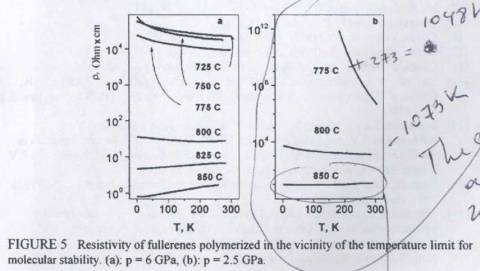
Figure from Makarova et al., Molecular materials, 2000
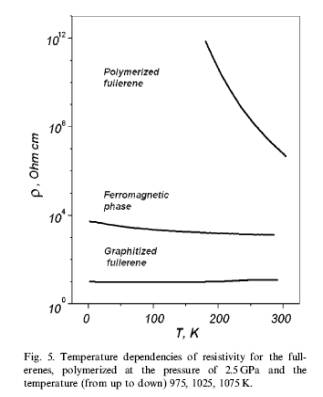
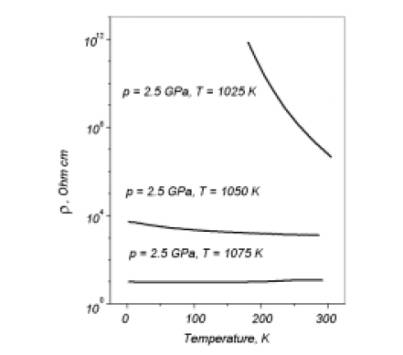
Figure on the right side is from review article from the book "Studies of High Temperature Superconductivity", 2003, 44-45, Ed. by A. Narlikar 1263–1268
Figure on the left is from more recent review paper: Journal of Magnetism and Magnetic Materials 272–276, 2004
The curves are assigned to different temperatures in all three pictures! Note that C60 collapse into graphite-like phase at 1073K (see e.g. Nature paper by Makarova). In 2000 (prior to discovery of ferromagnetism) curves are marked as 1048K, 1073K and 1123K (that is above C60 collapse point!). Three years later identical curves are already marked as: 1025K, 1050K and 1075K . The trend continues and one year later these curves already show even smaller temperatures:975K, 1025K and 1075K . Phase transition is completed-trivial graphitization from year 2000 become "metallic properties" of Rh-polymer. What is even more funny-the JMM paper from 2004 claim that all ferromagnetic samples of Rh polymer also showed metallic conductivity. Two non-existing properties get connection to each other. Since we know that original samples were marked in Celsius, the mistake in calculation from Celsius to Kelvin occurs in 6 calculations out of 6 and every time in different way. What is even more funny - two papers were published already to explain theoretically this metallic Rh-polymers.
Due to these mistakes Rh Rh polymer become metallic. One more unbelievable result. Can anyone believe that ASSOCIATE PROFESSOR is able to make such mistakes undeliberately? Well, not me...
3. Three more “mistakes” Celsius to Kelvin
(Makarova, T.L. Sundqvist, B.
Kopelevich,Y. Synthetic Metals 137, 1335–1337 (2003).)
The paper describe results of new experiments made at 2.5 GPa in Umeå.
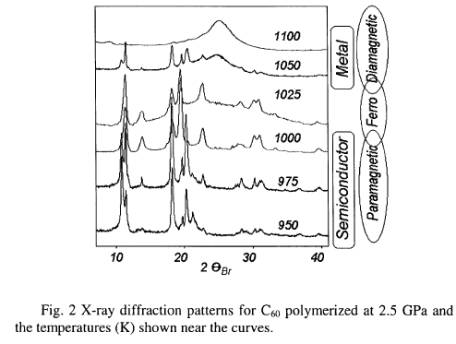
The paper describes new samples made after original "Nature" publication here in Umea. The paper shows figures with Raman spectra and with XRD supposedly recorded from these samples.
Now amazing fact: all three samples appears at different temperatures compared to the file provided by Dr.Makarova.
Two curves in the picture made by Dr.Makarova appears to be made from the same sample! One measured by herself and second by Prof. Agafonov. According to provided file all three XRD recorded by Prof. Agafonov were inserted into figure with WRONG temperatures. If we insert those true (?) temperatures the figure has no sense at all, all trends shown in this figure will disappear.
Misteriouslly , the curve for 1050K corresponds in the Makarova's file to the XRD from 1123K sample, but the XRD from 1050K sample is not present at all... Like it was never recorded. Why was it necessary? See next section, this XRD was once used to describe sample made at 2 GPa and 1123K. Now this "mistake" in calculation of celsius to Kelvin is realy necessary, because otherwise the figure shown in next section would become clear evidence of fraud.
So, this paper in Synth.Metals provided us with four more mistakes in Calsius to Kelvin calculations...
4. More evidence?
How many papers Dr.Makarova published about ferromagnetism in high pressure polymers? Only those two mentioned above, plus several conference proceedings with “review” of these results. She also published one major review paper (Semiconductors, 2004) where some previously unpublished results were suddenly inserted. Very unusual practice for review paper. Nobody desribes in review paper details of experiments and who measured what. The new data are again confronting common knowledge: it was published in 2003 (Korobov et al, Chem.Phys.Lett) that samples of magnetic carbon depolymerize into pristine C60 (like any other polymeric samples of C60) below 600K. Now Dr.Makarova desperately attempting to prove that only her samples not depolymerized even at 800K. Otherwise it will be clear that ferromagnetism is not connected at all to polymerization. The figure shows XRD from the sample E16 (2 GPa and 1123K) recorded by Prof. Esquinazi after heating to 800K. The second curve is provided by Dr.Makarova. Unfortunately, identical curve was found in the figure published earlier Synth.Metals in 2003 as tetragonal polymer made at 1050K. See figure from section 3 above. She put two XRD's from different samples in one figure showing it as one experiment (sample before and after heating). The choice of particular pattern for this piece of fraud is also very informative: Dr.Makarova chosen pattern of mostly tetragonal phase ( I tried to put toghether pattern of Rh phase into this figure instead-in this case the two curves in the figure look completely different). That proves, in 2003 she knew exactly that the sample E16 (one of two with measured 500K Curie T) was not rhombohedral. At the same moment Dr.Makarova claim that she was sure that E16 sample is made at 6 GPa, and 1025K and is of rhombohedral structure. But that is not all
The figure 17 from the review is shown below:
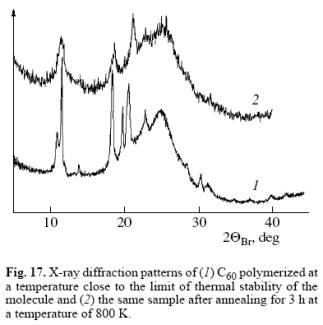
Citation from the text:
“One of the samples lost only
2% of magnetization, and the X-ray diffraction patterns remained unchanged
after annealing and corresponded as
before to the rhombohedral phase of polymerized C60. This result is
nontrivial since the rhombohedral phase is typically depolymerized at 560 K. “
Well, this sample was studied by Prof. Esquinazi using heating at high temperatures but was was destroyed during heating due to oxygen leak and therefore XRD or Raman spectra was never recorded from this sample after heating ( stated by Prof.Esquinazi for investigation in written letter).
One more citation:
“Figure 17 illustrates the
results of the relevant studies. Although a sample of polymerized C60 annealed
for 3 h at a temperature of 800 K lost 20% of magnetization, this sample did not decompose into starting fullerenes”
As written above, two XRD's were recorded from different samples if we believe to publsihed data. Second, it did decomposed if one analyze it. The XRD shown on the top curve is not from Rh polymer but closer to XRD of fcc C60 (but not exactly the same). That sample was also heated for 16 hours (not 3), but ok, she did not checked it. But how this figure with Tetragonal polymer can be “relevant” to discussion of Rhombohedral? Again, structure of E16 sample is not stated in the figure and synthesis conditions not specified. Only 2-3 guys in the world could see without special analysis that this is mostly AMORHOUS CARBON, with fraction of tetragonal polymer and very minor fraction fo Rhombohedral.
The Corrigendum to nature paper states that this sample is “mixture of the rhombohedral and tetragonal phases with some hard carbon”. Dr.Makarova was aware of true structure and true name of this sample. There is no other explanation to published data.
Why? We have only two samples with proven ferromagnetic properties and Curie T at about 500K. One is true Rh polymer made at 975K, and second is mixture of three phases, with at least 50% of collapsed fullerene molecules. But magnetic properties are nearly identical! Anyone would make a conclusion that ferromagnetism is not connected to polymeric structure and not connected to fullerenes. Anyone but not Dr.Makarova.
General question: how data
manipulation can be discovered?
1. By comparing raw data with published information.
Example. Bulgarian physicist Ninov replaced some raw data and as result a discovery of new chemical element was claimed. When verified, it appeared that some data were altered. The “discovery” was called back by colleagues. Ninov could speculate that his mistake was unintentional and he honestly believed in existence of elements 116 and 118. Nobody knows what did he said as an excuse, he lost his job and details of internal investigations were not published.
Comparing raw data on magnetic carbon to those published in “Nature” and some later papers also revealed very serious difference. Only one "Nature" paper which cites 5 ferromagnetic samples contained 5 "mistakes" in calculation of Celsius to Kelvin (inclusing synthesis temperature for the sample shown in all three figures). About 15 mistakes in calculation of Celsius to Kelvin (some in quite unlikely way) were admitted in other 3-4 papers and taken as satisfactory explanation. Mistake with "marking the sample" explained how the sample with different structure and pressure of synthesis was described as purely Rhombohedral. Claimed reproducibility never existed: 500K Curie T was ever found only on two samples and one of them was not even consisting of fullerene polymers!The "new specially synthesized set of samples" never existed: all samples were synthesized prior to experiments which revealed ferromagnetism without any care about impurities. Impurity analysis described in the paper proved to be impossible on individual samples (3 mg sample was described and 20 mg required for analysis cited in the paper). Many things heard on seminars also apepared to be not correct and wrong answers are explained by health problems.
2. Finding the same experimental curves (with all noise features) in two different papers about seemingly different samples.
Five such occasions were documented in published papers (including two figures from Nature paper) and four more occasions in written reports given in the course of investigation. Trusting to published data one can find that three figures in Nature paper were about different samples, while it was stated that they represent one “typical” sample. Ferromagnetism is shown for one sample, but Raman spectrum and AC susceptibility from another sample (which was not ferromagnetic). In the second example the XRD from seemingly two different samples were combined into one figure to show evolution of structural properties during heat treatment.
Similar “double published” curves were of the strongest evidence in case of badly famous Hedrik Schön exposed as largest scale fraudster of all times in physics.
In case of Dr.Makarova it is enough for her to say: in this paper the curve is correct, in other one it is wrong. It is only a “minor mistake” and, of course, the correct data are always in more important paper. Ok.
3. Any other methods? Not to my knowledge. It looks completely impossible to prove manipulation of data if all above methods are admitted not sufficient. ANY manipulation can be explained by non-deliberate mistakes as it looks now. There must be some point where even unintentional big mess becomes not tolerable. If doctor fail to sterilize instruments and patient dies: it is crime and he knows it. If seemingly the same standard practice is broken in Physics: it will be considered as sloppiness and that’s it. Student may not know how to sterilize instruments: professional who discuss this subject at least 4 years on international level (with tens of presentations) must know how to do it. He is, in medicine at least.
In physics-it is Ok after years of discussions about extra care against impurities to operate all samples by extra strong magnet (basically to put surgery instruments to trash box and to take them after that to operation).
Manual how to become famous and get good
job in science (I hope nobody will take it to action!):
Take some samples which are difficult for others to synthesize. Change
all conditions of synthesis as you want , ANY
incorrect number in your papers can be explained by mistake of calculation
Celsius to Kelvin and back. For example: claim superconductivity in Marsian
meteorite. The best is if it is indeed
some superconductor let’s say at -270 C. You put the number as 290 K, in this
case it become major breakthrough in Physics. You risk
nothing: in case if it
is discovered later you may say that it was mistake in calculation. You can
also write that result is reproducible. The same mistake you unintentionally
repeated 3 times, no problem. Now the
main challenge: to publish it in Nature. If you get lucky: your career is fine
for next 10 years. To increase chances for publication you could write whatever you want in correspondence with Nature editors. They never give away this correspondence and referee reports.
The paper in Nature almost automatically provide
you with good position in University financed by VR. 100 references are guarantied in two years:
everyone who write paper on meteorites will refer
to your paper as very important example why one need to study them.
First: it is difficult to get Marsian meteorite. If someone get it and have not confirmed superconductivity: tell them
that meteorites are very different, inhomogeneous and one need to study 100 of
them to find right one. This will scare away most of the people from doing the
job. Most important: burn your meteorite
to study for impurities: in this case nobody can check your result. In case if
other people got pieces of this meteorite: ask them to send it back. In case if
5 years later someone find another piece of the same
meteorite and decide to check your result, it is also not a problem-just say
that effect disappears slowly due to contamination of the sample during
storage.
Finally, if some student
checked your raw data (avoid having students! avoid keeping data, computer
crash is very nice thing!) and find your mistake in calculation of Celsius to
Kelvin: you will be only asked to publish corrigendum and accept it as a minor
mistake. The most funny fact is that your paper will
be in fact TRUE useful for studies of meteorites. Any paper in Nature helps to many people to
get financing. Your paper will bring
attention to the field of meteorites, many people who
study them will motivate their funding applications by extraordinary properties
of “some Marsian meteorites”. They will find TRUE interesting things, no
doubt. You will be a good guy after
all!
I forgot to say: at the time
when your “mistakes” discovered you already got permanent position in some
University, you could even make some good research in some other field and your
future is not in danger just because one paper is not confirmed.
It was already pointed out in some letter published by
“Nature”: for postdoc without exciting results who
risk not to find new job the fraud become no-loose situation. In case if your
fraud is discovered: you only risk to loose your job (the same punishment as for producing not enough exciting results). Even famous Hendrik
Schön only lost his job: nobody asked him to refund
millions of dollars spent by hundreds of other people.