 Introduction
Introduction
Introduction
My eyes were closed so they could be opened: Such is the lesson I have learned from my day as a person with blindness. When it was over, I felt like I had been hit by a semi: exhausted and worn down, both physically and mentally.
My preconceptions of blindness were shattered. I have gained a good deal of compassion for those who are now, for whatever reason, visually impaired. Functioning without sight is not nearly so easy as it might look. There's an old saying: "I've done that so many times I could do it blindfolded." Quite simply, this is not true. Nothing — no matter how familiar to a sighted person — is easily accomplished once the gift of sight has been removed.
I will tackle this paper in four sections. First, I will discuss the experiment itself and the issues it raised. Second, I will discuss current research and facts about blindness. Third, I will address how this experience will affect the way I would teach a visually-impaired student. And finally, I will cover general special education information from Exceptional Lives by Turnbull, Turnbull III, Shank, and Leal.
A brief note about my methods: I used a dark blindfold that completely eclipsed light. I was not able to see anything at all. Because it was all darkness, I often kept my eyes shut anyway. Incidentally, I never once felt self-conscious about my mask all day. Why? Because self-consciousness often depends on how you perceive other people reacting to you. Since I couldn't see a thing, and since almost everyone treated me kindly, I felt secure in the experiment.
The experience made me increasingly aware of my auditory surroundings. The creaks in the floor upstairs, the sounds of morning outside, the rattle — how loud! — of my spoon in the cereal bowl. I felt naked, having only this and my sense of touch on which to lean. I also felt invigorated: So this is what it's like to be blind.
A number of legitimate issues were brought to the forefront by my experience. I will address them individually:
 Mobility. This was perhaps the biggest
problem of them all. I began my day blindfolded, and found getting around
my apartment not difficult. When Amanda showed up, however, the trouble began.
Getting up and down steps, across uneven surfaces (such as my yard), through
tight places (such as Athens High School) proved extremely difficult, even
with verbal and physical guiding.
Mobility. This was perhaps the biggest
problem of them all. I began my day blindfolded, and found getting around
my apartment not difficult. When Amanda showed up, however, the trouble began.
Getting up and down steps, across uneven surfaces (such as my yard), through
tight places (such as Athens High School) proved extremely difficult, even
with verbal and physical guiding.
According to research, less than 2 percent of the blind population use seeing-eye dogs, a program begun in Germany in the 19th century. Most people who are blind use red-tipped canes to maneuver through their environment (Lorimer, p. 132). This amazes me. One day was hard enough, with a guide. Adapting to an entire life this way would take a remarkable amount of guts and determination.
Some of the more difficult places to reconnoiter were Jeff Hill (because of the 130+ steps), any classroom with a profusion of desks, and any uneven outdoor surfaces. Of course, any flat surfaces (such as Ellis or McCracken's hallways), sidewalks, and the one-floor Athens High School were quite easy.
Mobility was the most difficult issue from the perspective of Amanda, my guide. She noted later my inability to walk in straight lines. She also noticed that other pedestrians, upon seeing us, expected us to move out of their way — another obstacle for Amanda. But the most difficult part of the job, she says, is the worry: "When you tripped [which happened a couple of times], I felt really bad, because I thought it was my fault you tripped."
During our drives to and from Athens High School, I became extremely carsick. It proved to be a horrible experience, as I'm sure it would for those who are adventitiously blind. Without a visual point of reference, I was unable to keep my sense of balance. When we arrived, I was close to vomiting. I had to stand outside for several minutes to regain my composure.
Along with that, dizziness turned out to be a problem too. Unless I was always touching something, I almost immediately lost my sense of balance. Simply standing still was about all I could do on my own.
Another important experience to discuss was going to the bathroom. I only had to go once during the day (fortunately). It was also the one and only time I cheated. My fears of, ahem, missing while in the bathroom prompted me to take a short peek of reassurance.
Dependence. This wound up being far
more difficult than I had anticipated. Abandoning control to a friend and
trusting that she was not going to guide me into a wall, desk, curb, or corner
became, at times, a leap of faith. I noticed later that she guided me, rather
than letting me hold on to her. As was pointed out in class, this may have
left me feeling even more powerless. Also, I had to depend on her to read
me assignments during class.
In German, she patiently spelled each word. It took more than a minute to do one sentence, and there were dozens to do! Having to hear and add one slow word at a time to a sentence, listen for the blank, and then integrate my knowledge of German proved extremely difficult and frustrating. When it came time to read our answers aloud, Amanda and I had only finished about a third of them. Toward the end of the exercise, my professor asked me if I wanted to try one. Naturally, she picked one I hadn't gotten to; thus, I was unable to participate.
In French class, a good friend offered to help me keep up with class. Amanda faded to the back and observed while class covered a section on grammar. This time, the teacher was wonderful. I felt no different than other students, and actively participated. My friend wrote down my homework and took notes that later (using sight) proved useful.
 I also depended
on Amanda to keep me apprised of reactions of others throughout the day.
My constant litany was this: "What are they doing? Are they looking at me
strangely?" Not knowing was stressful; I am used to judging at a glance the
feeling and content of a room and its people. More, I am accustomed to using
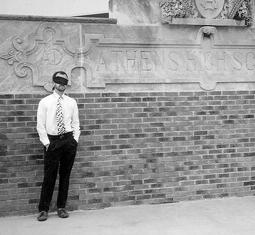
visual clues to facilitate interpersonal communication. At right, I am standing
in front of Athens High School, where I did my observation in Gloria
Muntean's French class.
I also depended
on Amanda to keep me apprised of reactions of others throughout the day.
My constant litany was this: "What are they doing? Are they looking at me
strangely?" Not knowing was stressful; I am used to judging at a glance the
feeling and content of a room and its people. More, I am accustomed to using
visual clues to facilitate interpersonal communication. At right, I am standing
in front of Athens High School, where I did my observation in Gloria
Muntean's French class.
A prime example of that happened on our way to lunch. Amanda ran into a friend and she accompanied us across the green. After introductions, a conversation ensued — one in which I took almost no part. Why? Because I had a hard time knowing without visual information when I could speak. Also, when her friend spoke, I didn't know if it was to me or Amanda she was speaking.
Energy. Whoof. By the end of the
experiment, I was ready for a long winter's nap! Because I was not able to
participate fully in class, I often zoned out. After a full lunch at Subway,
Amanda and I went to EDSE 270, where I promptly found myself dozing off.
It was a beautiful spring day, the talk became more and more distant, and
I found it very easy to quit paying attention. After all, who would notice?
Eating. Remarkably, this was quite
easy. You find the food, you aim it for your mouth, you eat. Even Amanda
commented how easy it seemed to be.
People's reactions. Now this was
interesting. First, let me cover classroom situations. In German, I was ignored;
in French (at OU), the teacher publicly asked me what I was doing, and gave
me a chance to explain, in French, the purpose for the experiment. I was
impressed that she did this. Later, in my high school French class, I used
the situation again to explain, again in French, what was going on.
However, it was what I didn't see that was the most noteworthy. The following information is courtesy of Amanda. Almost everywhere I went, I got odd looks. Students whispered about me in German. Strangers stared at me in French. The employee at Subway looked at Amanda, not me, when I was ordering. (I was even asked good-naturedly in Subway, because of my blindfold: "You're not here to rob the place, are you?")
To be legally blind, a person must have a central visual acuity of 20/200 or less in the better eye with corrective lenses, or central visual acuity of greater than 20/200 if the field of vision is less than 20 degrees. Within the field of education, any kind of visual impairment —
including blindness — is a disability which affects a student's educational performance (Turnbull, Turnbull III, Shank, and Leal, p. 635). In other words, if print can't be used to learn, then a student is educationally blind.
There are three general categories of visual impairment, according to Turnbull, Turnbull III, Shank, and Leal (p. 599):
Low vision. These individuals can see
print although they may need aids. In one way or another, they use their
visual senses for at least some learning.
Functionally blind. These individuals
will use Braille for reading and writing. They still have some visual ability,
however, and use it for mobility and basic functions such as clothes sorting.
Totally blind. These individuals don't
receive any visual input. They rely entirely on auditory and tactual sensory
input.
According to The Encyclopedia Americana (p. 129):
There
are between 41 and 52 million blind people in the world today. In industrialized
nations, only 0.2 to 0.5 percent are blind. In developing countries, it is
1 percent.
In
America, 1.1 million are legally blind. 10 percent of those can see no light
at all; another 10 percent can perceive objects, but no light.
Adults
over 60 account for 68 percent of those blind. Its incident rate is far less
for children.
As
of 1990, there were 48,000 legally blind students in America's schools. An
additional 30,000-40,000 are deaf-blind.
Approximately one American student in 1,000 has a visually impairment
which interferes with learning (Turnbull, Turnbull III, Shank, and Leal,
p. 605).
Visual
impairment accounts for less than 1 percent of the special education population
(Turnbull, Turnbull III, Shank, and Leal, p. 605).
The
disability is divided fairly evenly among the sexes. About 55 percent are
male and 45 percent female (Turnbull, Turnbull III, Shank, and Leal, p. 605).
There
is no evidentiary connection between ethnicity and visual impairments (Turnbull,
Turnbull III, Shank, and Leal, p. 605).
As
is shown below, poverty is often a significant cause of visual impairments
(Turnbull, Turnbull III, Shank, and Leal, p. 605).
There are a number of causes of visual impairments. Most of these are drawn from to The Encyclopedia Americana (pp. 130-31), unless otherwise noted:
The
No. 1 causes of blindness worldwide are trachoma, vitamin A deficiency
(xerophthalmia), and river blindness. In developing countries, the leading
cause is xerophthalmia.
In
the United States, the leading causes are glaucoma, age-related macular
degeneration, cataracts, and diabetic retinopathy.
Trachoma
is a contagious virus which can be prevented with sanitation and medical
care. The cornea becomes more and more opaque in this situation, leading
eventually to complete blindness.
Xerophthalmia is easily corrected by changing a person's diet to include
adequate amounts of vitamin A. Because of this simple treatment, it is chiefly
a third-world problem.
Glaucoma
is a condition in which excess pressure builds up within the eye. The results
are blurred vision, narrowed sight, and eventually total blindness (Plummer,
p. 11).
Macular
degeneration may have hereditary causes and often strikes older people. It
generally leaves the patient good peripheral vision and blurred central vision
(Plummer, p. 12).
Cataracts occur when the lens of the eye becomes cloudy. The two most
common sources are chemical burns and heredity. While not contagious, the
condition is progressive and is also operable.
Retinopathy of prematurity occurs when abnormal blood vessels proliferate
in the retina. This condition strikes premature babies most often, and in
30 to 50 percent of the time is correctable.
Rubella
(German measles) can cause blindness in an infant if a mother was not vaccinated
prior to conception. Such children are also likely to be born mentally retarded
and to have other physical problems (Plummer, p. 10).
If
a person experiences severe trauma of some kind, sight could be lost. This
is called adventitious blindness, a situation in which a person loses sight
because of an event, not because of a birth defect. (Turnbull, Turnbull III,
Shank, and Leal, p. 605).
An
increasing number of school-aged children are living in poverty and do not
receive adequate pre- and postnatal care. Lacking this essential care often
results in significant sight problems. (Turnbull, Turnbull III, Shank, and
Leal, p. 606.)
Increased medical technology has allowed more children to survive
life-threatening illnesses and too-early deliveries. Some of these children,
as a result, have visual problems. (Turnbull, Turnbull III, Shank, and Leal,
p. 606.)
There are a number of ways I would change the way I teach and the way I relate to accommodate a visually-impaired student in my class:
Curriculum. The chief change would
be adapting the curriculum. Since I will be teaching foreign language, much
of the material will be presented orally anyway. But I will go slower and
often spell words for the student. If possible, any material that's covered
would be adapted tactually for the student, and I would encourage the student
to take part in any physical classroom activities. In addition, I will work
with the special education or itinerant teacher to figure out ways to adapt
classroom materials, such as handouts, in Braille.
Tests. The student would be allowed
more time for tests. In fact, tests would be completely changed for the student.
Most would probably be oral, and shorter than the regular tests — but
no less difficult.
Verbally. One major factor that would
have helped me much more during my day as a blind person was to have my name
used when I was being addressed. I will do this in the classroom every time
I address the student to make him/her more secure.
Socially. I will help the student adapt
socially with the classroom through a number of methods. I will pair him
or her with outgoing students. I will require him or her to participate in
conversations. In essence, I will expect the student to perform socially
at the same level as other students and will do everything in my power to
make that happen.
Expectations. I will have high expectations
of the student academically.
Tardiness. I would understand if the
student is regularly late or has other time management-related problems with
his or her schooling.
Families. Lastly, I would encourage
family involvement in the education. If possible, I will meet with the family
to discuss ways they can help the student learn the particular material I
will be teaching. I will give them tips and ideas about the nature of the
language and creative ways to quiz and test the student, even if they don't
know the language themselves. Research shows that "warm acceptant parental
attitudes and a high degree of parental understanding" are directly tied
to good adjustment in the child (Cowen, Underberg, Verrillo, and Benham,
p. 170).
All text for this section is culled from Exceptional Lives: Special Education in Today's Schools (Turnbull, Turnbull III, Shank, and Leal). As I enter the workforce, I'll be encountering a classroom filled with cultural differences. The numbers of African-American, American Indian, Asian/Pacific Islander and Latinos is on the rise, while the white population is decreasing. And while the scene for education seems to be improving, I know as a teacher I'll be faced with a lot more problems than the bubble-gum chewers of the 1960s: Abuse and neglect (they're on the rise), adolescent problems (including premature pregnancies), and out-of-home placement (due to incapable parents).
I will probably also have students with disabilities in my class. About half of all disabled students have specific learning disabilities; another 23 percent have speech or language impairments, and 12 percent have mental retardation. Most of these students are white; 25 percent are African-American, and 8 percent are Latinos. As a result, I will be very careful about the labels and language I use around these students: they need to be positive and uplifting. This is especially important since only less than half graduate. More than a quarter drop out.
 Another
factor to throw into the mix is the family life of these students. Kids are
the poorest Americans, especially among the minorities. The good news is
that 87 percent of Americans live above the poverty line ($14,000 for a family
of four). Also, fully a quarter of all students live in single-parent homes,
and many have mothers who work outside the home. Student home lives have
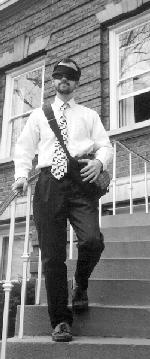
changed a lot in the past 50 years. (At right, I finally made it to McCracken
Hall at the end of the day.)
Another
factor to throw into the mix is the family life of these students. Kids are
the poorest Americans, especially among the minorities. The good news is
that 87 percent of Americans live above the poverty line ($14,000 for a family
of four). Also, fully a quarter of all students live in single-parent homes,
and many have mothers who work outside the home. Student home lives have
changed a lot in the past 50 years. (At right, I finally made it to McCracken
Hall at the end of the day.)
For students with disabilities, friendships (or the lack of them) can be a major factor. As a teacher, I can collaborate with special education teachers, work with groups of students, and teach social interaction skills to my disabled students in order to help them make friends.
For years, these students had experienced discrimination. But slowly, through a series of court battles, the law came around to their defense. The most significant of these laws is Public Law 94-142, the Individuals with Disabilities Education Act (IDEA). IDEA guarantees a free, appropriate public education for all students, regardless of handicap. There are several key components to this law:
Zero reject. No one can be excluded.
The American with Disabilities Act supplemented this in 1990, keeping students
free from discrimination (in principle, anyway) once they reach 21 —
the cut-off age for IDEA.
Nondiscriminatory evaluation. Schools
must be fair. For years, they had not been, and now parents have a right
to a fair assessment of their child. From screening to the IEP, the plan
is very specific and guarantees parental and student input in the process.
Appropriate education. Education must
be tailored if necessary. Once the screening has been completed and a disability
is confirmed, an IEP is formed, with direct parental involvement. A number
of other people must also be present, ensuring a level of nondiscrimination.
Least-restrictive environment. Disabled
students must be included as much as possible in the regular classroom. This
was one element of IDEA and intended to give the student maximum exposure
to non-disabled students, to reduce the stigma of special education, and
to save money for the schools.
Procedural due process. Giving parents
and students legal recourse for these rights. This also works both ways:
it makes parents and schools accountable to each other for the education
of the child. It's intended chiefly, however, as a safeguard against
discrimination.
Parent and student participation. Both
must be involved in the tailoring of a plan. This collaboration is beneficial
because parents are actively involved in the process of writing an IEP, and
are more likely to take it and the process seriously as a result. Because
a number of other people work on it as well — including the child's
regular teacher — the plan has a good deal of credibility.
Click here to go back to the main page.