
Ilya Magid
Basis of Grammar
(First
draft)
Introduction
I. Parts of Speech (Grammar Units)
II. Syntax (Syntax
Units)
III. Connections
between Syntax and Grammar Units
With appreciation to volunteers: Attorney and CPA Steven Siegel and English
teacher Lucille Mc Mahon for discussing and checking this article.
Boston
2002
Ilya,
I think you should leave explanation about grammar to professional language
experts.
I think your job is to write stories and essays and try to continue to
improve your grammar by writing and speaking a lot.
`
Teacher
I show him only outlines 'SYNTAX'
About me
On April 25, 1991 our family (my wife and I) came to my daughter in America
from the Soviet Union. Right now I am 78 years old.
We began to study English in different colleges (1991-1995): Hebrew College,
Bunker Hill Community College, Roxbury Community College. I have been
studying English with the help of a handsome volunteer, attorney Steven
Siegel once a week from 1993. In our building I have been attending English
class with the teacher Daniel Smollens, a very famous teacher from Roxbury
Community College, once a week since 1994.
We, my wife and I, try to attend many religious classes. We try to connect
ourselves to Judaism and go to the synagogue each Shabbat and other religious
holidays.
I try to write my stories in English, but my English is poor. I speak
poorly and my pronunciation is the same.
I like to write in English because it is a very strong language, the same
as mathematics. If I would write my stories in Russian I think they would
not be so interesting. Also I want to inform Americans about the Soviet
Jews. Those themes were forbidden in the Soviet Union. I also write about
life in the Soviet Union under the condition of dictatorship across the
life of different people, and other stories.
I study some
American grammar in college courses on the Internet:
Bibliography
1. Modern English
Grammar, English 126, Daniel Kies, College of Du Page
2. Guide to Grammar and Writing
3. English Grammar: Patterns and Choices
and many other books.
Preface
I know
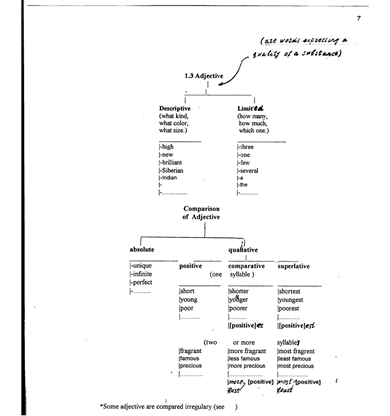
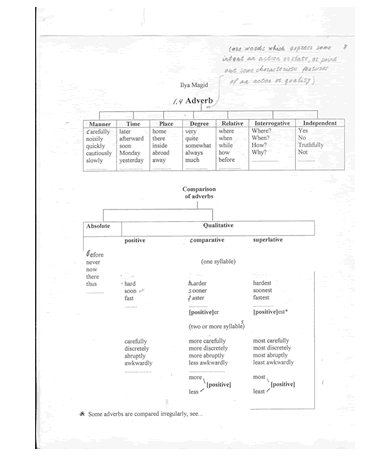
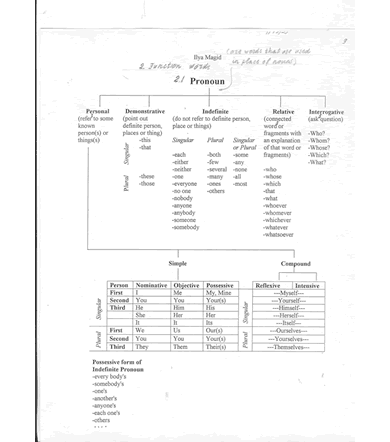
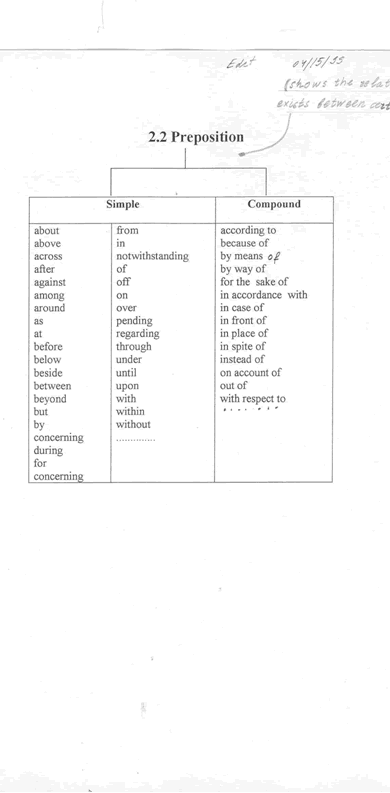
parts of Speech (grammar unit): Noun, Verb, Adjective, Adverb, Pronoun,
Preposition, Conjunction, Gerund, Participle, Infinitive, and Prepositional
phrase.
I know about the syntactic function of words in sentences (syntactic units):
Subject, and Predicate, and Complement: Direct Object, Indirect Object,
Subject Complement. I know about different kinds of Modifiers.
I know that the syntactic unit could be the different parts of speech
but the Predicate is always a Verb. In this division of Syntax we try
to use only syntax conception (terms) and did not use grammar conception
as Noun, Adjective, Adverb, etc.
There are considered the right American sentences. For simplicity there
are considered only complex declarative sentences.
Introduction
The
article Basis of Grammar is not traditional and is three chapters long.
In the first chapter, the parts of speech, we consider (grammar units)
nouns, verbs, adjectives, etc. In this chapter we don't refer to syntactic
units such as subject, predicate, complement, or modifier. Sentences are
considered consisting of only grammar units.
In the second chapter, syntax, we consider the syntactic functions of
words in sentences such as subject, predicates, complements, modifiers
or modifier of modifier. In this chapter we don't refer to any grammar
units. These are considered the correct English sentences for simplicity,
only complex declarative sentences.
In the sentences we create a question for each syntactic unit (each syntactic
unit required a definite question) to connect the syntactic units in the
sentences.
In the third chapter we are going to consider a connection between syntactic
units and grammar units. That chapter is not written right now. But in
the second Chapter, Syntax, you can see syntax units connected with different
kinds of Grammar units (see Patterns 1-22).
But the Predicate is always a Verb. There are three types of Verbs: Intransitive,
Transitive and Linking and respectively we have Intransitive, Transitive
and Linking Predicates. For each of them there is three types of sentence).
We thought when
'Part of Speech' and 'Syntax' are constructed in that way, they would
be mathematically more rigid and handsome. In that condition we would
be open to a new possibility in studying Grammar.
I changed some grammar definition, but we will explain in the text. Certainly
I bear only one responsibility for possible mistakes in that article.
The new view on grammar shown in this article would be helpful for improving
the reading and writing of adult ESL student. They could find syntactic
structure while reading and use it while writing.
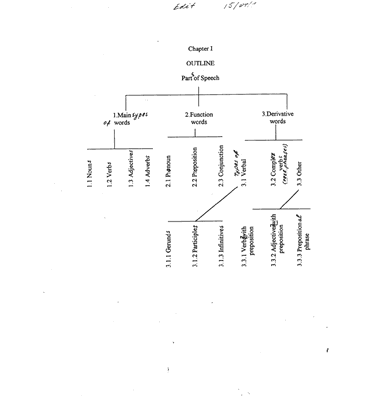
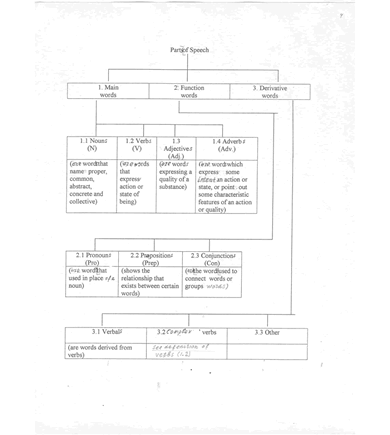
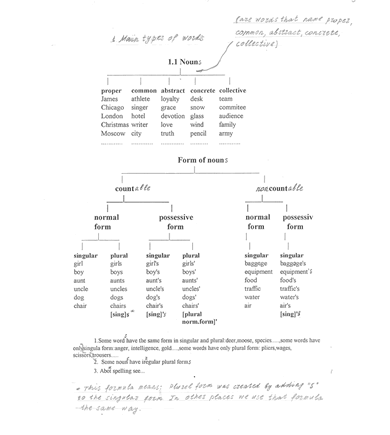
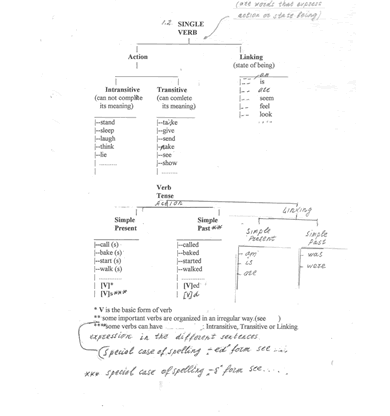
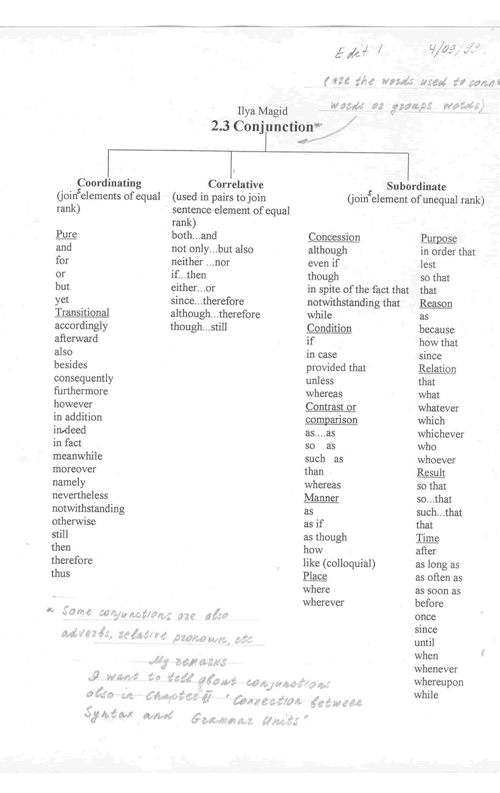
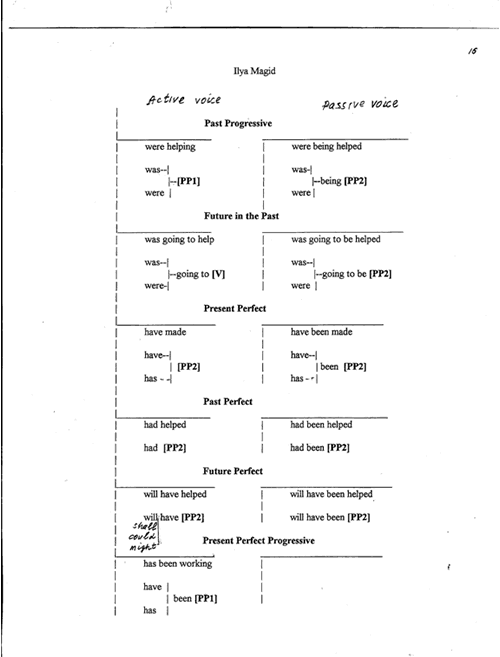
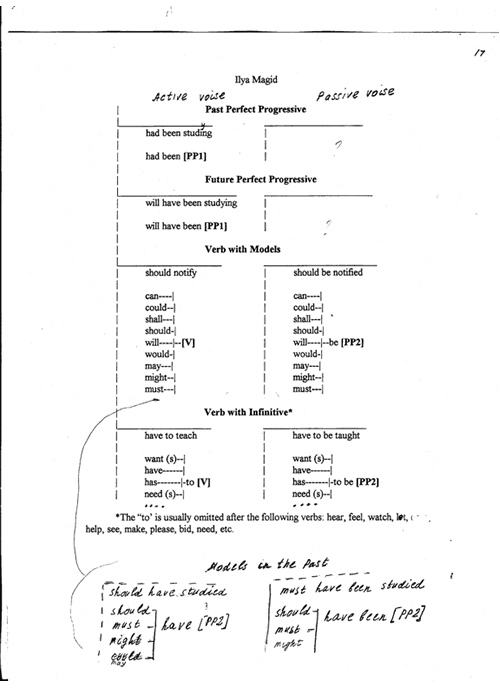
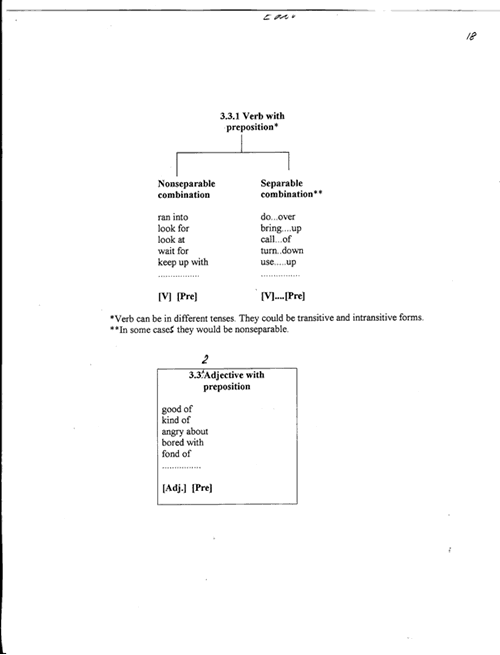
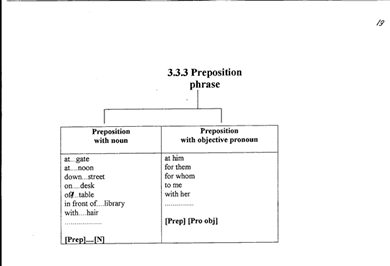
3. Derivative Words
|
3.1 Verbal |
3.2 Complex verbs |
3.3 Others |
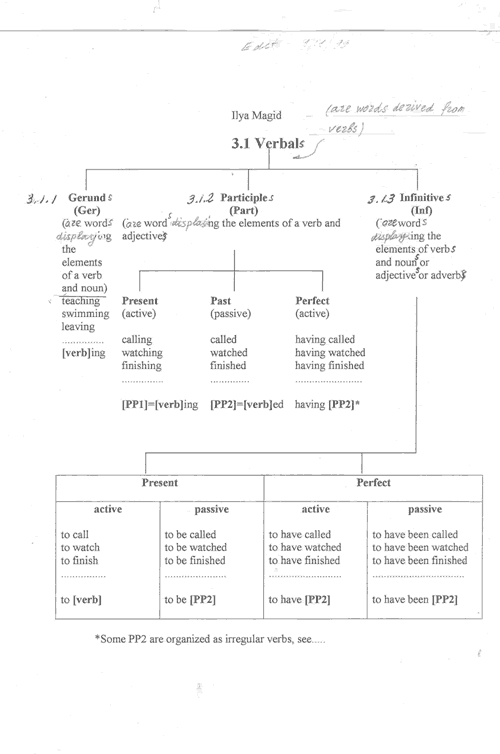
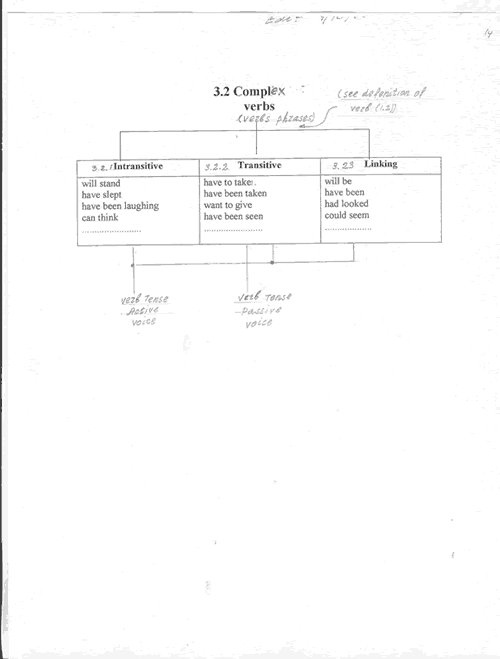
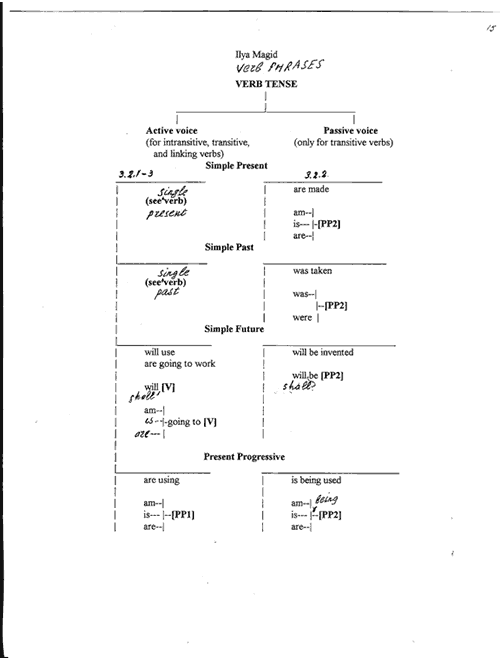
The end of chapter I.
Chapter II
SYNTAX
OUTLINE
A. Syntactic Unit in the Simple Sentences
1. Subject, Predicate and Complement
1.1 Subject (S) and intransitive Predicate (P)
1.2 Subject and transitive Predicate (P) with Complement:
Direct Object and Indirect Object
1.2.1 Subject and Predicate with the Direct Object (DO)
1.2.2 Subject and Predicate with the Direct Object (DO) and the Indirect
Object (IO)
1.3 Subject and linking Predicate with Complement: Subject Complement
2. Modifier
2.1 Modifier of Subject (S) or Complement: (Direct Object (DO), Indirect
Object (IO), Subject Complement (SC))
2.2 Modifier of Predicate
3. Modifier of Modifier
3.1 Modifier of Modifier Subject (S) or Complement (C)
3.2 Modifier of Modifier Predicate
B. Syntactic Units as Subordinated Clause
1. Subject as Subordinated Clause
2. Complement as Subordinated Clause
2.1 Direct Object
2.2 Direct Object and Indirect Object
2.3 Subject Complement
3. Modifier as Subordinated Clause
3.1 Modifier of Subject or Complement M(S,C)
3.2 Modifier of Predicate M(P)
4. Modifier of Modifier as Subordinated Clause
C. Syntactic Units in Special P* construction
Remarks 1
1. Syntactic Units as entire P* construction
1.1 P* construction as Subject
1.2 P* construction as Modifier S or C
2. Syntactic Units inside P* construction
2.1 Direct Object (DO) inside P* construction
2.2 Subject complement (SC) inside P*constructio
2.3 Modifier
P* (M(P*) inside P* construction
2.4 Direct Object (DO) as Subordinated Close inside P* construction
Remarks 2
About one case of Subject Complement (SC)
SYNTAX
A. Syntactic Unit in the Simple Sentences
1. Subject,
Predicate and Complement
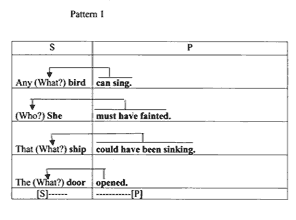
The Subject always answers the question: Who? or What?
The Predicate is completer of a sentence.
1.1 Subject (S) and intransitive Predicate (P).
1.2 Subject
and transitive Predicate with complement: Direct Object and Indirect Object
Complements complement the meaning of the predicate.
1.2.1 Subject and Predicate with the Direct Object (DO)
Predicate shows the action from the doers to Direct Object.
Direct object answers question What? or Who(m)?
Pattern 2
|
S
|
P
|
DO
|
| She | bakes | a (What?) cake. |
| He | likes | (What?) to write. |
| Martha | enjoys | (What?) painting. |
| I | love | (Whom?) her. |
|
[S]---
|
---[P]---
|
---[DO]
|
The object
usually refers to some person or thing other than the subject.
1.2.2 Subject
and Predicate with the Direct Object (DO) and the Indirect Object (IO).
Predicate shows the action from the doers goes to two objects: usually
the Indirect Object (Whom?) and the Direct Object (What?)
Pattern 3
| S | P | IO | DO |
| He | taught | (Whom?) us | his (what?) lessons. |
| We | gave | (Whome?) her | (What?) everything. |
| The librarian | read | the (Whom?) children | a (What?) story. |
| S | P | DO | IO |
| We | gave | (What?) everything | to (Whom?) her. |
| He | sent | a (What?) book | to (Whom?) John. |
| The tailor | made | a brown (What?) suit | for (Whom?)Edward. |
| [S]--- | [P]--- |
---[IO]--- |
---[DO]--- |
Fragment
from Chapter III
[If 'IO' follows 'DO' there appears a preposition 'for' or 'to'.]
The indirect object tells to whom the action is directed or for whom the
action is performed.
The indirect object usually refers to a person, but the direct object
usually refers to a thing.
1.3.
Subject and linking Predicate with Complement: Subject Complement (SC)
In that case the Predicate only renames the Subject.
We will consider subject and linking Predicate together.
The Subject complement answers a question: Who? or What?
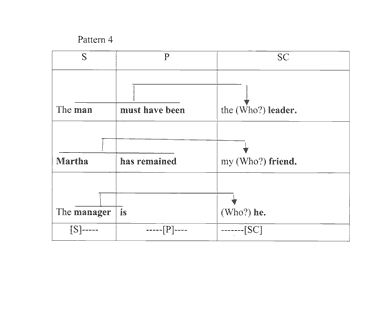
The Subject complement refers to the same person or thing as the Subject.
If Linking
Predicate is united with the Subject, you can ask a question ('What?'
or 'Who?') and receive Subject Complement. We receive a Syntactic Unit,
Subject Complement connected with a 'Predicate' ('Subject' and 'Linking
Predicate').
If a Linking Predicate is united with a Subject Complement you can ask
a question ('What?' or 'Who?') and receive Subject. We receive Syntactic
Units, Subject, connected with 'Predicate' Linking Predicate and Subject
Complement).
2. Modifier
Modifiers are words or groups of words, which add new ideas to the Subject
(S), or Complements (C), (Direct Object, Indirect Object, Subject Complement),
or Predicate (P).
2.1 Modifier of Subject (S) or Complement (Direct Object (DO), Indirect
Object (ID), Subject Complement (SC))-M(S,C))The Modifier M(S,C) answers
the question Whose?, Which one?, What kind?
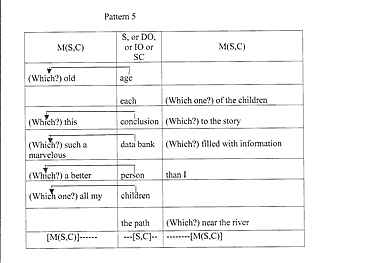
Remarks
concerning Pattern 1-4: In those sentences Subject connected with
complement (DO,
IO, SC) so they require are entire sentences; to be seen to Patterns 5-8:
S or DO or ID or SC connected only with modifier. It is enough to see
only part of sentences.
Fragment from Chapter III
[S or DO or IO or SC is Noun, Pronouns, etc. Their Modifier M(S,C), answers
question: Whose?, Which one? They are adjectives and some other phrases.
They can't modifier Predicate.]
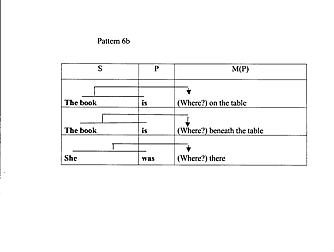
2.2 Modifier of Predicate
Answered question: How many?, How?, Where? When?, How often?, To what extent?
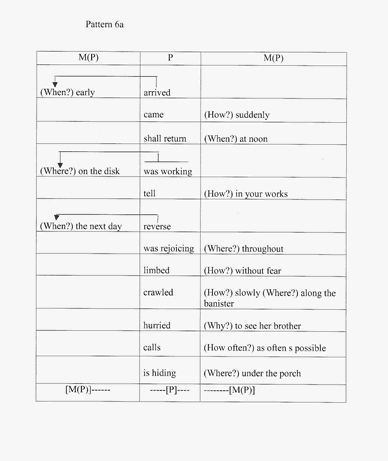
About Pattern 6b: sometime 'be' and other similar words are not linking Predicate but that 'linking Predicate' have only Modifier M(P). In that case we also consider Subject and 'Linking Predicate' together.
Fragment
from Chapter III
[Auxiliary Verbs are not syntaxes unit; they included in the Chapter I
.3.2 'Complex verbs']
3. Modifier of Modifier
Modifier
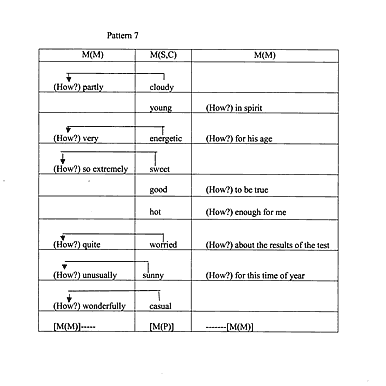
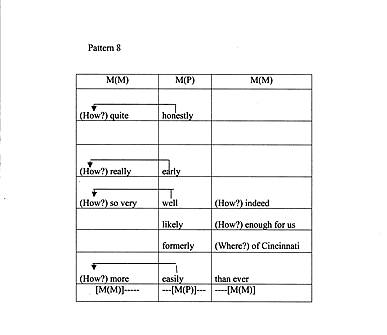
of Modifier M(M(S,C)) or M(M(P)) used to Modifier M(S,C) or M(P) accordingly.
They answered the question: How many? How?. It is similar to M(P) and
that question is a modifier M(M(S,C)) and M(M(P)) so
M(M(S,C))=M(M(P))=M(M)
3.1 Modifier of Modifier of Subject or Complement
Fragment
from Chapter III
[M(M) modifier M(S,C) answered question How many? How? are Adverbs, Adverb
Phrase.]
Fragment from Chapter III
[Exempla: He is very nice man.
He is (who? man- Subject Complement (SC) (noun),
man (which?) nice-Modifier Subject Complement (MC) (adjective)
nice (how?) very-Modifier Modifier M(M(C)=M(M) (adverb).]
3.2 Modifier of Modifier Predicate
Fragment
from Chapter III
[M(P) modifier P answer question how? How many?, How often? are Adverb,
Adverb phrase;
M(M) modifier M(P), answer question: How? How many? are Adverb and other
similar phrase.]
B.
Syntactic Units as Subordinated Clause*
_______________________________________________________
* (Each
clause could be investigated the same way as simple sentences)
________________________________________________________
1. Subject as Subordinated Clouse
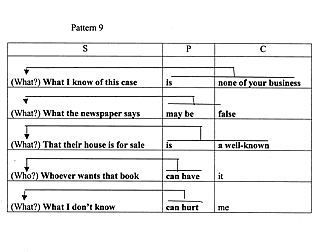
In Pattern 9 in the first 3 lines we consider Linking Predicate and Subject Complement together
2. Complement as Subordinated Clause
2.1 Direct Object
Pattern 10
| S | P | DO |
| I | knew | (What?) that she wuold be here soon |
| I | know | (What?) that you lied |
| I | bought | (What?) what you told me |
| I | argued | about (What?) how much he knew |
2.2 Direct Object and Indirect Object
Pattern 11
| S | P | IO | DO |
| The director | gave | (Whom?) whoever was there | the (What?) assignment |
| DO | IO | ||
| you | gave | (What?) tools | to (Whome?) whoever can use then best |
2.3 Subject Complement
Pattern 12
| S | P | SC |
| This | is | (What?) where I came in |
| Liz | can be | (What?) whatever she wants to be |
In this case Subject and Linking Predicate consider together.
3. Modifier as Subordinated Clause
3.1 Modifier Subject or Complement M(S,C)
Pattern 13
| S or C* | M(S,C) |
| son | (Which?) whom you have never met |
| the house | (Which?) you talked about |
| the book | (Which?) that you ordered |
| men | (Which?) who are thinkers |
| the boy | (Which?) to whom they gave the camera |
| books | (Which?) which we recently enjoyed |
| these facts | (Which?) you are divorced |
* Complements 'C' are 'DO' or'IO' or 'SC'
My remarks
When M(S,C) answer question Which?, etc. it connected with S or C. There
don't consider whole sentences.
3.2 Modifier of Predicate M(P)
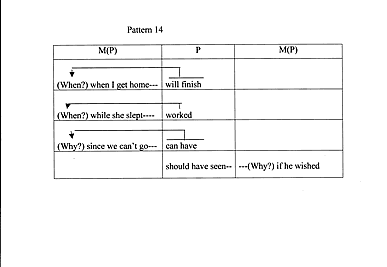
My remarks: When M(P) answer question When?, Why? it connected with P
4 Modifier of Modifier (M(M)) as Subordinated Clause
Pattern 15
| M(S,C) or M(P) | M(M) |
| higher | (How?) than I |
| earlier | (When?) than we expected |
| later | (When?) than it usually is |
C. Syntactic Units in Special P* construction
Remark 1
Some
words express action or state of being but they are not Predicates. We
will be named (P*). They could have complements (DO, IO, SC), modifier
(MP*) and subordinated clauses. But entirely construction in the sentences
could use as Subject (S), Direct Object (DO), Indirect Object (IO) and
Subject Complement (SC)
1. Syntactic Units as entire P*construction
Here are some examples when P* construction acts as a syntactic unit in
the sentences
1.1 P* construction as Subject
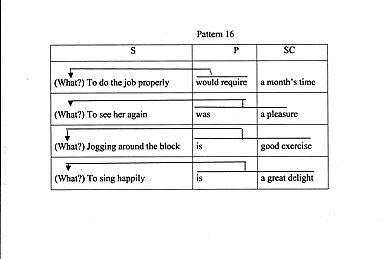
In pattern
16 in the last 3 lines we consider P and SC together
.
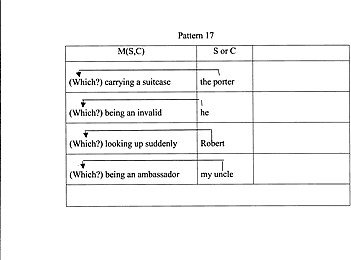
1.2 P*
construction as Modifier S or C
2. Syntactic
Units Inside P* Construction
There are some examples when P* construction have syntactic units inside.
2.1 Direct Object (DO) inside P* construction
Pattern 18
| P* | DO |
| carrying | (What?) an american flag |
| driving | (What?) that car |
| to play | (What?) the harp |
| to secure | (What?) attention |
| knowing | (What?) preference |
| to buy | some (What?) clothing |
2.2 Subject Complement (SC) inside P* construction
Pattern 19
| P* | SC |
| being | (What?) an ambassador |
2.3 Modifier P* (M(P*) inside P* constraction)
Pattern 20
| P* | M(P*) |
| loaded | (How?) with baggage |
| singing | (How?) before a crowd of people |
| to be | (How?) alone |
| to drive | (How?) fast |
2.4 Direct Object (DO as subordinated close inside P* construction)
Pattern 21
| P* | DO |
| knowing | (What?) what you like |
| to buy | some thing (What?) I need |
Remark 2
About one case of Subject Complement (SC)
Sometimes Subject Complement exist only by default
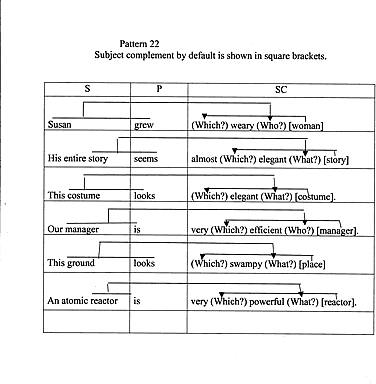
Fragment from Chapter III
[1. Subject Complement can be a noun
Tuesday is my birthday.
2. Subject Complement can be a pronoun
He is one of the best players.
3. Subject Complement exists by default
The apple tastes sour [apple]]
The end of Chapter II
|
This
site created and maintained by Larisa Luvish-Trell
|
|
Email
to Larisa Luvish-Trell
with questions or comments about this Web Site.
|