
This article was written
by Ilya Magid in Russian, Alef #763 Nov 1998, and translated into English
by Irina Magid
Editors: Steven C. Siegel and Dan Smollens
Meetings with Joseph Sivashinsky
RECOLLECTION ABOUT A PHOTOGRAPH
When
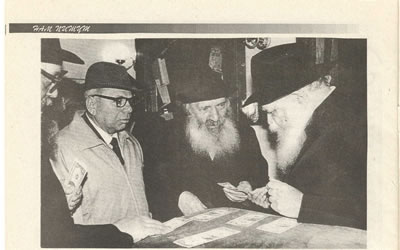
I visited my neighbor, Joseph Sivashinsky, I saw photographs on a wall
(see below). In one photograph there was depicted (from right to left)
the 7th Lubavich Rabbi, Menachem Mendel Shneerson, Joseph David Neimotin
and Joseph Sivashinsky. They were photographed in 1989.
About Menachem Mendel Shneerson, 7th Lubavich Rebe, there has been extensive
literature.
About Joseph Neimotin, Joseph Sivashinsky's cousin, and about other people
around him Joseph Sivashinsky told the following things:
Joseph Neimotin lived in a religious family in Leningrad. His father (uncle
of Joseph Sivashinsky) Samuel Neimotin, in order to keep the Sabbath,
worked at home for a team which produced clothing. He worked on a 400
needle-machine, producing knitwear. He was supplied with raw materials
through the team, which then took away the finished product.
They regularly went to the only Synagogue in Leningrad and brought home
Hassidic literature. To pray on the Sabbath, they, like other religious
Jews, met at someone's apartment because the Synagogue was too far from
their homes and they couldn't walk there. It was very dangerous because
illegal keeping of religious customs was punishable by imprisonment. Samuel
Neimotin always criticized Soviet power for unjust laws (abuse of human
rights.)
In 1935 Joseph Neimotin became severely ill with volvulus. His father
mailed a telegram to his Rabbi, the 6th Lubavich Rabbi Joseph Shneerson
who lived in Riga, (Latvia)* at that time with the request to save his
son (maybe to send some medicine).
__________________________
*At that time Latvia wasn't included in the Soviet Union.
It was a foreign state. All foreign mail went through censorship.
___________________________
After that Samuel Neimotin was locked up in jail; his relatives announced
in 1937 that Samuel Neimotin had been shot for religious activity and
practicing Hassidism. After WWII we learned that he died in Kolyma, Siberia.
Joseph Neimotin continued to work at home on a 400-needle machine until
he managed to leave the blockaded city of Leningrad in 1942 and went to
the city of Alma-Ata, Kazakhstan. There he met the father of 7th Lubavich
Rabbi Levi Itzhak Shneerson and his family.
"Levi Itzhak Shneerson
was a Rabbi in Dnepropetrovsk. In 1939 at 3:00 a.m.
officers of the NKVD came to arrest him. The court sentenced Rabbi
Levi Itzhak to 5 years of exile to Middle Asia. The place of exile was
the settlement Tchily in Kazakhstan.
Only in the last
year of exile was he permitted to be in Alma-Ata, surrounded
by religious Jews."
(See ALEF #698, August 17-23, 1997)
Joseph Neimotin served Rabbi Levi Itzhak Shneerson until his death in
1944 and took part in the Rabbi's burial.
After WWII in 1946 Joseph Neimotin, with a group of Jews, tried to leave
the Soviet Union for Poland. They tried to use false documents which stated
that they had been citizens of Poland before WWII. From Poland it was
possible to go to any country, for example to USA or Israel*.
______________________
*The migration of Soviet Jews to Israel began in the 1970's.
That immigration was possible early in 1946 only for former Polish citizens,
who had come to the Soviet Union as a result of WWII. They received permission
to leave the Soviet Union to return to Poland.
______________________
However, somebody reported them to the NKVD. All these people were caught
and arrested. Joseph Neimotin was condemned to 8 years of prison. He worked
in Siberia (Kolyma) as a lumberjack. After liberation he returned to his
family in Alma-Ata. In 1979 Joseph Neimotin with his wife and children
emigrated to America. The 7th Lubavich Rebbe Mendel Shearson met them
in New-York. Joseph Neimotin told the Rabbi about the last days of his
father and about his burial according to the Jewish tradition.
Joseph Neimotin died in 1991. In September, 1991 the magazine "ALEF"
published a tribute to his memory.
Episodes
associated with the life of Joseph Sivashinsky, the third person in the
photo: Joseph Sivashinsky was born in 1914 in Leningrad. His father Moisha
Sivashinsky was a shochet and mohel. He also worked at a slaughterhouse
as a meatcutter.
Joseph Sivashinsky had studied for a few years at an illegal cheder. In
1926 his father was declared a "lishenetz",* a participant in
a religious cult.
________________________
"Lishenetz" is the term for persons who were
deprived of the right to vote, to study or to work; those persons didn't
have any documents. "Lishenetzes" were declared workers of a
religious cult and former proprietors. A list of "Lishenetzes"
was hung out for general review. Most of them were arrested or exiled
from the big cities, (more then 101 kilometers from those cities).
_______________________
His children lived with relatives because his parents were afraid that
they together with their children would be deported from Leningrad. Joseph
lived at that time with his uncle Semen Sivashinsky.
His aunt Fanja helped Joseph to enter a factory-and-workshop school at
the lumber plant. (She knew the director of the lumber plant, Sofronov.)
All students in the class were in komsomol*.
___________________________
*Komsomol is an acronym for the words "Young Communist
League."
____________________________
They asked Joseph why he wasn't in komsomol? Joseph couldn't tell the
truth: he was a son of a "lishenetz" and that was the reason
why he couldn't be accepted into komsomol. But later Joseph entered komsomol,
by not revealing his social origin. Once at the dinner time Joseph said
that he had entered komsomol. It was at the home of his cousin Akiva.
After that Akiva went to the Komsomol District Committee and announced
that Joseph Sivashinsky was a son of a "lishenetz". Akiva explained
his action, "a Komsomoletz has to be honest and never lie!"
Joseph was expelled from komsomol, and in the factory-and-workshop school
there were hung placards which denounced him. It was only due to the director
of the plant that Joseph wasn't excluded from the school.
After graduating from the school Josef was sent to a job* in the town
of Kirishi at the woodworking plant (101 kilometers from the city of Leningrad.)**
______________________
*In the former Soviet Union each student who graduated
from college, factory-and-workshop, etc was assigned to a job for 3 years
by the government.
**The former prisoners and unwanted persons were forbidden to live the
big cities. They could live only far from the big cities, at a distance
of at least 101 kilometers.
________________________
He had to work there for three years. Joseph lived in barracks together
with former felons. His brigadier was from the former Kazaks. Joseph remembered
vividly only one phrase from the stories that he recounted later, "I
cut off the head of a kike, but he continued to run."
At that time there were often reviews of the records of communists ("cleanings").
The commission was interested in the social origin of communists (who
are his parents) and also it was necessary for a member to show knowledge
of the history and politics of the communist Party. If somebody didn't
pass "cleaning", he would lose his Party membership and even
lose his job, especially if he had a major function.
Before "cleaning", the Chief Mechanic of the plant came to Joseph
and asked him to teach lessons about politics and the history of the communist
Party. Maybe as a result of this teaching the Chief Mechanic passed "cleaning".
As thanks for the teaching he asked Joseph what he could do for him. Joseph
asked that he be discharged from the plant with the status: "downsizing"*.
_________________________
*In the former Soviet Union each working man had a labor
book (service record) where it was written where and when he did his work
and why he was discharged (because of heavy drinking, or absenteeism,
or downsizing or other reason.) For Joseph it was a good reason for being
discharged: downsizing, because it allowed him to obtain another job.
_______________________
I
t was very difficult, because Joseph had to have worked for 3 years but
the Chief Mechanic was able to get that status for him. Joseph could have
worked in Kirishi only two months.
Joseph returned to Leningrad and enrolled in work at the Halturin lumber
plant (The plant was named in honor of a known revolutionary, Halturin).
In a short time Joseph was called to the court. He was sentenced; "He
left his job without a permit, and he was pursued throughout the entire
the Soviet Union." Joseph showed a document about his status, "downsizing",
and his case was dismissed.
Joseph's father (Moisha Sivashinsky) could have been exiled as "a
lishenezt", but he wasn't exiled because he was a worker at the national
meat combine. In 1928 Moisha Sivashinsky was locked in jail together with
many others who were suspected of having gold. The cells of jails were
overcrowded by the many suspects. They had to denounce any other persons
also who had gold. Moisha Sivashinsky was in jail only one weekend, and
then he was liberated. He died in Leningrad in 1953.
Joseph Sivashinsky with his family emigrated to America, Boston, Mass
in 1987. When Joseph Sivashinsky visited his cousin Joseph Neymotin in
New-York, they met with Rabbi Mendel Shneerson and took a picture.
About Rabbi Evsey Neymotin (1853-1941), the grandfather of Joseph Neymotin
and Joseph Sivashinsky it is known that he (the father of Hanna, mother
of Joseph Sivashinsky) was a contemporary of the 6th Lubavich Rebbe Joseph
Yitzhak Schneerson. They were not rich people. They got a salary as State
citizen Rabbi.
They were Chassidic, followers of the Balshemtov and dispersed Chasidim.
They hold discussions with the other major religious school, the misnagdim.
They created Chassidic Yeshivas: in one of them the son of Evsey Neymotin,
Samuel Neymotin studied.
Under both Rabbi Joseph Shneerson and Evsey Neymotin there were many writings,
some of which were saved and will be published. (The writings were placed
in the office of Rabbi Zalman Chanin.)
In the 20's religious life was destroyed by the communists. Evsey Neymotin
left the town of Vitebsk for the city of Leningrad in order to join his
daughter Hanna. In 1942 he died in the blockade of Leningrad. Joseph Neymotin
and Joseph Sivashinsy left blockaded Leningrad after the death of their
grandfather. Then Joseph Neymotin came to the town of Alma-Ata and Joseph
Sivashinsky was assigned to work in another town.
So there were connected the fates of Joseph Neimotin, his father Samuel
Neymotin, Joseph Sivashinsky and his father Moisha Sivashinsky, and their
grandfather Evsey Neymotin with the 7th Lubavich Rabbi Menachem Mendel
Shneerson, his father Rabbi Levy Itzhak Shneerson and the 6th Lubavich
Rebbe Joseph Itzhak Shneerson.
|
This
site created and maintained by Larisa Luvish-Trell
|
|
Email
to Larisa Luvish-Trell
with questions or comments about this Web Site.
|