
Voting in the Soviet
Union
Result of Voting
In the Soviet Constitution the Supreme Soviet of the USSR had sovereign
power. The Supreme Soviet had two houses: the Soviet of the Union and
the Soviet of the Nationalities. The Supreme Soviet approved the Government
budget, laws, etc. The Supreme Soviet discussed the legislation and it
always came to a unanimous conclusion.
Voting for the Supreme Soviet took place every four years. In the Soviet
of the Union one deputy was elected by 300,000 voters; in the Soviet of
the Nationalities an equal number of deputies from each of the (15) Soviet
Republics was elected. There was proposed for election only one candidate
"from blocks of communists and not party people."*
_________________________________
* It is a big paradox. All the Soviet people could be divided
only two categories: communists and non-communists. (Other parties besides
the Communist party were forbidden). In reality a single condidate was
proposed and confirmed by the communists.
______________________________
In the election of the Supreme Soviet nearly 99.5% of the voters participated.
The result of the voting was 99.97% "yes" for the candidate
from the "blocks of communist and not-Party people"
Such a high percentage contradicts human nature.
Russian emigrants right now criticize the Soviet Union, but when they
lived there they also voted "yes". (I hope that most of them
were not communists.)
How can you explain those votes?
2. The Voting Process
In the Soviet Union voting was a very important event although communist
could spent nothing on a campaign. (See below)
Two months before the date of voting the regional committee of the Communist
party organized the voting commission and directed its members in their
duties. They were released from their jobs for that time.
The voting sites were open from 6:00 AM to 12:00 AM midnight. They were
located in schools and other government buildings. Each dwelling was assigned
to a certain voting site.
I will tell you about my experience in voting. I went to the school where
the voting site was. Three of the four floors were used for voting. In
the first floor they sold some nice things and food which were usually
hard to buy in the shop. I went, for example, to the second floor. (See
figure) I went to the entrance. There were in front of me two cubicles.
In each cubicle, instead of the door, there were two pieces of material
to clouse the cubicle. No pencil was provided. You had to have your own
pencil.
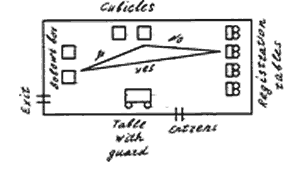
The figure is a schematic portrayal of a voting hall
On the right side there stood four tables with maybe 10 people where you
could receive the voting ballot. You showed your passport; they checked
you off on the paper and gave you two bollots: one for voting for the
candidate in the Soviet Union (one candidate) and one for voting for the
candidate in the Soviet Nationality (one candidate). Opposite the voting
booths there was a table (left side of entrance where a woman with a red
arm band and a police officer sat. They watched very intently each person.
On the left of entrance, across from the registration table there were
two ballots boxes.
For a vote of "yes" you had to take the ballot from the registration
table to the ballot box and leave from the other exit.
If you went to a booth you were choosing to eliminate the Soviet rule
. You would vote "no". You had to be as courageous, as a revolutionary.
If I did not go to vote a guard would go to my home. (I heard that they
could tell about that in your plant). They took ballot boxes to the homes
of ill people. The guard could not finish his job until his absentee voters
all voted.
I thought, if you were required to go into a booth there would be a secret
vote and then the vote to eliminate the candidate would not be 0,03% but
20%. (Nobody could say or write anything against the candidates before
voting.)
That was the only procedure.
I thought also that a member of a commission at the voting polls could
have changed a ballot with an eraser and the other member of the commission
would have pretended not to have seen that because they did not have opposition.
The election district contested one with other. A bad result was bad for
the commission. They could lose their jobs. The people who wanted to get
into the "nomenclatur" were more than the number of positions
available.
I thought that I saw only the tip of the iceberg, but what I saw confirmed
the overwhelming authority of the "party".
|
This
site created and maintained by Larisa Luvish-Trell
|
|
Email
to Larisa Luvish-Trell
with questions or comments about this Web Site.
|