
A German commanded, "Kike step out of the line. "If the Jews did not move quickly, Russian and Ukrainian soldiers pointed them out and then the Jews were killed in front of the line of soldiers.
Sometimes Jews said that they were Tatars (Tatars are circumcised at 13 years of age.) If the Germans did not believe them, they were sent to the German doctor, who ascertained, whether it was done at 13 years old or on the 8th day.
JEWS IN WORLD WAR II
(The Soviet Union, 1941-45)
Semen (Shimon) Portnoi, born in 1910 in Odessa told me the basic elements
of that story
Ilya Magid
Editors Steven Siegel and Dan Smollens
Boston
1999
Outline
1. The Portnoi Military Way
2. The Mine Thrower Regiment
3. Problem of Some Jewish Soldiers
4. Jews in the Regiment
5. First Military Episode
6. Second Military Episode
7. Third Episode
8. Fourth Episode
9. Fifth Episode
10. Psychological Attack
11. War's Fortune
12. Sandomir's Foothold
13. The Commandant of the German Town of Gerliadorf
14. About Lend-Lease
Vignette
V1. Opinion about Jewish Soldiers in the Soviet Union
V2. Event under Retreat
V3. Case in the War
V4. Meeting on the War's Road
V5. Soldiers on Forefront
Conclusion
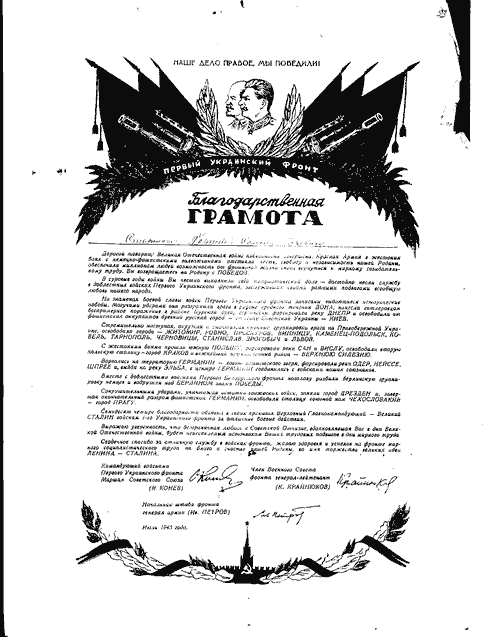
Testimonial Charter (Translated into English)
Original Testimonial Charter (Scale 1:2)
Supplement
S1. Portnoi Before War Time
S2. Portnoi After War Time
1. THE PORTNOI MILITARY WAY
Portnoi was a highly skilled soldier. He was drafted into active service
in 1929 and directed to serve on guard duty for the prisoners.
On the first day of W.W.II with Germany (1941) Semen Portnoi was drafted
into the army. He found himself in (later named) the First Ukrainian front
(more than one million soldiers.) He was in the 18th army (more than 300
thousand soldiers) where Colonel Breznev was the commander of the political
department. Breznev was to become president of the Soviet Union.
First, Portnoi was directed to report to commander Yelzin of the control
station of the Southern front, as his orderly. This Yelzin is not the
same as the current president of Russia. There arrived trains with weapons,
food, etc. They distributed the supplies among the military units. Very
soon the commissar, a gypsy, arrived. He ordered that Portnoi be sent
to the front.
Then Portnoi was assigned to the 54th battalion of the 34th division.
In the second battle Portnoi was wounded in the leg. (A bullet wound was
more honorable than, for example, wound from fragments of shells. It meant
that he saw the Germans face to face.) After the hospital he was assigned
to the 180-reserve regiment. The officers arrived there. They chose soldiers
for commission in their regiments.
Portnoi was taken to the 569th mortar regiment, (later cited for medal
of Suvorov, Aleksandr Nevski, Kutusov) the reserve of the main command,
where the commander was a Jewish major whose name was Zilberberg. Their
regiment was part of the group that participated in breaking the German
front. There were 200 soldiers among whom were 12 Jews. The regiment had
two squadrons, each squadron had two batteries, and each battery had 5
mortars. The food in that regiment was considered first class, the same
that the air force received. They provided more than the norm of 100 grams
of vodka for each soldier and additial 5 biscuits for officers.
7 soldiers served one mortar. Their batteries were located about 800 meters
from the front. At rear of the regiment there were its politicians and
support personnel.
Their commander, Zilberberg, deleted the Jewish families from the list
of those to receive medals. (It was no so good if the list had many Jewish
families.) Portnoi served from the beginning of 1942 until 1943 under
his command. Zilberberg was wounded in two legs with shell fragments when
he secured the battery in its position.
The next commander of the regiment was a Siberian lieutenant Colonel,
Uvarov. While he was driving a Willis, shells hit him. Then the commander
of the regiment became Lieutenant Colonel Karpov. Under the two last commanders
there was no discrimination against Jews.
At first Portnoi was a soldier in the battery. He carried the shells;
then he became the sergeant. Under Karpov he was promoted to sergeant
major. He commanded 40 soldiers. His duties were organizing the meal service,
clothing supplies and checking the condition of the trenches. He checked
the dugouts, which had a roof of three layers of logs.
Portnoi ended the war in Berlin. After the allies (including Russia) defeated
Germany and they all signed the articles of surrender Portnoi's army went
to Prague, where the troops of field Marshal Sheer opposed the agreement.
Portnoi had two orders of the Red Star, one medal for Courage, one medal
for battle and many medals for capturing cities.
Portnoi told me that he rarely could connect his reward with specific
military episodes. An executive sent the list of the soldiers to Moscow,
who would receive the medals; then they sent the medals to the regiment.
Only 28 out of the original 200 soldiers including Portnoi were in the
regiment at the end of the war. All the others had been wounded or killed
and went away for other reasons.
Major Zilberberg, after being in the hospital, was promoted to commander
of an artillery corps, and he fought until the end of the war. He obtained
the rank only of colonel, although he performed duties, which were at
the rank of general. After the war he returned to the hospital again,
where he died from military wounds.
2. THE MINE THROWER REGIMENT
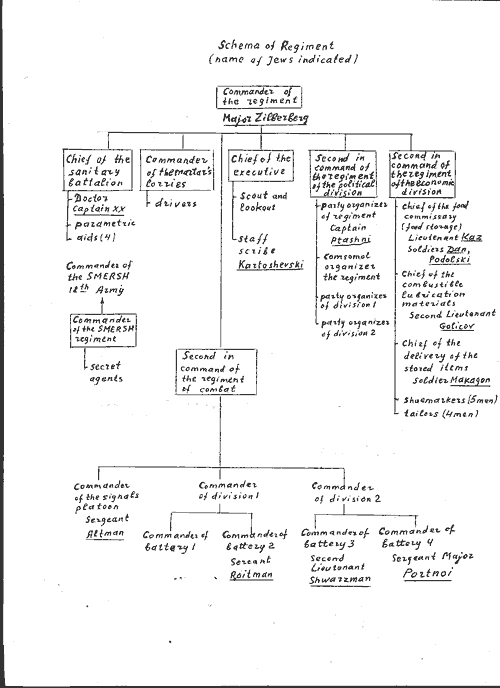
The scheme of the mine thrower regiment where Portnoi served is presented
later. There was indicated the units of the regiment and also the names
of Jews in the units in which they served
What is the mine thrower? The mine thrower is a kind of artillery; it
is an artillery piece for throwing fire. The mine thrower is a pipe, which
is fixed to a metal circular plate. The plate has from below a ribbing
for connection to the earth. The pipe is supported by a metal tripod,
which allowed change of direction of the pipe. The mine to the mine thrower
is like a shell but it has on the end a director (trail plumage). The
weight of the mine is 8 kilograms.
The mine is set in a pipe on top. There was a pin in the base of metallic
plate. When the mine reached the base of the plate the pin strikes an
exploder of the mine, and it shorts out from the plate.
Batteries are located a distance of 800 meters from the front lines. The
range of the mine thrower was 800 meters. If it was necessary to increase
the distance more than 800 meters, they attached a special ring-shaped
bag with gunpowder above the director of the mine. They could put up to
three additional bags. That ensured a distance of 2.5 kilometers.
Near each mine thrower they dug two cellars, one for demolition of the
mine, and the other for fragmentation of the mine (last used against the
infantry). Seven soldiers attended the mine thrower: loader, three assistant
loaders, etc.
Each battery had 5 mine throwers. The mine throwers were located at a
distance of 200 meters apart. The battery occupied one kilometer on the
forefront. Four batteries occupied 4 kilometers. There was a depth of
3 kilometers for the regiments on the field. The rear of regiment was
located no more than 3 kilometers from the forefront of the regiment.
Usually the mine thrower regiment was connected with the infantry regiment
(3000 soldiers) or division (20.000 soldieries). If it was necessary to
put into effect some temporary jobs, the infantry regiment provided soldier
for them.
3. PROBLEMS OF SOME JEWISH SOLDIERS
My son-in-law's mother told me a story. Her uncle was in the war with
the rank of Lieutenant. At one time they stopped receiving letters from
him. The relatives sent an inquiry to different military levels. He was
not on the lost or missing lists.
Six months after the war his colleague, a Jew, who served in his unit,
came to their apartment and said, "I have the duty to report to you:
when we went to attack, somebody from our soldiers shot him in the back."
Maybe the military made an investigation. Later the family received the
notice, "He perished in the line of duty." He was killed two
weeks before the end of the war.
Portnoi commented on this story, "Among the troops on the First Belorussian
front, where commander Marshal Zukov of the Soviet Union was, there were
more anti-Semitic incidents than in our front where there was the intellectual
commander Marshal Konev
Some Jewish soldiers tried to conceal their nationality. Where they were
able to do so, their lives became better. The soldiers' nationality was
written in the document called the "soldier's book" (for an
officer in his "officer's book".) The commander of the unit
also had a list of his soldiers' names with indication of their nationality.
There were many illegal ways to change their nationality. For example,
after being in the hospital a soldier received a document about his wound,
which did not indicate nationality. In his newly assigned troop he could
say, "I lost the soldier's book." Then they could write a new
soldier's book, from the medical document about the wound, where they
could indicate another nationality. If you were discharged from the army
you could receive a passport with an indication of Russian nationality.
Mark Zaluk, a veteran, told me, "In 1947, when I was discharged from
the army, my commander (I had a good relationship with him) said to me,
'I could give you a Ukrainian document', but I refused to accept that."
Evsey told me the following story. After the war he, as a veteran, met
with other veterans of his division. There arrived the daughter of the
deceased executive of that division. The veterans were surprised that
she was a Jew. They thought that her father was Russian. She told a small
number of them that the leaders gave her father a document stating that
he was Russian before he was assigned as the executive of the division.
Portnoi thinks that the chief of the regiment's medical unit, Captain
XX, was a Jew. When he spoke only with Jews he spoke in Yiddish. He explained,
"I was drafted from the town of Viniza and I learned Yiddish there."
He looked like a Jew. Portnoi developed close relationship with him under
the following circumstances.
That was in 1942 when Portnoi had a problem with his feet. The skin on
his feet pealed off because he could not take off his soldier's high boots
for many days. He went to the chief of the medical and sanitary battalion
(Medsanbat), Captain XX, who told him, "You have to go to Madsanbat
about this some day". Portnoi was ashamed to ask the commander of
the battery about that. In each battery there was one nurse. She went
to his commander and told him about Portnoi's case. The commander made
her a promise. The doctor told him, "warm up his feet in the sun."
After Portoi's recovery, the Captain asked him, "bring me two cans
of American stew." Portnoi took him those cans from the food storage
where he had friends.
Later Captain XX was killed by a direct hit from a shell in the area of
Medsanbat. Portnoi assisted in the funeral. There was big crater created
by that shell. Portnoi organized the local inhabitants to place all the
bodies in the crater. Then they erected a wooden pillar and attached to
it a message, which said, "Chairman of kolchoz: erect a monument
hears." After that they fired in to the air with their automatic
weapons.
Portnoi told me about an incident in his regiment in Czechoslovakia in
1944. When replacement soldiers arrived, they were assembled in the dining
room. Portnoi passed nearby. One soldier told other soldiers, 'He is a
kike." Portnoi turned back and commanded him, "Stand up."
Other soldiers also told that soldier, "to stand up because the sergeant
major had commanded him." When he stood up Portnoi hit him in the
face. (He could have killed him, but he thought that it would have result
in a long hearing. They could have sent him to a 'penalty battalion',
i.e. true death.) Second Lieutenant Odnorog the regiment's SMERSh commander,
ran to them, "What is happening, Portnoi?" He told the lieutenant
everything and Portnoi did not see that soldier in the regiment anymore.
4. JEWS IN THE REGIMENT
Each Jew could tell an individual story, about many things that Portnoi
did not know.
4.1 SECOND LIEUTENANT GOLIKOV, LIEUTENANT KATZ, SOLDIER PODOLSKI, SOLDIER
AND LATER LIEUTENANT DON, SOLDIER MAKOGON.
Second Lieutenant Golikov, Lieutenant Katz, soldier Podolski, soldier
Don, soldier Makogon obeyed Zukov (a strong anti-Semite) the second in
commander of the regiment of the economic division (see plan of regiment).
Second Lieutenant Golikov was chief of combustible- lubrication materials
(GSM). He had under him some soldiers who operated a gasoline tanker,
which also carried containers with grease.
Lieutenant Katz was chief of the food commissary regiment (Nachprod).
He commanded soldier Podolski, chief of food storage. (In peace times
Podolski was at Kharkov tractor plant where he worked as chief of vegetable
storage.) Lieutenant Katz also commanded soldier Don, a worker of food
storage. (In peaceful times Don was in the city Stalino where he worked
as chief of the trade division of the City Soviet (of People Deputies).
What was the procedure of the operation? Lieutenant Katz arrived at the
central storage and wrote an invoice at the details of the operation.
After that, Don came with a car and loaded the food products and took
them to Podolski. Podolski transferred them to a sergeant major for his
batteries. (If it was necessary, the chief of the food commissary could
ask soldiers to temporarily help the executive or commander of the regiment.)
The sergeant major organized the distribution of the soldier's food. In
the battery there was a copper pot for cooking. Once a day soldiers (and
officers) ate warm food.
Second Lieutenant Lichmanov was chief of the division of delivery of the
stored items. One of his soldiers was the Jewish soldier Makogon.
In the beginning of the fall 1941 during the general retreat of the Soviet
troops, second Lieutenant Golikov and Lieutenant Katz absented themselves
from the regiment for two days and appeared on the third day. At that
time Stalin's order was in force: "If a soldier was absent from the
troop more than one day he was a deserter".
The Chief of SMESh, captain Alecsandrov, ordered to kill the two Jewish
soldiers as deserters. Portnoi thought that the commander of the regiment
Zilberberg understood that they could have gotten lost and that they had
not thought to surrender to the Germans. They had to leave the regiment
for legitimate duty. The commander of the regiment, Zilberberg, together
with the second in command of the regiment under the political division
(commissar), Lieutenant Colonel Rizov, departed for the headquarters 18th
army to chief of the SMERSh of the Army. After a few days the chief of
the SMERCh of the regiment, Alexsandrov, was recalled. In his place there
was sent the chief of the SMERSh regiment, second Lieutenant Odnorog.
(Portnoi thought that Odnorog was not an anti-Semite.)
At a later time commander of the regiment Zilberberg (maybe it required
a second in command of the regiment of the economic division Zukov) assigned
the three Jews, chief of food storage soldier Podolski, soldier of food
storage Don, and soldier of the storage items, Makogon, to Portnoi's battery.
After their assignment to the food supply of the regiment, the quantity
of food was reduced. In the end the soldiers of the regiment were given
only pearl barley. The soldiers went out into the pastures. They collected
potatoes and vegetables in the field.
In that time commander of the regiment Zilberberg was wounded in the feet
and he was sent off to the hospital. The new commander of the regiment
was Siberian Lieutenant Colonel, Uvarov. Under the new commander of the
regiment the second in command of the regiment of the economic division,
Zukov, was assigned to other troops of the 18th army. The new second in
command of the regiment of the economic division was Captain Markentjan
(an Armenian). The Jews from Portnoi's battery returned to their original
positions. At once the food of the regiment became better. Captain Markintjan
recommended that soldier Don be promoted to Lieutenant, chief of the commissary
(Nachprod.), in place of Lieutenant Katz, who had been killed.
Captain Markitjan was soon discharged from the army, because he was overage.
Another second in command of regiment of the economic division was assigned
in Markitjan's place. That new commander did not have a problem with Jews.
4.2. SERGEANT ROITMAN
Sergeant Roitman was the loader of battery #1, where the commander was
Lieutenant XX. The procedure of firing was as follows. The commander of
the firing platoon received an order from the commander of the battery
about German objectives. There were three assistant loaders. One opened
the mine boxes (boxes located in the earth cellar), 5-6 meters from the
mortar. Another assistant loader brought the mine to the mortar, removed
the safety pin and transferred the mine to the loader.
The loader inserted the mine into the mortar's muzzle. When the gun fired
the loader shouted, "short" and received the next mine, etc.
There were some unfortunate accidents. In the heat of battle when the
loader inserted the mine in the mortar prematurely and then the mortar
detonated and all people nearby perished. In soldier's slang, it was called
a 'rose'.
4.3. SERGEANT BARODOVSKI
Sergeant Barodovski was the personal barber of the commander of the regiment
and of the second in commander of the regiment in the political division,
and he was their valet. They also had a personal cook (not a Jew).
The haircuts of the battery's soldiers were sup pored to be given by the
sergeant major himself, but he usually entrusted that job to one of the
other soldiers.)
4.4. SERGEANT ALTMAN
Sergeant Altman from the town of Viniza was the signalman in his platoon
of 8-10 men. The commander of that platoon was captain Chechkin. He obeyed
major Karelin, the second in command of the regiment under the combat
division. The signalers were running with wire reels. They took care of
communications between the regiments, divisions, battery, commanders and
lookout station. Usually signalmen were located at the battery's lookout
station or at the regiment commander's station.
4.5. SERGEANT ZUMSKI
Sergeant Zumski was the artillery master. He fixed machine-guns and other
military weapons. He reported directly to major Karelin, the second in
command of the regiment in combat division.
4.6 SCRIBE KARTOSHEVSKI
Scribe Kartoshevski reported to executive major XX. Other staff members
were scribe Solnzev (Russian), and finance clerk, Zivkov (Russian) He
distributed the pay to the officers monthly. Under the command of the
executive there was a platoon of lookouts and scouts. Portnoi said that
executive major XX was afraid of the German planes. Later he was killed.
4.7. SECOND LIEUTENANT SHWARZMAN
Second Lieutenant Shwarzman was commander of battery #3. Once a German
plane was over the territory controlled by Shwarzman's battery and it
crashed. That plane was a German Chenkel. The pilot was killed. The plane
was burned. The wounded gunner-radio person was pulled from the plane;
all his clothing was leather. The gunner-radio person was a woman. Shwarzman
tried to speak to her in Yiddish. She answered, "I am a nazi pure-bred
Aryan. Stinking kike I don't want to speak to you." Shwarzman ordered
the soldiers to throw her back into the fire.
After that case he was transferred from the regiment.
4.8. CAPTAIN PTASHNI
At first Lieutenant Ptashni was a komsomol organizer (komsorg) of the
regiment. At the end of the war he became the party organizer (Portorg)
of the regiment and received the rank of captain. The party organizer
obeyed the Substitute for regiment's political division, Lieutenant-colonel
Rizov. Ptashni also commanded the party organizer of the division 2, captain
Zaizev and the party organizer of division 1 XX. The divisions' party
organizers assigned propagandists from soldiers of the battery. Those
agitators conducted politcal talk (politbeseda) there. The agitators read
the Soviet newspaper and discussed different events. The agitators reported
to the party organizers about the soldiers' mood. (Secret agents were
connected with SMERSh. We did not include them with the agitators.)
Ptashni accepted soldiers into the party. He asked a candidate for party
membership to write a petition for admission into the party. The period
of time between the petition to the party and receiving the party's acceptance
was 3 months during wartime (Candidate standing.) In peacetime the candidate
waited one year. (In the time of collectivization in the villages, that
candidate could be sent to dispossess the 'kulaks', rich farmers, to search
and confiscate their corn, and to exile them to Siberia.)
Captain Ptashni went to present the documents of the candidates for party
membership. He gave the party membership pertitions to the Political department
(politodel), the 18th army of Brejnev, and delivered the acceptance tickets
of the party's candidates to the regiment.
Captain Zaizev, the party organizer of division 2, accepted Portnoi into
the Party.
Rejection by soldiers to be a member of the party was very dangerous.
5. FIRST MILITARY EPISODE
It happened in the summer of 1942. Germany attacked the North Caucasus
and the city of Stalingrad. Portnoi was assigned by the commander of a
small intelligence group and received the task, "After the retreat
of our troops, to blow up the ferry across the river Don" (Axaiska
ferriage). The Germans held the main bridge near Rostov. The commander
gave him 8 men.
The replacement for Portnoi was Krut. Krut in peacetime was a teacher
in the city od Dnepropetrovsk, and in the regiment he was a letter carrier.
Portnoi found out later that Krut was an agent of SMERSH (contraction
for the Russian words "Death of Spies"), military counterespionage.
He read secretly the soldiers' letters that they sent home and received
from home.
Once the commander of SMERSH, Major Lieutenant Odnorog, with three soldiers
of SMERSH, arrived at the battery. All soldiers of the battery stood at
attention. Odnorog pointed to two soldiers and commanded them "to
take two steps ahead" of the line. The soldiers of SMERSH escorted
them to a separate dugout. Examination and search took place, while the
commander of the battery, Chukov, and Portnoi stood by. The soldiers of
SMERSH searched through and found German leaflets on those two soldiers,
who explained, that they used them for smoking. (They rolled tobacco in
those leaflets to make cigarettes). They were executed near the forest,
where they had previously dug a hole during the night.
Some words about what the leaflets said: (An appeal to the Soviet soldiers
was on one side of the leaflet, and a pass for exit to the Germans was
on the other side of the leaflet.)
"Kill kikes and commissars. They are plutocrats. They began the war.
We don't want war against you. We want to be set free from the communist
yoke..........Maiski is a kike. (He was ambassador in England).......President
Roosevelt is a kike also, his real name is Rosenfeld..........Take with
you the spoon (That meant the Germans will feed them.)" It was interesting
that the leaders sent only Jews to collect those leaflets.
Another soldier was a demolition engineer. He had completed recently the
Mining Institute, but the regiment's military did not receive his document
from Moscow and he was an ordinary soldier.) Other soldiers were Cassack
Korobkin, Ivanov, Verevkin, and other.
The first task of Portnoi's group was to help the troops retreat by the
ferry on the river Don. The river Don in that place was 800 meters wide.
The ferryboat had a rope, which the soldiers pulled from one side of the
river to the other side. Then Portnoi's group blew up that ferryboat.
The group was instructed how to return. They were shot at when they approached
the village 8 kilometers from the ferry. They could move only at night.
Portnoi ordered all to assemble on the cornfield to decide what they would
do. (The corn was high and nobody could see them.) There occurred the
following conversation.
Engineer Arcadi: "We have to surrender to the Germans with our arms."
(Germans did not like deserter soldiers, without arms in hand.).
Portnoi: "I cannot surrender arms to the Germans."
Engineer Arkadi: "We would tell the Germans that you are Armenian."
Krut: "Whatever you, Portnoi, decide that is what will be."
Ivanov: "I will become 'Primak'. (He wanted to go to another soldier's
wife and live with her).
Engineer Arcadi: "I will surrender arms to the Germans."
He wanted to take his automatic weapon. Portnoi put his foot on the engineer's
automatic weapon. The engineer tried to take back his weapon. (He said,
"I signed for it") The engineer grabbed his grenade and tried
to insert the triggering device into it. (Their device was in the pocket
of the soldier's shirt). Karobkin hit him in the face. He said, "Germans
killed us and you will kill also". The engineer was going to the
high cornfield. It is necessary to act. Portnoi fired the gun at the engineer
and hit him in the neck. The engineer turned about and was approaching
him with bloodshot eyes. Portnoi fired the second time and killed him.
They relocated the troops to almost ten meters away. (In the last place
a soldier was killed, therefore, it was not so good to continue meeting
there.) They decided to get away two at a time. Portnoi pointed out Armovir's
creamery as a place to meet on the other side of the river Kuban. (They
heard the thunder of battle. The long automatic rounds that the Germans
and the short automatic rounds were ours.) Portnoi's group consisted of
Krut, cossack Korobkin and himself. At that time a Jewish civilian couple
(husband and wife) came upon the Portnoi group. They had fled from the
occupied German City of Rostov.
At night their group was going to the outskirts of the village. Cossack
Korobkin (he had a local dialect) and Portnoi were headed for a hut. Others
in the group headed for a trench close to the road. They wanted to go
to the other side of the Cuban river. Korobkin knocked on the window.
Portnoi and Korobkin came into the house and saw fishing nets. There lived
an old man and old woman. The old man said, "I don't know where it
is possible to wade across the river." Portnoi threatened him with
his pistol. He was ready to kill him. The old woman compelled the old
man to show the way. They took the old woman with them, because she could
tell the Germans about them. The passage was 3-4 kilometers from the village.
(They could see a sunken tractor in the middle of the river.) Portnoi
took the old man with them to the other side of the river, but he ordered
the old woman to stay and wait for the return of the old man.
When they got to the other side, they went to Armovir's creamery 'soukhoz'
but they did not see other soldiers of their group. They discovered their
bottles of spirits. Portnoi broke them. The soldiers complained. Portnoi
said, "We, as drunkards, could not escape from the Germans."
Then they joined the 138th cavalry regiment, which was fighting the Germans.
The commander of the regiment was Major Juriev. The Jewish couple from
Rostov (a husband and wife) stayed in the regiment. The wife began to
work in the kitchen.
Portnoi's group was reduced from 8 to 3 soldiers.
The regiment was a cavalry one. Portnoi could not ride a horse. The commander
gave him a break as leader of the group. His group received a task: "cover
the passing of the German tanks in the ravine (Ostrovski.) Portnoi's group
received three more soldiers and two PTR (anti-tank rifles.) (Two men
on a rifle.) The chief of staff chose a strategic location for the group.
The anti-tank ammunition did not penetrate the armor of the tank. It is
necessary to fire at the tank's caterpillar, and then you could destroy
the tank.
The group waited three days. Nobody came to bring them food and water.
If the group of Portnoi returned without orders, they would be killed.
Portnoi took the responsibility on himself. He gave the order to the group
to "retreat" and they all returned to the regiment. Portnoi
made a report to the commander of the regiment. The commander called to
the chief of staff. He said that he sent a messenger with orders to call
back the group, but maybe the messenger was killed.
After that case Portnoi was appointed to be commander of the scouting
platoon.. After some time Portnoi contacted major Zilberberg, but commander
Juriev did not want to give Portnoi's group back to Zilberberg's regiment.
Finally they agreed to substitute three of Portnoi's group's soldiers
for 10 other soldiers.
Maybe Portnoi was a powerful person or maybe it was important that Krut
worked in counterespionage (SMERSH).
When Portnoi came back to his regiment he got to feel that SMERSh was
investigating his case. The engineer was a valuable man in the regiment.
He commanded the military construction projects. The commander of SMERSh
took away Portnoi's pistol, pulled off his belt, and put him in a dugout
with a guard nearby. When Portnoi asked the guard to give him a light
from his cigarette, the guard told him, "They want to 'swat' you."
In the soldiers jargon it meant kill him.
He had evoked an investigation. The judges were as follows: commander
of the regiment, Lieutenant-colonel Uvarov, commander of SMERSh, Lieutenant
-Colonel Rizov, and commander of the regiment's SMERSh Lieutenant Odnorog.
Portnoi testified all about his case. After that Krut evoked an investigation.
In the end Portnoi was released from detention. Lieutenant Odnorog told
him later the words of Proverbs, "Who remembered old times lost an
eye."
When later Portnoi was interested in the fate of the 138th cavalry regiment,
he heard the answer, "They dried the teeth." That meant in soldier's
jargon 'the unit was destroyed'. The regiment had to take cover while
the cavalry division retreated.
6. SECOND MILITARY EPISODE
It was in 1944 when the Soviet Army attacked Germans on all fronts.
The infantry battalion received an order for a night attack. Portnoi's
battery had to support the offensive battalion. The commander of the battery,
Chukov, Portnoi, and the signalman were attacked together with the other
infantry soldiers. They ordered the battery in the rear to fire back.
The soldiers occupied the first line of the German trench. Portnoi's group
was located in the German dugout.
The commander of the battery ordered Portnoi to observe the enemy. German
tanks appeared on the left. Portnoi was afraid to tell the commander about
the approaching tanks, because that could create panic. If any soldiers
created a panic the commanders might kill him. Portnoi said to the signalman,
"I cannot understand. You look." That signalman also said he
did not understand the situation. The battery commander Chukov, looked
himself. The tanks were encircling right and left, because they wanted
to recapture their position. They surrounded the battalion. Chukov tried
to contact the commander of the regiment but communication was cut off.
The signalman crept to repair the communication, but he was killed. After
that Portnoi crept to repair the line and he accomplished it. He said,
"Tracer-bullets fell from the sky like rain." The commander
of the regiment was allowed to return to the initial position of the battery.
They approached the line of soldiers of SMERSh. SMERSh soldiers wore green
shoulder straps. Chukov and Portnoi had artillery straps. The SMERSh had
to kill the escaping soldiers of the infantry. After negotiation they
received permission to go to the rear (back to the battery.)
The next day there was the order for all regiments in that area to attack.
At this time we can understand that military intelligence had learned
the system of defense of the Germans (the location of tanks, heavy artillery,
and trenches.) The Soviet battalion's soldiers were taken prisoners and
sentenced to death. (The infantry battalion had 800 soldiers.)
The next day when Portnoi's group went on the attack he saw on the field
soldiers who killed the soldiers of SMERSh yesterday (in the head). The
soldiers of SMERSh at the last moment moved back to the rear.
7. THIRD EPISODE
That took place in March of the year 1942. Germany advanced on the Caucasus.
Portnoi's regiment was located in the hamlet of Finogoriski. His regiment
was attached to an infantry regiment (3-4 thousand soldiers). They defended
the road to the city of Tuapse.
The harbor of Kipchak on the Black Sea was in our hands. There was delivered
ammunition by submarine. Portnoi received 8 soldiers of a transportation
company from an attached infantry regiment. They had to receive mines
from the harbor of Kipchak and deliver them to Finogoriski at the location
of his battery.
Those soldiers were drafted from a Soviet Republic in Middle Asia. They
spoke poorly in Russian, and were less educated than other soldiers. This
war had no meaning for them.
They waited for night to cross the mountain pass and the cold narrow rivers
nearly 12 kilometers from the port to the regiment. Many soldiers had
soldiers' boots with leg coverings.
Each soldier carried two mines, one mine on his back, the other on his
breast (each mine weighed 8 kilograms) and also a bag with biscuits for
the regiment (4 kilograms.) So in a chain they moved on path. Each soldier
ate hard biscuits from the bag of the soldier before him.
Those soldiers did not freeze in the camp, because Portnoi ordered them
to stay close together. They could not set a fire for warmth during wartime.
But one soldier died from the extreme cold. Portnoi took his mines and
carried them. Another soldier fell from cold and exhaustion in the area
of the regiment. A paramedic took him away.
When Portnoi arrived at his battery his commander said to him, "What
is wrong with you? You are all white." After crossing the river Portnoi
had puss all over his body from being frost bitten.
There was the following case. At daybreak the Germans brought a pot with
mutton and rice (pilaf), the national food of Middle Asian inhabitants
at a neutral strip. The wind blew the odors of the food into our trench.
The Middle Asian soldiers ran to the pot. They revealed the trench's location
and many of them were killed by the Germans. After that all Middle Asia
soldiers were transferred from the front to a rear infantry regiment.
8. FOURTH EPISODES
It happened in Germany, 1945. The regiment situated itself on the outskirts
of the forest. Portnoi was sent to the headquarters, which was located
nearby. Portnoi with a driver went in a Dodge Venice (American pickup
truck with a metal plank) to the headquarters at night with headlights
on.
The driver got lost. They drove into a hamlet. There was a post there.
Portnoi saw the German soldiers in helmets, and a German mine -thrower.
In the center of the hamlet there was a Protestant church. Portnoi pointed
a gun at the driver's back and ordered him, "Drive around the church
and then drive back very fast." They heard the cry, "Halt",
and shots. Through the car's windshield two bullets hit the driver's shoulder.
There was a big problem. Portnoi had to take control of the car without
stopping. Portnoi drove him to the aid station.
9. FIFTH EPISODE
That was in Ukraine in 1943. Our troops advanced. The regiment shifted
to a new position. Portnoi's battery loaded onto the trucks with their
ammunition. The battery's commander Chukov ordered Portnoi to stay there
and wait for the vehicles that were carrying the repaired mortars. He
was supposed to wait maybe two hours. However, Portnoi actually waited
a day and night. Nobody came to him. He went alone on the raid in the
direction in which the regiment was moving.
On the road he came upon a car from his battery that had broken down.
There were the commander of the fire platoon, Lieutenant XX, and his 10
soldiers and their mortars. Portnoi tried to organize the horses and wagons.
In the forest there were "Benders". (They fought for an independent
Ukraine. The Soviet regime after the war sent the "Benders"
to Siberia as prison laborers.) Portnoi with a pistol forced three men
with wagons to approach the immobile car. (One man with a wagon escaped.)
The soldiers and Portnoi loaded the mortars onto one wagon and the platform
and boxes with mines onto another wagon and drove to the regiment. They
arrived at the regiment after several days late at night. When Portnoi
was absent from the regiment, somebody informed the commander of SMERCh,
Odnorog, about that. Maybe it was the commander of his battery. Odnorog
met him and removed his pistol and belt and put him in a shed and posted
a guard near him. The guard knew Portnoi and told him, "They want
to kill you."
There was a court martial. The court was located in a big shell crater.
There were commanders of the regiment, second-in command of regiment of
the political division, commander of the SMERCh, Odnorog, the commander
of his battery, Chukov, and many other officers. Portnoi told all about
that case. The commander of the regiment shouted at the commander of his
battery, Chukov, with obscene language. The only clear words were "With
what will you fight. You lost all the mortars?" (One commander was
not supposed to shout at another commandeer in the presence of subordinates.)
The commander of the fire platoon Lieutenant XX and his soldiers did not
have any problem upon their return to their regiment.
10. PSYCHOLOGICAL ATTACK
In 1942, Portnoi's regiment defended Finogorski, located on a hill. Among
the defenders, there was the 83rd marine brigade. The sailors were dressed
in black pea jackets and sailors caps. The Germans were located below
on the territory of a former sanatorium. Baskakov, an aide of the executive
under the intelligence unit, and Portnoi were located on the hill and
observed the surroundings with a periscope. (The regiment did not have
enough mortar mines. They were authorized only 50 mines daily.)
It seems that the German battalion began to attack. Germans in the line
of combat marched in the direction of Fenogoriski. (Portnoi thought that
they were drunk.) The sailors shot at the Germans with machine- guns,
etc. but all the Germans did not get shot. Inside the sailors began to
panic. (The Germans moved forward in several lines. In place of the killed
or wounded soldiers, came soldiers from the rear lines.)
Captain Sherman, a Jew, who commanded the sailors, shouted, "Banditti,
came with me", instead of the customary, "for homeland, for
Stalin." After their ammunition was depleted they fought in hand
to hand fighting, using short shovels. The Germans did not stand but ran
away. The sailors pursued them for a short while and retreated back because
there were German trenches in front of them.
Later the Germans occupied Fenogoriski, and Portnoi's regiment gained
a new position; they defended the road to Tuapse.
11. WAR'S FORTUNE
1943. Our troops prepared for an offensive. The commander ordered some
regiments, including Portnoi's regiment, to move over the roads at night.
By moving back and forth they wanted to misinform the Germans about the
place of attack. A German intelligence plane, Foke Volf (Rama) hung over
them and observed their movement.
At dawn Portnoi and the Battery cook assembled a tent for sleeping. When
they got settled, Portnoi said to the cook, "Give me a match for
a cigarette". The cook answered, "I have it in my shirt pocket
but I am warm and don't want to stand up".
Portnoi went to get a light from a car near the road. An explosion occurred
in the area. Portnoi fell uninjured. A mine had blown up the tent. In
the tent Portnoi had left a plan with documents for receiving food for
the battery's soldiers. After a long search they found the plan, all torn
in fragments, far from the tent. They collected some parts of the cook's
body in their pocket. They dug a small hole in the ground for those parts.
12. Sandomir's Foothold (1944)
The Germans created strong defenses along the river of Visla. Our command
was going to prepare to break the defenses through Visla in order to capture
the city of Krakow. In that place the width of the river was 500 meters.
There was assigned a task: gain the foothold on the other side of the
river Visla. The Germans were waiting for the breakthrough. At night they
launched lightning rockets, which slowly fell in parachutes. Then the
Germans bombarded our position. Our troops fired back. They hid a big
line of guns along the bank of the river so as to camouflage the place
for crossing the river.
The crossing was not realized in some narrow place of the river where
Germans could wait. The infantry regiment gave up one battalion to break
the defenses across the river. Commander of the battery Chukov, sergeant
major Portnoi, and signalman Ivanov were included in the infantry battalion
for correcting the firing of their mortar's battery, located on the other
side of the river.
There was an order to use 'hand means' for crossing the river. Close to
them there was an abandoned village. They broke into the houses doors
and windows and other thinks. They used also tires from the cars. Soldiers
would be told that it would be intelligence fighting. (Maybe they said
that because if the Germans took their 'tongue' they could not disclose
the plan of operation).
At 4:00 AM the soldiers were led across the river using 'hand means'.
Uniform and weapons were placed on small 'rafts', which they pushed under
ourselves. They gained a foothold of 100 meters. At 7:00 AM the Germans
counterattacked them. Mortar's battery supported them across the river.
They forced the Germans to begin digging in. The Germans fired 5 body
mortars at them. The battalion (including their) 4-5 times attacked so
the foothold increased. A ferry was organized. Boards were put on empty
barrels and used for moving soldiers with machine guns and small regiment
mortars. In their team there were 40 men, but there were left only 26.
At first ours and the Germans did not fire at each other with artillery
because trenches were located very close to each other. After some time
the artillery began to fire. Another of the battalion of infantry regiment
joined with them. After several days they extended their foothold to 3
kilometers. Then ours created a pontoon bridge, and drove tanks across.
Then there was created a second pontoon bridge, etc.
Portnoi heard about another division that established the Doromiski foothold.
After 3 months Portnoi was called into headquarters, where they gave him
the order 'Red Slogan' and an order book with the name Sergeant Portnoi,
signed by Kalinin
13. THE COMMANDANT OF THE GERMAN TOWN OF GERLINDORF
When Soviet troops occupied German territory they put their own military
men as commandant of German towns.
Infantry troops went forward. Portnoi's regiment commander assigned him
to be the commandant of the small regional town of Gerlindorf (5 thousand
residents). Portnoi had to provide food for the townspeople. He ordered
to give people 400 grams of bread daily. There was a sausage plant. The
people also received bones, feet, head, etc. of animals.
Close to the town there was located a Jewish concentration camp. From
8000 men there remained only 400. (Portnoi saw Concentration camp before
in Poland.) Among them there were highly qualified tailors and shoemakers.
They had produced the clothing and boots for the German officers. All
Jewish prisoners were set free. Portnoi called up the town's burgomaster
and ordered him to allow the freed prisoners to use German apartments
where they could wash, dress, and get a haircut. It was necessary to do
this quickly, but the burgomaster began to object that he couldn't do
that so quickly. Portnoi told him, "That is an order. If you don't
do that, we will kill you, and your wife, and burn your house."
The citizens gave their clothing to the prisoners. However, the freed
inmates were so emaciated that their coats could be wrapped around their
bodies many times. Portnoi ordered that the sausage factory owner provide
two kilograms of sausages for each prisoner. Later, freed concentration
camp prisoners were directed to transit camps in the city of Gerliz where
there was a Soviet commandant's office. I am sure concentration camp Jews
were happy because the town's commandant was a Jew, Portnoi.
Another case: Once during the night Portnoi received information that
a civilian German convoy tried to escape to the west (to the Americans).
Portnoi, with submachine gunners, drove on "willises" (American
cars) to intercept them. He compelled the convoy to turn back. Portnoi
was witness of the scene. An unshaved young German tried to put a knife
into himself.. One woman rushed to him (maybe his wife). He repeated,
"I am a nazi. It will turn out bad for me. The Russian pigs have
come here." Portnoi understood that conversation because he knew
Yiddish. Portnoi ordered the woman to come away. The German cut his arm's
vein and his throat
Portnoi settled down in that German's apartment. Portnoi said now, "Good
German woman". She showed him an office document with a rubber stamp
that certified she was a purebred Aryan. On the next day he asked an interpreter
to translate to her that he was a Jew. She became white.
After 10 days Portnoi and his regiment departed for Berlin.
Portnoi said, "Authority is awesome. I never felt so good."
14. ABOUT LEND-LEASE
In March 1941 the American Congress passed the law about Lend-Lease (gave
on loan or lease: arms, foodstuffs, etc. for allies foreign states.)
A quotation from the Soviet Encyclopedia, Moscow, 1954, "Law about
Lend -Lease gave the American imperialists a big possibility for realization
of their expansionist aspiration".
In the Soviet Union, American assistance was not publicized. In the front,
Portnoi saw many American cars (Willies, Dodges, Studebakers), American
products: pig's stew, powdered egg, cheese, bone flour, etc. Officers
wore overcoats sewed from American cloth. (Soldiers near the front wore
overcoats made from Soviet cloth. Soldiers in the rear wore used overcoats).
In 1943, he saw the American Douglas planes, American mine throwers. Another
veteran told me, that he saw a formation of American planes crossing over
Iran to the Soviet Union. At that time, Iran was occupied by the allied
troops. (The main stream of American assistance went across the North
to Murmansk.)
David told me when he was evacuated with the airplane factory from the
city of Charkov to the city of Kuibishev they had a shortage of airplane
armament. After our request, Americans sent armament for the planes.
I worked in a military plant. We were happy when we received our food
card for the American cans of stewed pig meat, and we were not happy when
they changed that to American frozen salmon that did not satisfy our hunger.
America did everything to help the communists win and did not go into
an agreement with Germany, as they did in 1918 (Brest-Litovski peace)
and 1939 (agreement with fascists.)
VIGNETTES
V1. OPINION ABOUT JEWS IN THE SOVIET UNION
a) Jacob told me, that soldiers from the front lines told him, "Because
you are here, you are one of ours, not a kike." Later Jacob was wounded
in the breast and was discharged from the army, but he was assigned to
a military plant.
b) My Jewish neighbor, Faina (she died) served in an artillery regiment
of 122-millimeter cannons. She directed the firing.
(It is interesting that her maiden name was Neimar, which was the same
as the name of the commandant in Berlin. SMERCh many times called her
about that. Her soldier's book did not have any indication about her nationality.
She went to the headquarters and said to them, "Write my nationality
in your documents and my soldier's book that I am Jew." After that
SMERCh left her alone.)
She told me, that when a military letter-arrived in the forefront, he
regularly stated, "The Jewish troops occupied the city Tashkent,
and continued the attack on the town of Ashhabad, etc."
Among the people there was the opinion that all Jews were in the rear
in Middle Asia, that they saved themselves from war. (They 'shed blood
by bags'). Maybe that was a fact, that there were many Jews in Middle
Asia. Nobody explained the reasons.
Many evacuees were Jews. (I think that Jews composed of the total maybe
90%, other nationalities were 10%. Last were the nomenclature that went
to Moscow and some workers of evacuated plants.) Many religious Jews also
were exiled to Middle Asia (Hassids).
Ukrainians, Belorussians and Russians did not evacuate. If the Germans
won, they would not have had a bad life. For Jews evacuation meant did
not to be killed.
c) My mother and I evacuated to Chilabinsk region, were my mother died
from starvation. I was assigned to work in the military plant. You could
not escape the draft into the Army (see book, "My military time.")
d) The situation in Israel they explained the same as later in peacetime.
They wrote irate articles in all newspapers, "Israel bombed Lebanese
villages and killed many people." The real story was that previously
Hezballah attacked the Israeli settlements and killed some Israelis with
Katusha rockets. In response Israel bombed not Lebanese villages but terrorist
bases.
e) After the Israeli war of 1967 I heard the anecdote, before the revolution,
the Black Hundreds (equivalent to American Kukluxklan) told, "Beat
kikes, save Russia," after 1967 we were told, "Beat animals
as kikes."
f) Usually Jewish veterans were discharged from the army with rank below
Lieutenant colonel. Some veterans told me that they did not feel anti
Semitism in wartime; others said that they felt anti Semitism more in
peacetime [than in the wartime.]
V2. Event under Retreat
(Semen's story)
In the beginning of World War II between the Soviet Union and Germany,
approximately 300 young men were mobilized from Moldova and went to the
East under the orders of the commander. They retreated with the Soviet
Army. All Moldavian young men gradually deserted the army and went back
home. The Moldavians did not have any problem with the Germans. Only 70
Jews, including Semen, continued to go to the East. The Germans persecuted
only Jews.
V3 Case in the War
Jacob Simkin, who served in a tank division, told me this story:
"It happened in the region of Stalingrad. The platoon of our tanks
penetrated the rear of the Germans. We captured the headquarters. What
is there to do with the captured Germans? We ordered them to go into a
tank trench and we wanted to kill them. (When tanks stopped for a period
of time, the tank soldiers dug trenches for the tanks.) Amazingly, one
of the German soldiers ran to me and cried, 'I am a Jew, save me.' But
what could I do?" We shot them all.
V4 Meeting on the War's Road
David Golshtain, born in 1920, Lieutenant, commanded the battery of 120
millimeter mortars in the 712 infantry regiment. He was wounded three
times, later was appointed to the military academy. He was demobilized
in 1952 in the rank of Lieutenant colonel.
David told me the following story: In case German could capture me, I
always saved one bullet for myself. At the end of 1942, we held our defense
on one side of the river Voronege. On the other side of the river Voronege
were Germans (in the town of Voronege). In the German trench there was
conducted some construction job. My mortar battery bombarded their position.
(We had enough mines for mortars at that time.)
Later our troops assumed the offensive. Our regiment moved forward in
the break. We met a column of people on the road in civilian clothing
(some with winter coats and other clothing) with yellow stars of David
on the breast and on the back. They were 30-40 years old. They came to
me, as a Jew, and tried to speak with me in Yiddish, which I didn't know,
but I knew German. They were Czech Jews. They sought the location where
the prisoners (Germans) were being held.
Germans had used them for building trenches. (As I understood, my battery
had bombarded their position. The Germans had a trench fully dug, but
we had quickly dug up that trench.) They received 200 grams of bread daily.
The Germans told them, "You have 'coput' (end), and the war has 'coput'.
(I met them after the Stalingrad battle). I told them the direction of
the holding place of the prisoners.
V5 SOLDIER ON FOREFRONT
That story was told to me by a Jewish veteran, Naum Sherman, (he died)
born in 1923, "I, 18 years old, a boy, was drafted and arrived in
a formation in the town of Ribinsk. We had training for two weeks and
a marching company (350 soldiers) was sent to the Volchovski front to
join the 1600 regiment outside the ring surrounding Leningrad in August
30, 1942. (Soviet soldiers were also inside the ring of Leningrad, where
Germans created the blockade of Leningrad. The blockade lasted until March
1944.)
The commanders asked us, " Who is the scout? Who are the machine-gunners?,
etc." and commanded, "Go out!"Maybe 50 soldiers went out.
Other soldiers and I remained apart from them. I was assigned to be second
number to the gunner. We had disk's machine-gun (Degterov). (Our group
changed active troops who could rest in the rear. We took their position.)
On the second day there was an explosion. I asked the machine-gunner,
"What is on my back?" He answered, "There is blood on your
back." He tore off my shirt and bandaged me.
I went to the observation-point to see the commander of the regiment.
He asked me, "Are you a deserter?" I showed him my back. When
there accumulated five wounded soldiers, he ordered one submachine gunner
to follow us. We went to the road. Nobody else stopped to take the wounded
soldiers in the rear of their vehicles. Our submachine-gunner began to
shoot, and one car stopped. They took us to the 'medsanbat' (medical and
sanitary battalion). A doctor told me, "After 3 months you will be
well. The shrapnel did not affect important parts of your body."
On February 18, 1943, I was sent to the 58th special brigade at the forefront.
The commander of the company was first lieutenant Shabolgaev. He was prepared
to be the commander for 6 months. In peacetime, they studied for 2 years.
We did not like him. My commander of the platoon was cadre, Nicolai. He
had been enrolled in the company's special school in Minsk. Before the
war, he had an incident. He returned to his army unit late by two hours.
He received a prison term of 10 years. Right now, he has a ticket of leave.
I have a good relationship with him. We were often sent to help in the
kitchen. I (and another also) usually stole a loaf of bread and piece
of American bacon and ate it in the trench. (Inside the ring of the blockade
of Leningrad, the soldiers were hungry. The soldiers received 400 grams
of bread.) That life continued one month. There was a calm. Then under
protection of tanks, we went to attack. The commander of the company Lieutenant
Shabolgaev with a pistol went ahead and was killed. Near my tank there
blew up a mine and I received a wound. I crawled away to a shed and in
the night, a paramedic found me. I had a bad wound. In the hospital of
the town of Ribinsk I met platoon's commander Nicolai. I was removed to
a hospital in the city of Sverdlovsk. Later I was moved to Chita. In the
hospital, I convalesced for 6 months. Then I was discharged. If the wound
were not so serious, I would have been directed to work at a military
plant.
In the forefront, I was accepted to the 'comsomol' for the second time.
(The first time, I was accepted during peacetime.) I was young (18) and
could not be accepted into the party. After the war, I received the award
for the Domestic war the second step, and some medals.
CONCLUSION
At the time of World War II the goals of the Soviet dictatorship and Jews
were the same. The Soviet dictatorship wanted to save itself (maybe the
elite) and Jews to save themselves from full annihilation. The Soviet
newspaper told us, "Germans killed all: Russians, Ukrainians, Jews,
etc, all without distinction." In reality Germany killed only Jews.
Russians and others could advance in the German administration. They could
become a police officer, a captain of villages, a burgomaster but could
not realize those dreams because the Germans lost the war. The communists
knew how to use Jews. They can not surrender. They often were commanders
of intelligence platoons, etc.
I think that the role of Jewish soldiers for the Soviet Government in
the first period of War when all Russian forces were retreating was more
important than in the last period when all Russian forces attacked. Anti-Semitism
was always in the army, but SMERCh tried not to let it be displayed.
In my own case, in wartime I worked as a helper of a carpenter in a military
plant. The carpenter began showing anti-Semitism towards me. I wrote a
warning to the personnel department. They shifted me to the gas station.
I worked fueling the cars. I had only a guard under me.
In other times, in 1952 (anti-Semitic time) when I worked in the scientific
institute, I was directed to help in the harvest at a 'kolckoz' together
with other workers in our institute for one month. There were two boys
from a workshop. (The workshop was a unit of the institute.) They persecuted
me; other persons of the group did not intervene in that conflict. I could
not wait until the end of the month. I worked well in 'kolkoz'. The leaders
of the 'kolkoz' commented about that.
In my opinion, the KGB, SMRCh, etc. conducted secretly their politics
about Jews.
Testimonial Charter
(Translated into English)
Our act was right we conquered
FIRST UKRAINIAN FRONT
Testimonial
CHARTER
[The following line was written with a pen, not typed]
Sergeant-major Portnoi Semen Lvovich
Dear comrade! The Great Domestic war ended in triumph. The Red Army in
brutal battles against the German-fascist invaders defended honor, freedom
and independence of homeland, assured millions of people the possibility
of returning from the fronts of the war to peaceful, constructive labor.
You returned to your Homeland with VICTORY.
In the austere years of the war you went beyond the call of duty in carrying
out your patriotic obligation. You performed meritorious service with
very capable troops on the First Ukrainian front, which demonstrated overall
your love of the Soviet people.
The banners of military glory of the First Ukrainian front recorded the
great historical victories. They directed many powerful bombs towards
the enemies in the region of the middle DON, inflicted an unparalleled
defeat on Hitler in the region of Kursk's arch, heroically crossed the
river DNEPR and liberated from the fascists occupants of the ancient Russian
the town-capital of the Soviet Ukraine-KIEV.
Having quickly advanced, surrounded, and destroyed the enemy armies on
the Right side of the river in Ukraine, we liberated the towns-ZITOMIR,
ROVNO, PROSKUROV, VINNIZA, KAMENEZ-PODOLSK, KOVEL, TORNOPOL, CHERNOVEZI,
STANISLAV, DROGABICH, and LVOV.
With brutal fighting we entered southern POLAND, crossed the rivers SAN
and VISLA, liberated Poland's second capital KRAKOW, and important region-of
UPPER SILESIA.
We conquered the territory of GERMANY, the den of the fascist beast, crossed
the rivers: ODER, NACE, SHPRE and continued to the river ELBA, in the
center of GERMANY, and joined with the troops of our allies.
Together with very capable troops of the First Belorussian front, we defeated
Berlin's defenders Germans and erected the banner of VICTORY over BERLIN
With successive attacks we annihilated the remaining enemy troops, we
occupied the town of DRESDEN and completed the defeat of Fascist Germany
and liberated the allied capital of CZECHOSLOVAKIA, PRAGUE.
Seventy-four examples of gratitude were proclaimed by the Supreme Commander
in chief, Great STALIN, to the troops of the First Ukrainian front for
excellent military action. *
____________________________
*The gratitude of the Supreme commander-in chief was printed in all newspapers
and transmitted on all radio stations of the Soviet Union, and was given
whenever the front's troops liberated towns from the Germans. In their
honor Moscow fired 20 artillery volleys from 124 or more cannons. The
number of cannons depended upon the size of the liberated town.
_______________________________
I express certainty that the unending love of the Soviet Homeland which
inspired You in the days of the Great Domestic war will be an immeasurable
source of inspiration in the performance of your peacetime work.
I gave you hearty thanks for the excellent service of the troops on the
fronts. I wish you good health and success on the fronts of peaceful labor,
on the rebirth and happiness of our Homeland, and in the name of triumph
of a great idea of LENIN-STALIN.
The Commander of the troops of the First Ukrainian front, Marshal of
the Soviet Union
(I.KONEV) (Signature)
Member of the Military Soviet front
Lieutenant general
(K.KRAINIKOV) (Signature)
Executive of the front,
Army-General
(Iv. PETROV) (Signature)
July 1945
SUPPLEMENT
S1 PORTNOI BEFORE WARTIME
Portnoi's father lived in Besorabia. He was not a religious man, but his
wife was from a religious family. Before the revolution he moved to the
city of Odessa. He had four sons. His son Semen Portnoi was born in 1910.
He studied in the heder until 1918 (then the heder was closed). For a
very short time his father invited a Russian teacher to their home and
after that Semen's education was ended.
In 1924 the father's two sons crossed river Dnester secretly in the winter
(in white robes) to Besorabia. (At that time it was a foreign country).
The father was the owner of a tobacco storage facility. In 1928 Portnoi's
father and mother, as 'nepmen', were exiled to the northland to the town
of Storo-Belsk (near town Kotlas.)
['Nepmens' were people, whom the Soviet Government deemed to be capitalist
elements who upset the growth of socialism. The Soviet Government confiscated
their property and exiled them.]
The sons were in that time in other towns so they were not exiled with
their parents. Semen lived with an aunt in Teflis and his older brother
was in Leningrad.
His parents were led by soldiers of the special troops that escorted prisoners,
a military service into which Portnoi was drafted later. Portnoi was drafted
into the army in 1929. At that time Portnoi worked in a plant in the city
of Tiflis. When he was drafted he said that he was an orphan (there were
many after the civil war) and he knew nothing about his family. However,
he had references from his civilian job.
Portnoi told me about some episodes of his military service, in guarding
prisoners.
An uprising happened in town of Povlador (Ukraine) against the Soviet
rule. The Soviet Government suppressed rebels. The special troops that
escorted prisoners moved in the night into that region. At that time prisoners
did not receive a sentence of more than 10 years imprisonment (after 10
years there was killing). The next, more severe sentences, was execution.
"Black ravens" (special cars for shipment of prisoners) did
not exist in the town of Pavlodor at that time. Portnoi, a major guard
and another guard moved one prisoner from court to the prison. (One guard
went ahead of the prisoner and another behind him. If there were transported
two prisoners there were three guards. If there were transported three
prisoners there were four guards, etc.) That prisoner was sentenced to
be shot. The road, which passed across the hay market, was dangerous.
Portnoi removed all buttons from prisoners' uniforms. A prisoner had to
hold his trousers and so would not run far.
Then Portnoi transported the prisoners to the Far East in a railroad stockcar.
They traveled for approximately two weeks. A guard stood outside of the
doors of the wagons. Each carriage did not have such platform. The prisoners
sometimes broke out into the woods by cutting a hole in the floor of the
carriage. They then fell onto the roadway. They removed their outer striped
clothing, and wearing only their white underwear, they ran into the forest.
The last wagon guard could see that and would stop the train, but the
prisoners had time to run into the forest. The area was the taiga and
it was nearly impossible for prisoners to survive.
Portnoi then continued to the Far East (Chabarovk's camps) and there he
guarded a prison camp: He stood on a tower over the camp.
In 1930 there was military conflict with China (on KVDZ). The USSR won
this conflict and the country celebrated the victory. Portnoi was demobilized
from the army at that time. Portnoi received advice to apply to the authorities
(Portnoi was a soldier from the Far East) to help him release his father
and mother from exile. It was necessary for two party members to write
a recommendation for them. He obtained such documents. In 1931 his parents
returned to Odessa. Portnoi's father died in 1934.
Portnoi married. He and his wife first rented a private apartment. Across
from the Komsomol's District committee he applied for work as a house
manger of some houses. A situation arose when it was necessary to provide
40 rooms for students. The tenants, who lived in their 3-4 room apartments,
had one room confiscated. Portnoi also received one room for his family
(43 square meters).
After that he worked in a hotel of foreign guests as a stock person. (That
was good job in that time of hunger time.) Then he worked for the railway
trust (division of ministry) fixing the roads. There were 80 horses. He
provided them with hay. He arranged with "kolkhoz", a collective
farm. It gave the soil. Portnoi organized the mowing. Illegal people without
passport, etc. worked there. Trust paid workers small income. Half of
the hay he gave to "kolkhoz", the other part he bound in bundles
and sent then to the railway trusts.
About two of his brothers in Besorabia (Moldovia): In 1940 the Red Army
captured Moldovia. One brother perished there before and the other was
sentenced to 5 years imprisonment for illegally crossing the border in
1924. He served his sentence in the Orenburg's camp (Ivlag).
Portnoi's wife in wartime was in Tashkent with their small daughter. She
worked as a cook in the ministry. She could help his brother by sending
food to the prison in a package by mail. She saved his life. (In the beginning
of the war, when the Germans approached Odessa, the commander of the division
defending Odessa ordered the soldiers to send his wife in a passenger
train to the city of Tashkent. Portnoi's wife previously arranged with
commander's wife, that she was her sister and she was sent also in that
train.)
S2. PORTNOI AFTER WARTIME
Portnoi, after demobilization from the Army in the fall, 1945 received
20 thousand rubles (for his service and medals, etc.) At that time a bottle
of vodka cost 500 rubles in the black market.
His house in Odessa was destroyed. He received an 11 square meter room,
where he lived with his wife and daughter. They received a government
3-room apartment only after 25 years.
Portnoi worked in an All-Union Organization, the "Ukrainian grocery".
In the trading job, the people had low income but they had unrecorded
cash. They all stole. Therefore, they had higher illegal income. Portnoi
did not have cash in his job. He received only monthly wage, but he had
the possibility to buy products that were in short supply for Government
prices.
His wife worked in a shoe store on Deribasovski Street. Their daughter
married. Her husband worked in a machine tool plant. Portnoi became a
grandfather. Portnoi's wife was a friend of the director of the Jewelry
factory. She sold foreign shoes that were in short supply (Italian, Czechoslovakian)
at Government prices. In gratitude, the director enrolled her son-in-law
as an apprentice in the Jewelry factory. After some time, he began illegally
to produce gold products (rings, earrings, etc.). The neighbors began
to say, "What is happening, what do you sew all the time?" To
live became dangerous. The daughter wanted to emigrate. They emigrated
in 1979 to America.
His mother died in Odessa in 1965. His imprisoned brother returned to
Odessa and Semen helped him to find a job. He died in 1970. Portnoi's
wife died 12 years ago in America. Semen sponsored his older brother for
his immigration to America. (He had been drafted during the war in the
air force.)
Now Portnoi's grandson saved his original Testimonial Charter.
After the war Portnoi visited a synagogue only on Yom Kippur.
(In the Soviet Union by a visit to a synagogue was persecuted, especially,
by a member of the party.)
|
This
site created and maintained by Larisa Luvish-Trell
|
|
Email
to Larisa Luvish-Trell
with questions or comments about this Web Site.
|