
Ilya Magid
Outline
Introduction
1. Experience of World WAR II
2. Terrorism and Methods of Fighting It
3. The Battleground
4. Problem of Russia
5. Prediction of Movement of World WAR III
Editors:
Steven Siegel and Dan Smolens
Boston
2002
PREDICTION ABOUT
WORLD WAR III
Introduction
In March of 2001 I
wrote an article the text of which appears below.
See Ilya Magid, "Variation of the Jewish Theme" (Issue I), beginning
2001:
|
5.5 About
Arab Terrorism Against Israel |
Big trouble
happened in America on 09/11/01. Terrorists destroyed two buildings of
the World Trade Center in New York City and destroyed part of the Pentagon.
I was surprised at my prediction.
President Bush announced the beginning of World War III against terrorists.
I will write about my prediction about World War III.
1.
Experience of World War II
(Russian View)
The Soviet Union was a dictatorship. There was censorship. Before World
War II newspapers told us that England and France wanted to direct Germany
(fascists) on the east against the Soviet Union.
I asked many Soviet veterans of WWII: "When did WWII begin?"
They answered me; "It began in 1941on June 21. One of them told me,
"Germany attacked Poland; the Soviet Union liberated in series West
Ukraine and Byelorussia, Moldova (part of Romania) and the Baltic States
(Lithuania, Latvia, Estonia). Also they knew about the Finland Company
(1940), when the Soviet Union captured the Coral isthmus of Finland, because
it was very close to city of Leningrad.
At the time the fascists, defeated France, and England entered the War,
nobody told me the real situation.
Really the Soviet Union announced an agreement with Germany about not
attacking each other (August 1939). World War II began in September 1939,
when England and France declared war when Germany attacked Poland. England
and France had an agreement with Poland about mutual aid. The Soviet Union
wanted to sit and observe as the other countries made war. When those
countries would fall the Soviet Union would advance the communist idea
in other countries.
England and France had a more principal position than the Soviet Union.
England and France were democratic countries. They had to explain their
position to their people. Their moral values were close to the biblical
(Torah's) values. The Soviet Government was not required to explain anything
to their people. In the Soviet Union nobody could object to an explanation
of any position of the Soviet Government.
From September 1939 Germany conquered almost all of Europe (including
France) and in June 1941 Germany attacked the Soviet Union.
This war between the Soviet Union and Germany was a very deadly war compared
to other wars for the period of World WWII. (The Soviet Union lost 20
million people in that war.)
In the time of War II in the Soviet rear we knew only from a bulletin
of the Soviet Information Bureau about the war. The loudspeakers in the
streets reproduced that bulletin and it was repeated in the newspapers.
Each day they changed that bulletin. That bulletin was divided into two
parts. What was success in the rear and the situation on the fighting
front.
Reports about success in the rear were: plant where director 'X' improved
his production, for exempla, 20%, etc. [All plants worked for the war
effort.]
Reports about the situation on the front in the first period of the war
were: After bitter fighting our troops left the town (city) 'X'. [We know
right now that Germans surrounded whole armies; Germany had 5 million
captured Soviet soldiers.] When the Soviet Army began to advance from
Moscow, they began to write about liberated towns near Moscow. I was surprised
how close the Germans approached Moscow. Later they announced that Soviet
troops surrounded the German troops and liberated the towns from Germany,
and Moscow would be saluted in their honor the troops First (Second, …)
Byelorussian (Ukrainian, …) front 124 (224, ….) gunnery. They
wrote only about the results of the operation. But I could not often read
bulletins; because I worked 12 hours a day (one hour was dinner).
The Soviet people wondered why America and Great Britain did not open
the Second Front for a very long time. But few knew that America and England
destroyed the troops from Germany and Italy in North Africa. They freed
Italy. For America, Japan also was a battleground. They freed territories
occupied by Japan (Burma, Indochina, Philippines, Indonesia, etc.)
American help to the Soviet Union under a Lend-Lease program was not publicized.
It is very interesting that the Soviet people in World War II saw Hitler
and his henchmen only in cartoons, but never as real people in the newspapers.
A quotation from the encyclopedia dictionary of 1953 in the article 'World
War II' read: "In the time of World War II, when Hitler's Germany
began the war against the Soviet Union, the England-France-America block
did not only unite with Hitler's Germany, but the opposite, it also forced
a coalition with the USSR against Hitler's Germany."
"WW II was brought to conclusion in a historical global victory when
the Soviet Union was victorious against a coalition of the Fascist states."
"The USSR, which saved humanity from servitude, under the fascist
aggressor, was the biggest contributor as it advanced the fight for peace."
2.
Terrorism and Methods of Fighting against It
The catastrophic events of September 11, 2001, are obvious acts of terrorism.
But to give a definition of terrorism is not simple. The World is in constant
change. Both sides of the conflict use the vituperative word 'terrorism'.
In a dictatorship, what is terrorism is defined by the government's point
of view. People do not know another point of view.
In democratic countries it is very important how much money one side of
the conflict gives to the mass media to support their point of view. There
is a good decision when the international court has to decide the problem
of the conflict. Pirke Avot speaks, chapter 1, "When the litigants
stand before a Judge he regards them both as guilty, but when they leave,
having accepted the judgment, he regards them both as guiltless.
For terrorists that way is impossible.
Usually dictatorships supported terrorism. Terrorists helped their political
objectives to be carried out. All dictatorships have a similar nature.
A good example is the former Soviet Union. Their education and propaganda
prepared soldiers for the communist idea of acting like robots ('canons
meat'), so they gave good technical education. Later the government wanted
to save the bureaucracy ('nomenclature'). What destroyed dictatorship?
There were many reasons. I think that foreign radio transmission into
the Soviet Union was very important.
The West transmitted day and night: Voice of America, BBC, German's radio,
Free Europe radio. They transmitted on 25, 31, 41, 49 frequencies. Canada,
Sweden and Israel transmitted at certain times.
In the Soviet time short wave wireless equipment was produced only in
the range of 25-49 meters. Really the West transmitted also on 13, 16,
19 ranges. Some people built those ranges illegally into their short wave
wireless. It gave forbidden information to the Soviet people. For me it
is strange: why do the American people not buy short wave wireless radios?
The Soviet Government broadcast special radio noise to block foreign radio
frequencies (glushilka) so Soviet people could not hear that information.
I think there were many radio transmitters and members of the KGB who
designed the blocking of those frequencies. They could not use powerful
radio transmitters to create noise, because the powerful radio transmitters
would have destroyed the effectiveness of the permitted frequencies. They
had to use many small radio transmitters to create noise. The members
of the KGB worked around the clock in three shifts. I think that was more
expensive than building the Berlin wall and controlling it.
That forbidden information that the Soviet people heard, was one of the
reason for the collapse of the Soviet Union. We have to act the same way
against the dictatorship supporting terrorism. Right now we have new possibilities
for spreading information: Internet, Satellite TV, cell phones; and we
can use the traditional radio transmitters.
The structure of society in the Soviet Union and in the new dictatorship
is different. In the Soviet Union the income of the people differed no
more then 1/10 compared to the income of the leaders. Private property
was not big. More important was whether you would be connected with the
bureaucracy or not. The bureaucracy had government dachas, government
cars, special medicine, and special shops for them. If the member of bureaucracy
did not agree with the politics of the communist party he could go to
prison or in the better case he would use up all his benefits and have
a big problem to receive another job.
Right now new dictatorships often have a capitalist, not socialist, system.
There are rich elite and plebeians. The elite dominated the plebeians.
In the Soviet time foreign radio transmitters had good editorial offices
abroad. Those offices included Soviet dissidents. The forbidden literature
was secretly sent to the West and it was transmitted back to the Soviet
people.
We have to give the same possibility for all dissidents in new dictatorship-
to inform their people about their ideas.
The problem of terrorism is a constant problem for people. If maybe a
small percent do not agree with something they could become terrorists.
The development of science has permitted the perpetration of great destruction
to a community.
3.
The Battleground
(First Stage)
In the first stage the battleground will be Afghanistan, the central states
formerly the Soviet Union and Russia
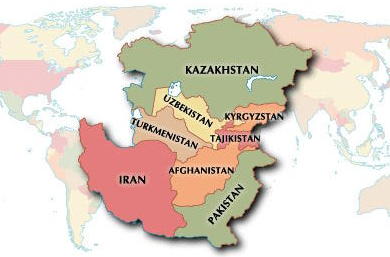
I gave some quotation
from the Encyclopedia Americana (2001) and Britannica (1995).
3.1 Afghanistan
Capital: Kabul
Official languages: Pashto, Dari (Persian)
Official religion: Islam
Area: 251,825 square miles
Population (1995): 18.129,000
Ethnic composition (early 1990):
Pushtun-38%
Tadzhik-25%
Hazara-18%
Uzbec-6%
Religious affiliation (1990):
Sunni Muslim-84%
Shu Muslim-16%
Central Asia States Formerly the Soviet Union
3.2 Kazakhstan
Capital: Almaty
Official language: Kazakhs
Official religion: none
Area: 1,047,200
Population: 16,783,100
Ethnic composition:
Kazakh-41.1%
Russian-37.3%
Ukrainian-5.3%
German-5.0%
Religious affiliation:
Believers are predominantly Sunni Muslims
Christian minority (Russian, etc)
3.3 Kyrgyzstan
Capital: Bishkek
Official language: Kyrgyz, Russian (right now I heard on TV that Russian
Language will be only a second language).
Official religion: none
Area: 76,600
Population: 4,483,000
Ethnic composition (1989)
Kirgiz-52.4%
Russian-21.5%
Uzbeck-12.9%
Religious affiliation:
Believers are predominantly Sunni Muslims
Christian (minority).
3.4. Tajikistan
Capital: Dushanbe
Official language: Tajik
Official religious: none
Area: 55,300
Population (1995): 5,832,000
Ethnic composition:
Tajik-63. 8%
Usbeck-24.0%
Russian-6.5 %
Religious affiliation:
(do no know)
3.5. Turkmenistan
Capital: Ashgabat
Official Language: Turkmen
Official religious: none
Area: 188,500
Population (1995): 4,081,000
Ethnic composition:
Turkmen-73.3%
Russian-9.8%
Uzbek- 9.0%
Religious affiliation:
Believers are predominantly Sunny Muslim (Suff)
3.6. Uzbekistan
Capital: Tashkent
Official language: Uzbek
Official religious: none
Area: 447,000
Population (1995): 22,889,000
Ethnic composition:
Uzbek-70.0%
Russian-7.7%
Tajik-4.8%
Religious affiliation (1993):
Believers are predominantly Sunni Muslim (Hanaffyah)
3.7. Russian Federation
'Encyclopedia Americana'
24:28-30a
A little over 80% of the totals were ethnic Russian and remaining 20%
included more than 80 other ethnic groups, the most numerous of which
were Ukrainians, Tatars, Chuvash, Bashkirs and Mordvinians. More then
30 ethnic groups, of varied ancestry, share the Islamic religion and live
in the Northern and Central Caucasian region. Some 24 million Russians
live in other republics of the former USSR, and this has been a source
of friction between the federations and neighboring states dominated by
other groups, especially Ukraine, Mordova, the Baltic States, and Central
Asian republics.
Capital:
Moscow
Official language: Russian
Official religion: none
Area 6,591,100
Population 148,000,000
Ethnic composition:
Russian 85.0 %
Tatars 3.9 %
Ukrainians 2.4 %
Chuvash 1.2 %
Bashkirs 1.0 %
Mordovian 0.7 %
Byelorussia 0.7%
Major Religions:
Russian Orthodox Church
Islam (predominantly Sunni)
Judaism
Buddhism
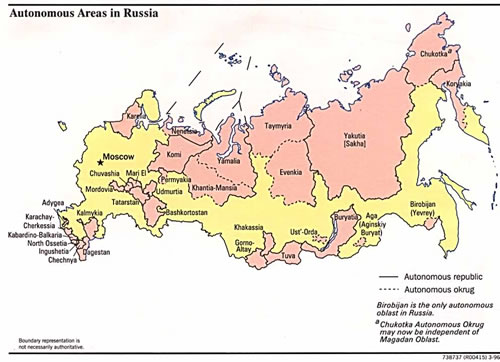
Russian Autonomous Republics
Russia has 16 autonomous republics and 10 national regions. I will show
only some autonomous republics.
3.7.1 Bashkortostan
Capital: Ufa
Official language: Russian
Official religious: none
Area: 55,400
Population: 3,983,300
Ethnic composition:
Russian
Tatar
Bashkir
Chuvash
Mari
3.7.2 Tatarstan
Capital: Kasan
Official language:
Official religion:
Area: 26,300
Population 3,754,000
Ethnic composition:
Tatar 49 % (Islam)
Russian 43 %
Tatar language is a member of the Turkish language group.
Following the break up of the Soviet Union in 1991, the republic declared
its independence from the Russian federation, but this claim was not immediately
recognized.
3.7.3 Chuvashiya
Capital: Cheboksary
Official language:
Official religion: many adopted the Russian Orthodox Christianity religion
Area: 7,000
Population (1990): 1,340,000
Ethnic composition:
Chuvash 70%
Russian 26 %
3.7.4 Udmurtiya
Capital: Izhevsk
Official language:
Area: 16,250
Population 1,619,000
Ethnic composition:
Russian
Udmurts
Tatars
Mary
3.7.5 Dagestan
Capital: Mahachkala
Official language:
Area 19,400
Population: 1,854,200
Ethnic composition:
Avar
Russian
Dargin
Kupyk
Lezgin (they comprise 80 % of the population)
3.7.6 Buryatiya
Capital: Ulun-Ude
Official language: mongolic language (Buryat)
Official religion:
Area: 135,000
Population (1992): 1,059,000
Ethnic composition:
Roughly half of the population consists indigenous
Burats
Religious affiliation:
Buddhist
3.7.7 Mordvinia
Capital: Saransk
Area: 10,100
Population (1995): 959,000
Ethnic composition: Russian who comprised more then 3/5 of the population
3.7.8 Checheny-Ingushetia
Capital: Grosni
Area: 7,400
Population of Chechen: 862,000
Population of Ingushetia: 460,000
Religious affiliation: Muslim
On Nov 2, 1991 Chechen nationalist Drhokhar Dudayev declared independence
for Chechnya. Russian ignored the declaration for three years.
3.8. Iraq
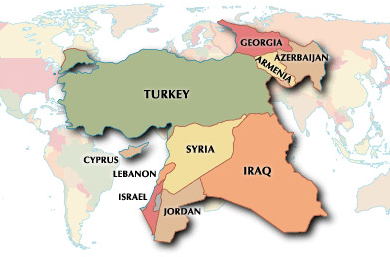
Capital: Baghdad
Official language: Arabic
Official religion: Islam
Area: 167,975
Population (1995): 20,413,000
Ethnic composition (1983):
Arab-77,1%
Kurd-19,0%
Azerbaijany-1.7%
Assyrian-0.8%
Religious affiliation (1994): Shri Muslim
62,5%
Sunni Muslim 34,5%
(Arab Sunnites, Kurdish Sunnites)
Christian 2,7%
·The Kurds who speak a language related to Farsi
(Persian) live in the north and northeast Iraq. Iraq
have Sprite majority but the Arab Sunnites dominate the government.
4. Problem of Russia
4.1
The Soviet Union is Underground Russia.
The dictatorship was in the Soviet Union. All belonged to the Government.
Centralized economy was ruled from Moscow. Who and for whom products were
produced was planned there. A constant government price was decided in
Moscow. All the time some products were in shortage.
The chief officials of the republic had been member of the central committee
of the communist party. The first secretary was the representative of
this native republic, and the second secretary of the central committee
was Russian.
In the Soviet time the Russian political philosophy was to russify the
native republics and the native autonomous republics.
It is very interesting, that in the Soviet time almost all national republics
and national autonomous republics used the Cyrillic (Russian) alphabet
for their national languages. That concerned the Muslims and other group.
In the Soviet time the national religion was persecuted in both the national
republics and national autonomous republics.
They all had a bad experience with the Russian dictatorship.
In the Soviet Union in the beginning of the 1980s, I had a conversation
with one person and I wrote a story, the text of which appears below.
See "Short and not so Short Stories about Life in the Soviet Union"
by Ilya Magid, Boston 1
|
3.13
Winning a Competition
I am happy that I survived until the dissolution of the empire and
the dictatorship |
4.2 Russia and the Independent States
(Breakup of the Soviet Union)
In 1991 the Soviet Union collapsed. Instead there became an organization of Russia and 14 other independent states. Russia became the successor to the former Soviet Union.
4.2.1 Independent States
The independent states go different ways according to their traditions. All independent states entered the U.N.
I think when the Central Asian (Muslim) republics become independent they will change their alphabet to Arabic. That change would permit them to connect to the centuries old Muslim culture.
4.2.2 Russia and its Problems
After the collapse of the former Soviet Union, Russia has many problems. The economic connection with the last Soviet republics was destroyed. That was the process of transition from Socialism to Capitalism, maybe only with elements of capitalism (free price of products, partly privatization in the economy, etc.) Another problem is that many Russians from the independent states are returning to Russia.
The Russian nationalism has important meaning. It wants to save its status as a Global power. The military potential wants to be powerful, but its resources have decreased.
The Soviet Union had great scientific potential. The big potential remained in Russia, but many specialists emigrated from Russia to many other countries.
Russia also has complicated relationships with the Autonomous republics. In some Russian autonomous republics, the majority of the population is Russian. But the minority nationalities there did not have a homeland as the Russians did. Those nationalities will fight for their independence.
I heard on TV, that one deputy from Duma said, "It is necessary to forbid a change of the Cyrillic alphabet in the autonomous republics".
Those autonomous republics are a time bomb (together with the problem of the Caucasus).
All Muslim republics of the former Soviet Union and Muslim autonomous republics of Russia will support the Chechens secretly with force and money.
Russian nationalism did not promise to give freedom to their autonomous republics, as Britain gave to their colonies. Russia cannot go to compromise.
Another deputy of Duma said, "It is good that America quickly defeated the Tallibs in Afghanistan. They spared the lives of Russian soldiers [he is dreaming right now that Russia will rule there.]
My conclusion: the disruption of Russia will continue.
5. Prediction of Movement of World War III
[I wrote
my prediction of the movement of world War III in October 2001. After
that I wrote another chapter supporting my point of view. Volunteers,
Steven Siegel and Dan Smollens, corrected my writing.]
| 1. | America will organize a coalition of democratic states against terrorism. |
| 2. | In the first
stage of the battleground will be Afghanistan and the Central states
formerly of the Soviet Union (Uzbekistan, Tadzikistan, Kazakhstan,
Turkmenistan and Kyrgyzstan). [The population of Afghanistan is primarily Pushtun, and in the Northern part of Afghanistan live Tadziks and Uzbeks.] |
| 3. | In Afghanistan, Russia will support the Northern Alliance (the majority of the soldiers were Tadzik and Uzbeks) against the Tallibs (Pushtun). [Talliban is a very orthodox direction in Islam. The Northern Alliance defends the border of the former Soviet Union on the South.] |
| 4. | Russia is waiting; it does not initiate active fighting. [It will continue the same politics as in the beginning of WW II.] |
| 5. | Russia and America will fight for influence in the Central Asian states. |
| 6. | The Central
Asian states will be sympathetic to American influence. Those states
will accept Islam of the Turkish model; it is not so aggressive against
other religions. [The Central Asian leaders continuously worked from the Soviet time. They are not so religious.] |
| 7. | In the Russian Autonomous Muslim republics: Tatarstan, Bashkortostan, Mordva, fighting will begin for their independence. Their fighting will unite with the fighting by the people of the Caucasus for their independence. |
| 8. | On the Northern border of Kazakhstan with Russia there will begin a conflict. [In the North of Kazakhstan live many Russians.] Russia will begin the war. |
| 9. | Russia will begin to support the Tallibs, to reduce pressure from them on Russia. |
| 10. |
In Afghanistan, America supported the Pushtun, when they went against the radical tallibs |
| 11. | After some action the autonomous republics: Tatarstan, Bashkortostan, and the Caucasus autonomous republics will receive independence. |
| 12. | Afghanistan's coalition government will be created with Talibs, and the Northern alliance representatives and others, under the leadership of the king (Pushtun). |
| 13. | The Central Asian states will enter NATO. |
| 14. | At some indeterminate time the democratic world will unite their forces and begin WAR also against Iraq. |
| 15. | In the War with Iraq Russia will be supporting Iraq. Iran will be against Iraq. As a result, Iraq will be divided. The Kurdish state will arise. |
| 16. | In the Middle East the situation will be better for Israel. |
|
This
site created and maintained by Larisa Luvish-Trell
|
|
Email
to Larisa Luvish-Trell
with questions or comments about this Web Site.
|