The Beginning -
Havana
We arrived in Havana,
tired and exhausted after a long flight.We had some accomodation
booked with a  professor
at the local university, which i had organised by email. But we
had to get their first, and as there were 5 of us we had to split
in to 2 taxi's. Me and Blake got in one cab, gave the driver a
slip of paper with the address and he knew where he was going. He
then picked up a crazy Canadian guy who was going to visit his
Cuban girlfriend - this meant a journey through the slums of
outer Havana, and our first real taste of cuba. We travelled in
silence for most of the journey; despite how obviously poor these
people were, they were also full of life, colourful and happy,
and took an interest in us rich westerners as we passed them in
the cab.
professor
at the local university, which i had organised by email. But we
had to get their first, and as there were 5 of us we had to split
in to 2 taxi's. Me and Blake got in one cab, gave the driver a
slip of paper with the address and he knew where he was going. He
then picked up a crazy Canadian guy who was going to visit his
Cuban girlfriend - this meant a journey through the slums of
outer Havana, and our first real taste of cuba. We travelled in
silence for most of the journey; despite how obviously poor these
people were, they were also full of life, colourful and happy,
and took an interest in us rich westerners as we passed them in
the cab.
We eventually found the appartment
we were staying at, in the new town, and to our relief Dan,
Caroline and Lucy were there already. The appartment was very
nice - Raul was obvously not one of the poorer Cuban citizens, he
had a decent stereo, TV and a generally well furnished place. We
found out why - by charging $30 a night for 2 rooms he was making
a healthy living. We weren't ripped off - this was about the
going rate in Havana, but because he had access to the internet
he was always fully booked. The average monthly salary in Cuba
was $20 at the time, and despite the massive taxes collected by
the government from people who let rooms out to tourists, he was
doing well. He was also a lovely bloke, him and his wife Magaly
looked after us well, and i would recommend contacting him if you
want accomodation for the first couple of days: his name is Raul,
check his website in my links
page. There are great views from his balcony, he provides a
brochure for you and there's even a framed photo on his wall of
Magaly with Castro himself.
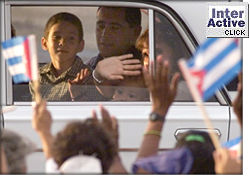 It was here that
we witnessed the return of Elian from the
States, and from the look on Magaly's face we could tell how
important this was for the people of Cuba. I wished we had known
about the return and managed to stay at the airport to see it for
ourselves if possible.
It was here that
we witnessed the return of Elian from the
States, and from the look on Magaly's face we could tell how
important this was for the people of Cuba. I wished we had known
about the return and managed to stay at the airport to see it for
ourselves if possible.
Not far from this casa particular
was the Plaza de la Revolucion. This is where
Castro makes his legendary speeches, often dragging on for around
8 hours. At one end is the famous Che Guevara face on the side of
a building complete with the revolutionary phrase "Hasta la
Victoria Siempre" (Ever onward to victory), and at the other
end is a huge obelisk, a statue of José Martí and the platform
from where the speeches are made. I took this opportunity to get
in a posed photograph wearing my Southend Utd shirt, which I
later sent in to the club and managed to get in the matchday
magazine; one of my proudest moments.
Havana is like two cities in one -
most of it is old, decaying and in need of urgent repairs; a
reminder of the old socialist ways, but there is also a new area
complete with luxury hotels - perhaps the way of the future. We
used these hotels in order to go to the toilet, simply because
they were so much nicer than any others - you are guarenteed
toilet paper. But these hotels will not let in any Cubans unless
they are with a tourist carrying the magic dollars, which has led
to comparisons with apharteid. It's the same with the police
around Havana - they will always stop and question a Cuban who is
with a tourist because they believe the tourists are being
hassled. These magic dollars bought in from tourists and Miami-based
relatives have transformed the society from the egalitarian one
idolised by Castro to a two-tier sociey - those with dollars and
those without.
In our search to sample the
nightlife of Cuba we went to a local bar and met two guys who
would ultimately influence our views on Cuban people, but more of
that later... Their names (i think) were Ernest and Elgenio, and
we drank rum and beer with them before arranging to meet up with
them the next day to walk in to Old Havana. Quite a walk this
was, taking us over an hour in the searing heat, and on the way
we saw the strange sight of a man taking a pig for a walk, but
the little piglet was so tired it just wanted to sleep on the
pavement.
Old Havana
One of our trusty handbooks had
been the Lonely Planet guide, and it became all the more
significant after seeing a little cuban chap walking around with
a copy in his hand. We recognised him at once - he was in one of
the photos in the book, showing off his Che tattoo on his chest -
we 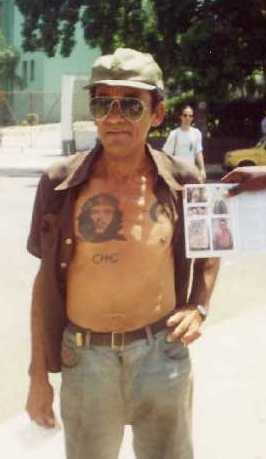 then
took the opportunity to take a photo of him, tattoo out, holding
the book in his hand, open at the page where he pulls the same
pose. Quite surreal.
then
took the opportunity to take a photo of him, tattoo out, holding
the book in his hand, open at the page where he pulls the same
pose. Quite surreal.
Highlights of Old Havana include
the Capitolia building, similar to the Senate
House in the US; the sheer amount of 1950's american cars, (we
took an 'illegal' taxi in a HUGE 1958 Plymouth); the
Museo de Automovil is also worth a visit to see some
more classic vintage vehilces. Obispo street is
very popular, particularly with its hustlers and runs from El
Floridita in the touristy zone (where Hemingway used to
hang out) to the Plaza de Armas. The rest of the streets are non-touristy,
complete with narrow cobbled streets, kids playing, stray dogs,
laundry hanging from the balconies and music blaring out. We saw
one tiny little kid doing random somersaults in the street, all
the kids seemed to be doing some sport or another. Baseball is a
favourite, even though they use their hand instead of a bat -
Cuba has a very good baseball team with many 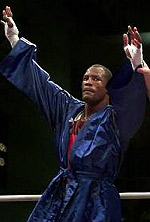 players emigrating to the US to persue a
professional career in the sport. Maybe this is where some of the
kids of today will end up in the future, or maybe they'll stay
amateur in the wishes of Fidel, following in the footsteps of the
triple Olympic winning boxer Felix Savon, who
has refused offers of millions of dollars to fight the likes of
Mike Tyson. Turning pro is obvously not allowed - any Cuban
wishing to do so must cut off all links with the island - ie
baseballers who leave for America will not be allowed to play for
the Cuban national team again. Obispo is also the main area to go
at night, there's plenty of cafe's and restaurants - and we went
to one kind of nightclub. This place was a restaurant by day, and
by night they moved the tables and played some music. It was a
strange feeling as we were talked into entering for $1, then
without realising some locals had been moved out of the way so we
could sit down, and we had a waitress come over and take our
orders for beer. Basically, our dollars meant we were treated
like royalty - we were the only tourists in the small room and
seemed to get the most attention. It was only after we had sat
down that we realised that the people sitting there had been
moved especially for us - we didn't want this treatment but it
took us by surprise so we stayed and drank there for a while. The
beers were a dollar each, Blake, Lucy and I stayed for a while
and we even had a dance to the music, which ranged from
traditional salsa to Mambo #5. Lucy had a go at salsa with one of
the doormen, who like all Cuban men had fantastic rythm, and Lucy
herself was pretty good.
players emigrating to the US to persue a
professional career in the sport. Maybe this is where some of the
kids of today will end up in the future, or maybe they'll stay
amateur in the wishes of Fidel, following in the footsteps of the
triple Olympic winning boxer Felix Savon, who
has refused offers of millions of dollars to fight the likes of
Mike Tyson. Turning pro is obvously not allowed - any Cuban
wishing to do so must cut off all links with the island - ie
baseballers who leave for America will not be allowed to play for
the Cuban national team again. Obispo is also the main area to go
at night, there's plenty of cafe's and restaurants - and we went
to one kind of nightclub. This place was a restaurant by day, and
by night they moved the tables and played some music. It was a
strange feeling as we were talked into entering for $1, then
without realising some locals had been moved out of the way so we
could sit down, and we had a waitress come over and take our
orders for beer. Basically, our dollars meant we were treated
like royalty - we were the only tourists in the small room and
seemed to get the most attention. It was only after we had sat
down that we realised that the people sitting there had been
moved especially for us - we didn't want this treatment but it
took us by surprise so we stayed and drank there for a while. The
beers were a dollar each, Blake, Lucy and I stayed for a while
and we even had a dance to the music, which ranged from
traditional salsa to Mambo #5. Lucy had a go at salsa with one of
the doormen, who like all Cuban men had fantastic rythm, and Lucy
herself was pretty good.
Other higlights of the city are
the fantastic markets with their hustlers; the
main catedral de la Habana; the museums -
particularly the Museo de la Revolucion in the
old presidential palace which had blatant anti-US propoganda (claims
of the US sending over exploding cigars sticks in my mind); 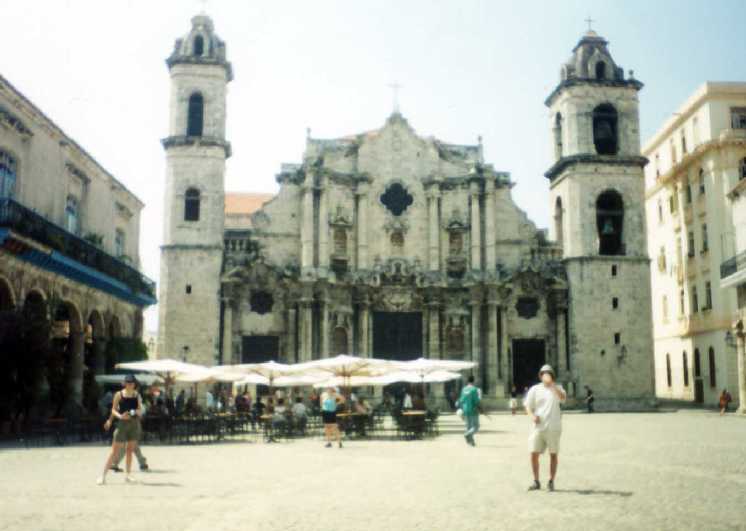 great restaurants with performers (make
sure you check the bill!); the huge, packed buses which seem to
crush their many passengers; the kids playing a variation of
baseball with no bat in the streets; the prostitutes; the
cathedrals and churches; the hustlers... It is also worth
visiting a cigar factory, we took a tour for $10
in the Partagas factory opposite the Capitolia. It was incredible
to watch rows and rows of men and women making all sorts of
cigars, each one taking just two minutes from start to finish,
listening to a man at the front who would read newspapers and
novels. The workers got to take home a certain percentage of
their cigars, often they'd save these up in order to sell. One
woman worker was 70 years old, smoked 4 HUGE cigars a day, and
was effectively a gimmick for the factory, and she can be seen on
many postcards, as well as on this page. Cigars are a must to
buy, but beware of, you guessed it...
great restaurants with performers (make
sure you check the bill!); the huge, packed buses which seem to
crush their many passengers; the kids playing a variation of
baseball with no bat in the streets; the prostitutes; the
cathedrals and churches; the hustlers... It is also worth
visiting a cigar factory, we took a tour for $10
in the Partagas factory opposite the Capitolia. It was incredible
to watch rows and rows of men and women making all sorts of
cigars, each one taking just two minutes from start to finish,
listening to a man at the front who would read newspapers and
novels. The workers got to take home a certain percentage of
their cigars, often they'd save these up in order to sell. One
woman worker was 70 years old, smoked 4 HUGE cigars a day, and
was effectively a gimmick for the factory, and she can be seen on
many postcards, as well as on this page. Cigars are a must to
buy, but beware of, you guessed it... 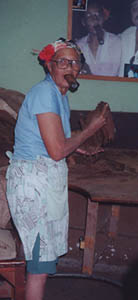 hustlers.
I bought 10 Romeo y Juliet tubo cigars from an official shop for
$17, but also managed to get 25 famous Montecristo no. 4 (the
ones Fidel used to smoke) on the black market for $25. We
arranged this through the lady we were staying with at the time,
but heard stories of people buying banana skin cigars, so you
have to be careful.
hustlers.
I bought 10 Romeo y Juliet tubo cigars from an official shop for
$17, but also managed to get 25 famous Montecristo no. 4 (the
ones Fidel used to smoke) on the black market for $25. We
arranged this through the lady we were staying with at the time,
but heard stories of people buying banana skin cigars, so you
have to be careful.
An excellent way to travel around
Havana is on a "pedicab", for a dollar
or two you can travel up the main streets, passing the new
hotels, whilst the Capitolia dome is always in sight. They're all
over the place, and it's a relaxing way to see the sights in
Havana. Or alternatively just get in a lada cab - we made the
most of them, they're everywhere.
Whilst in Old Havana we stayed in
an appartment on the coast owned by two sisters, who judging by
their old photos, had enjoyed a Hollywood life-style pre-revolution.
Nowadays they make their living by renting out their rooms to
tourists and selling cigars (this is how we got ours). The
appartment block even had a security guard (who was keen to
practice his english on us) and someone operating the shaky lift
at all times. From their balcony you can see into Old Havana, and
also to the smog filled port. The view from the back bedrooms is
a complete contrast - from such a height (7 floors) you can see
the state of disrepair many of the buildings are in - we sat and
just stared for quite a while as the sun came down on such an
amazing sight. These were the homes that were too small to be
rented out, and seemed dangerous to live in. There's nothing the
people can do - they obviously don't own their homes, it is
provided for them as well as their 400 peso ($20 monthly wage).
In fact if they want to move out they have to try and swap it
with other families, which is probably not very easy.
Being careful is a warning we
should have listened to more - we had read about people (particularly
young men) who will offer to show you around, then demand a 'fee'.
This was the case with our friends Ernesto and Elgenio - we met
up with them a few times, during the day they did show us around
and managed to get us some cheap pizzas using their peso's, and
we also went out drinking with then at night. They were good
blokes, seemed genuine and we did have a good time with them, but
on leaving them i was asked to give them $15 for reasons they
suddenly struggled to explain in english. We wouldn't give it,
because we had bought them enough drinks and food over the past
few days, and they had insisted to us after being quizzed by the
police that they were not after our money. We felt stupid, and i
also felt some guilt, but lucy met up with them in her last week
and despite some awkwardness she said they were OK. But beware...
don't trust everyone you meet.
Old Havana is incredible - the
people, the buildings, the restaurants, the cars, the 'different'
nightlife, the looks off the locals, the markets, and finally,
the hustlers; every few minutes you will hear: "You, my
friend, where you from? Taxi? Cigar? Private restaurant? Chica?..."
Next...