 |
| Yule - The Winter Solstice - 21st December
Yule is the darkest time of the year, the time of the longest night where the day is at its shortest. It is a time of change and transformation, when the days will start to lengthen and like the first beginnings of the return of the sun, life will return and conquer death. The Oak King slaying the Holly King marks this change in some traditions. Mistletoe, a symbol of fertility, gives us the promise of future fruitfulness and after seeing out the longest night, we greet the now waxing sun and feast as a mark of what is to come. |
| Imbolc - 1st February
Imbolc, celebrated by most Wiccans around February 2nd celebrates the first stirrings of the coming of spring, welcoming it and is the time for the banishing of winter. It is a celebration of the three-fold Goddess: Maid, Mother and Crone. She has passed through her phase as the crone, hag or wise one, and is a maiden again, mythologically celebrating the moment where the Goddess, as Diana, restores her virginity each year in a ritual bath. Imbolc, translated from Gaelic as "in the belly" and "ewe's milk" represents the quickening of light and life and we celebrate the return of life to the earth after the barren darkness of winter. Although it is still the dark half of the year, the days grow perceptibly longer and it is a time to dust off our resolutions, get back in touch with our potentialities and look outwards. |
| Ostara The Spring Equinox - 21st March
Ostara is the festival of the Spring Equinox, marking the equal point between the length of day and night. This is a joyful and optimistic celebration of new life bursting forth and the beginning of the light half of the year. The festival is named after the Goddess of fertility, known variously as Eostre, Eastre and Ostara who was connected with eggs (a symbol of rebirth) and hares. This is a time when we celebrate the stirring of the reproductive powers of nature and is a time of new life and fertility. Ostara is a time of balance and this is an ideal opportunity to reflect on how our male and female energies balance within us, what plans we have for the future at this time of growth and fertility and how we can develop ourselves. |
| Beltaine - 1st May
Beltaine is a celebration of fertility and is represented by the mating of the Goddess as May Queen with the God as Green Man. It is the time when the Goddess moves on in her cycle from Maiden and her union in the greenwood with the God is still celebrated with the phallic May pole and Morris dancing in many villages. Beltaine is the beginning of the Celtic summer and the name derives from Bel-fire, Bel being the Celtic God known as Beli, Balar and Balor amongst others, god of light and fire, the Bright One. Fires are built at Beltaine and traditionally cattle were driven between two fires, or through the ashes of one, to ensure they yielded plenty of milk; single young people would jump the fire bring a husband or wife, women to ensure fertility and easy childbirth. Beltane is an excellent time for Handfastings, communing with nature spirits and things associated with fertility and growth. |
| Litha: Summer Solstice - 21st June
The festival of Litha, the summer solstice, is a celebration of the triumph of the fertility of the land, of the god as Sun King on the longest day of the year fertilising the land, with the sun is at its zenith. Litha is a pivotal time, like Yule, where, in reaching its peak, the sun will move into decline. This turning of the wheel is represented through the decline of the Oak King and the beginning of the ascendancy of the Holly King. The Goddess shows a Death-in-life aspect, being extravagantly fertile but presiding over the death of the Oak King. Litha is a time of fulfilment of love, time to celebrate our energy and look forward to the fruitfulness to come. |
| Lughnasadh - 1st August
Lughnasadh, also know as Lammas from the Anglo-Saxon meaning loaf mass, is the festival of first harvests and an observance of the fruitfulness of the land; first crops have been harvested and the hedgerows are full of rich berries and fruit. This is only the beginning of the harvest and we anticipate fruitfulness and look forward to the bounty of the earth. The name of Lughnasadh means �the commemoration of Lugh� who is the Celtic God of light and fire and God of crafts and skills. This is a fire festival at which the Goddess presides and where she will move from her fuller aspect of mother towards the darker wizened crone. The corn God has been given life by the Goddess and is sacrificed to be transformed to sustain us through the coming winter months; this is a festival of fullness and transformation and though Lugh is mourned, it is part of the natural self-sustaining cycle. This is also a time to acknowledge the turning of the seasons as we move from the fullness of the midsummer sun, to shortening days as the sun God looses strength and the nights lengthen. The Wiccan theme of the turning battle between the Oak and the Holly Kings is played out here, with the Oak King having been slain at Midsummer, Lughnasadh is the time for the sacrificial mating of the Holly King and Goddess, before he again succumbs to the Oak King at Yule. Lughnasadh is a time for long-term hopes and harvests, so now is the time to think about what you want for the future. |
| Mabon: The Autumn Equinox - 21st September
Mabon marks the completion of harvesting the crops; it is a time for thanksgiving and time to prepare for the onset of dark nights and winter chill. The autumn equinox is a time of balance; day and night are equal but we are moving towards the dark phase. The God, Lord of the Greenwood in the summer and the Corn King at Lughnasadh now dances his last dance upon the earth as the God of wine, music and dance, before making his descent to the underworld to take up his role as Dread Lord of Shadows. Mabon is a time to take stock of what we have harvested, marshal our resources for future months, and consider the balance in ourselves, our male to female, dark to light. |
| Samhain - 31st October
Samhain, or Halloween, is the death festival, marking the onset of winter. It is a time of endings, but also a time of beginnings as Samhain is a Celtic New Year's Eve festival. Thus we relinquish the past and look to the future. Samhain marks the completion of the God�s journey to the underworld where he is Lord of the Underworld, the dread Lord of Shadow. This is the when we see the Goddess as the Cailleach, the Crone, the Wise One. She is the Dark Mother who devours the God that he may be reborn again. Samhain is the time when the veil between the worlds is thinnest (also known as All Hallow�s Eve). It is a time when we remember and honour those who have died and we call on the spirits of the dead and our ancestors and invite them to feast with us and share their wisdom. This is a good time for us to reflect on the year that has passed, take stock of what has happened and learn from it to dispose of our outworn baggage. Samhain is a good time for banishing magic, skrying and for sorting out unfinished business, it is also the time to face and acknowledge the dark side of ourselves. |
| TThe Sabbats
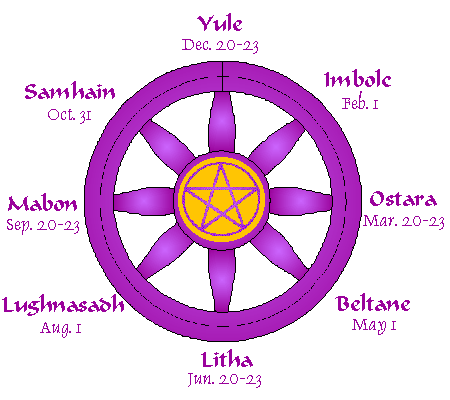
Wicca celebrates the cycle of the year, known as The Wheel of the Year, consisting of eight Sabbats, and each stage is seen as reflecting the interplay of the greater forces of nature. |
| The festivals coincide with important times and natural milestones in the agricultural cycle of the year. Different people in different places celebrated the Sabbats in the ancient world; the Sabbats, as we celebrate them now, have evolved from this observance of the natural cycle.
The Sabbats are; the quarter days or fire festivals - Samhain, Imbolc, Beltaine and Lughnasadh, the Summer and Winter Solstices and the Spring and Autumn Equinoxes. At each point in the Wheel of the Year the Goddess and God are seen in their various aspects: maid, mother and crone, son, King and Lord of Death. No phase of life is seen as negative or worth less than the others. All stages in any process are necessary, are of equal worth and part of the natural cycle. |
 |
 |
 |
 |
|
 |
 |
 |
 |
 |
 |