Competency
Area III: TEACHING, LEARNING, AND THE CURRICULUM
Teachers
implement curriculum plans, that include
methods and strategies for applying technology to maximize student
learning. Teachers:
Sub-Competency
A:
Facilitate technology-enhanced
experiences that address content standards and student technology
standards.
Evidence: Unit
Plan This unit plan
has lesson plans that involve the
state standard course of study standards while incorporating student
technology standards.
Reflection:
Throughout the
course of their teaching during the day it is important that teachers
incorporate methods and strategies of teaching that include technology
into student learning that address the appropriate content standards to
be learned. In the evidence provided above, almost every lesson
provide some type of technological enhancement. The application
of technology standards to content standards enhances student learning
by increasing the motivation of each student learning. Technology
is also a part of each student's life. We as teachers need to be
sure that we are providing as many opportunities as possible for our
students to become familiar with because it is not going to away, it is
only going to advance further in the future. We would be doing
our students a disservice if we did not at least introduce our students
to the available technology. Unit plans that incorporate technology and
then list places of where to get available technology, such as the one
in the link provided, make it convenient and efficient for the teacher
to apply many technological resources in his or her lessons and
therefore content standards.
Evidence: Zoo Planning
Committee Biome Webquest Lesson Plan
This lesson plan
incorporates the use of a computer
WebQuest while teaching students about the wonders of habitats
Reflection:
This lesson
incorporates the use of
the internet into the student learning of world biomes and
habitats. The internet can be a powerful tool in student learning
if used used appropriately. The application of the internet in
the learning of content provides students with more resources than
would have been available had the internet not been available.
These resources must be assessed and evaluated with caution, but the
resources that the internet contain on any given content area of the
curriculum seem endless. The benefit to our students and teaches
of incorporating the internet through lessons, such as a webquest is
that students and teachers get to explore other ways of looking at
various topics. This could be especially true in history
webquest. Students also get a chance to use their imaginations
through such internet activities and use higher order thinking
skills.
Sub-Competency
B:
Use
technology
to support
learner-centered strategies that address the diverse needs to students.
Evidence:
Habitat Explorer Video This video would be
used to introduce the unit on Habitats and
would students and opportunity to do a job in the video preparation
that best suit their talents.
Reflection:
Activities that
have multiple job
allows a degree of independence. When producing a video there are
many jobs that become available. There are writers,
videographers, lighting and sound specialist, cue card holder, and
editors. Some jobs such as research for the video the whole class
would be involved in. Students would then be assigned or allowed
to pick a job that best matches their learning style. Matching
students to their learning style is important because it important for
all students to motivated in the job they are doing, especially in
technical lesson such as a video production where classroom management
is of the utmost importance. Not only are students engaged
because technology is motivating and engaging, but they are also
matched to a job that they are best suited to do according to their
needs or learning style.
Evidence:
Journal Article Review
Addressing Diverse Learning Styles
by: Susan M. Montgomery
University of
Michigan
Frontiers
in
Education Conference, 1995. Proceedings., 1995, Vol. 1, Nov. 1995
http://www.vpaa.uillinois.edu/reports_retreats/tid/resources/montgomery.html
In this journal article the author addresses the use
of multimedia and it's effect on the learning styles of students within
a classroom setting. She weighs the effects of multimedia in
addressing learning styles that traditional methods, such as the
popular lecture, seems to neglect. For her study she used the
Solomon's Inventory of Learning Styles which has four dimensions.
These dimensions are processing (active/reflective), perceptive
(sensing/intuitive), input (visual/verbal), and understanding
(sequential/global). Most students seemed to fall within the
processing and input learning styles.
Using various types of discovery multimedia software
throughout the semester students were given the opportunity to make
comments that were then validated by the inventory. This told
researchers that the software and then what type of learning style the
students were. As far as the learning styles of active/reflective
goes, researchers learned that discovery was an important part of the
educational process and that multimedia engages students in ways that
lectures cannot. These learners preferred movies and interaction
thought a variety of mediums. Sensing/intuitive learners like to
deal with facts and data. These learners succeeded with
multimedia that provided a simulation that allowed them to work with
facts. Visual/verbal learners obviously are going to benefit from
multimedia, especially visual learners. The author claims this is
through graphics, animation, video, and illustrations. Finally,
the author claimed that sequential/global learners were able to things
in the larger context throughout the use of multimedia.
Reflection:
As each student is
unique, also is each learning style of each student unique.
While it would be nearly impossible and most likely drive us crazy to
incorporate every learning style into every lesson we present in the
classroom, we as teachers need to strive to incorporate as many
learning styles into our lessons as we can. We need to be sure
than we are not giving on learning style more attention throughout the
day and throughout the term than another. If we do, there is
going to be a group of students who get left behind in the
curriculum. Multimedia is unique in that it provides something
for everyone. It benefits students in that it is truly
student-centered and student-friendly. It addresses the many
needs of students. While it many benefit some more than other,
such as visual learners, it helps everyone be successful in their
learning. There are many forms of technology available that can
be used in a classroom setting to accommodate each learning
style.
Sub-Competency
C:
Apply technology to develop
students' higher order skills and creativity
Evidence:
Habitats Spreadsheet:
was created from scratch using data found on the Internet. This
spreadsheet contains formulas that can be used to perform various
calculations.
Spreadsheet Questions: was
created using pre-made spreadsheets (Nutrient
Spreadsheet)
by Dr. Bob Houghton
and from the above mentioned Habitat Spreadsheet
Database Questions: was
created using pre-made database by Dr. Bob Houghton (counties and
Europe database). Questions were originally thought of
my
myself.
Reflection:
Higher order
thinking skills generates
independent thinking and judgments. This is the level we want our
students to achieve while in our classrooms. We want our students
to grow beyond the ability to simply be able to recall simply
facts. We want them to compare, analyze and synthesize their own
facts. In the evidences given above higher order thinking is
taking places. When students are allowed to create their own
spreadsheets and even databases with information that they have found
online or from books in the library, they using higher order thinking
skills and creativity to incorporate that information into that form of
technology. They are deciding how it should go in that
format. In other words they are making independent judgments
based on the information they have available. Also, when students
create questions that go along with these spreadsheets and databases or
those that have been pre-made and answer them they are using higher
order thinking skills. For example, when students are asked "What
is the difference in the rate of habitat destruction between the years
of 1970 and 1990?" Students are being asked to compare
the rate of habitat destruction of 20 years. Comparison is a
higher order thinking skills that teachers need to be promoting.
By helping our students think on a higher level, we help our students
think beyond the obvious and beyond what is right in front of
them. We are helping them thinking on their own.
Sub-Competency
D:
Manage
student
learning activities
in a technology-enhanced environment.
Evidence:
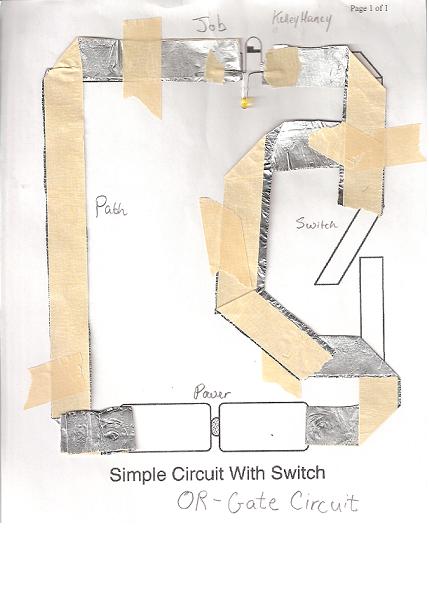
Circuit Activity
Reflection:
Student learning
can extend beyond the
obvious technology of computer keyboards and digital cameras. A
lot of state curriculums call for teachers to teach about
electricity. Why not have students build their own circuit as a
way to teach this. Technology lends itself very well to hands-on
learning. Wherever possible in the curriculum teachers should
find ways to incorporate technology into the content standards so that
students will have a better idea of what the content is and what it
means. When students have the opportunity to work hands-on with
something, your kinesthetic and your visual learners are going to
benefit greatly from this experiences.
Page Author:
Kelley Haney
Back to Technology Portfolio Home