

|
|
||||||
| Home |
|
Click on the drop down menu to reveal the answer. Specialized and Contractile Cells of the Heart 1)What is the resting membrane potential of a specialized cardiac cell 2)Which specialized cell acts as the pacemaker of the heart 3) Name the ion whose increased permeability naturally contributes to a specialized cell's autorhythmicity 4) A steeper prepotential slope in a cardiac cell is an effect of which division of the ANS 5) In the question above, which drug would also illicit a similar change in prepotential slope 6) What structure contributes to the ability for contractile cells to contract in "syncytium" 7) Why are SA nodal cells the pacemaker of the heart 8) What region of specialized cells in the heart depolarize at the slowest rate 9) What is the term for change in force of contraction 10) In the question above, the presence of what ion results in increased force of contraction 11) Separate depolarization and contraction of the atria and ventricles is crucial to the heart's mechanism as a pump. What two reasons account for the delay at the AV bundle 12) Unlike skeletal muscle, whose calcium releasion is stimulated by change in voltage, Ca++ releasion from the sarcoplasmic reticulum in cardiac muscle is dependent on 13) The latent period between action potential and muscle contraction is in cardiac muscle. 14) Do muscle twitches summate in cardiac muscle 15) Explain why for the question above Cardiac and Fetal Blood Flow Review 16) Damage to heart valves can occur when antibodies against create an autoimmune inflammatory reaction against heart valves. This condition can occur if the patient is suffering from 17) A patient with aortic semilunar valve stenosis is examined after complaining of poor circulation. Fill out the chart below to explain the patient's condition.
18) Which vein in the fetal circulation contains the most oxygenated blood 19) As blood enters the right atrium of a fetus it can either pass through the directly into the left atrium, or enter the pulmonary trunk and pass through the into the aortic arch. 20) Upon birth, the baby's lungs inflate and a series of changes occur within the baby's circulation. The ductus arteriosus constricts to stem blood flow and ultimately resulting in the fibrous ligamentum arteriosus. The ductus arteriosus's constriction is actually stimulated by 21) After birth, back flow of blood pushes a flap closed over the foramen ovale. Why would the blood want to go back through the foramen ovale Where is pressure high and low 22) An infant's worried parents bring their child back several week's after birth...and ask for a refund... Just kidding! The baby has cyanosis on the left side of it's head. What does the baby most likely have Explain what is actually happening within the baby's heart 23)What are the four characteristics of tetrology of fallot 24)In the question above it is a to shunt. The EKG 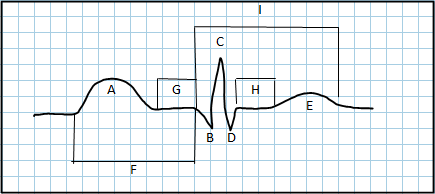 Use the image above to answer the questions below 25)ventricular depolarization 26) if interval exceeds .2 seconds, may indicate AV nodal block 27) atrial depolarization 28) ventricles contract here 29)Indicates time of delay in AV bundle 30)The arrow of a vector would point to this event 31) What did I forget to put on the picture that shows one complete ventricular cycle of depolarization and repolarization 32) Starts at the beginning of the P and ends at the beginning of the Q 33) Starts at the end of the P and ends at the beginning of the Q 34) Ventricular systole 35) Which part is used to find MEA 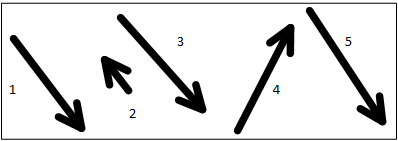 For the questions below use the image above. 36) Which vector represents repolarization of the ventricles If compared to lead I, predict whether the pen will deflect above (A) or below (B). 1- 2- 3- 4- 5- If compared to aVR, predict the pen deflections. 1- 2- 3- 4- 5- I got lazy, so feel free to do the rest of the leads on your own. Action Potential Phases 1) the image below describes an action potential in what cell 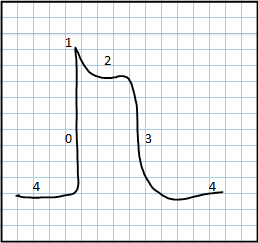 2)which phase/s represent the point at which there is equal entry and exit of charge 3) which phase/s is present in contractile and skeletal muscle cells only 4) which phase/s represents rapid entry of sodium into the cell 5) which phase/s are due to increased permeability to K+ 6) which phase/s would a vector arrow point to 7) which phase/s is due to cardiac muscle's slow closing Ca+ gates 8) which phase/s would have a negative surface charge 9) which phase/s would have a positive surface charge 10) which phase/s would have a positive charge on the inside of the membrane Some Math Problems 1) If a person's blood pressure is 100/60 what is their pulse pressure 2) The EDV is 180ml, The ESV is 55ml. The HR is 60 bpm. What is cardiac output 3) If a person's blood pressure is 100/60, what is their MAP 4) If a person's CO is 6 L, what is their flow 5) A person's arterial pressure is 100mmHg. Their venous pressure is 0mmHg. If the flow is 1000 mL a minute, solve for resistance. 6) The same person above exhibits R AV valve stenosis. The CVP has risen to 40mmHg. If resistance is still .1mmHg/ml/min what is flow 7) If CVP is 5 mmHg, what is the pressure in the R Atrium 8) If BP is 120/80 what is pulse pressure 9) Tricky problem: CO is 950mL/min and resistance is .3 mmHg. If diastolic pressure is 70, what is systolic pressure 10) Using the values from the problem above, what is this effed up person's MAP 11) What is flow if bp is 160/80 and resistance is .1mmHg 12) If HR is 72bpm and SV is 70mL what is CO 13) What is resistance if flow is 700mL/min and bp is 120/90 14) If the radius is increased from 3uM to 6uM, how much will flow change and in what direction 15) Challenge: According to Poiseuille's law, calculate resistance if the vessel length is 5mm, the radius is .5 mm, and the viscosity is 5 sq meters/second Control of Blood Flow and Pressure 1) What three things is tissue perfusion dependent upon 2) The use of nitric oxide produces more term effects, while hormones tend to exhibit more term control of blood pressure. 3) Baroreceptors are firing off impulses at a slower rate, what can be said about blood pressure 4) Both and are located in the carotid bodies and aortic arch. 5) What receptors are located in the atria and pulmonary trunk 6) A huge tidal wave of stroke volume is expelled from the left ventricle. Stipulate the rate of action potentials arrising from the baroreceptors 7) For the following substances, select C for vasoConstricter and D for vasoDilater. Capillary Hemodynamics 1) What is the net force number at the arteriolar end of a capillary 2) What is the net force value at the venule end of a capillary 3) Fill out the table below.
Edema and the Starling Forces 1) You are wearing a hawaiian lei at your parent's luau and get stung by a bee. Histamine is released by mast cells and basophils at the site of the sting. What is the effect on the capillary coefficient (Kf) 2) What are the two GENERAL causes of Edema 3) Tragically, one side of a patient's heart fails. In addition, the patient complains of inability to breath. The nurse suspects pulmonary edema. Which side of the heart failed 4) In the question above, which starling force was most causative to the impending edema 5) Upon returning from a vacation to the nematode infested beaches of Cozumel, you notice abnormal swelling of your scrotum(if you have one). What starling force most accounts for the date-killing swelling downunder . Care to elaborate on why 6) Krashikor, or disease of the first born, afflicts children in third world countries. What is the starling force most responsible for the swollen stomach 7) A patient has liver failure and edema. What is the change in starling forces that accounts for the edema, which is probably the least of his/her worries 8) A doctor sees a patient whose primary complain is hemmorrhoids. To humor my question the doctor tests for proteins in the urine. Sure enough, wouldnt you know it, the aforementioned patient's urine is positive for excessive proteins excreted in urine. Describe the change in starling forces responsible for those woeful hemmorrhoids 9) Lets talk about intracellular edema 10) The kidney is failing shooting out renin in all directions. As what seems the theme, edema crops up. What force was changed to incur such edema 11) Just to quiz you... In the question above, what does renin have to do with increased blood volume | ||||||||||||||||||||||||||||||||||||||||||||
