
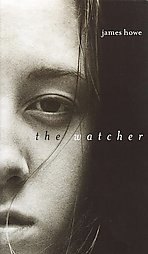
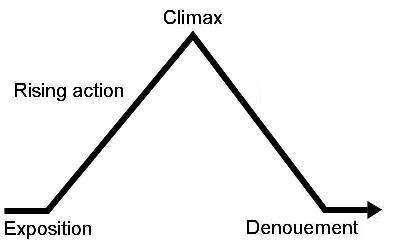
In the exposition of the story, the author begins by describing the appearance and troubled personality of a young and abused child named Margaret. Magaret takes the nickname of �The Watcher� because every day she observes and writes about everyone on the beach. She also writes about the beast that drives her to the beach every day, making her too fearful to swim or talk to anyone. Too fearful to do anything but write silently in her notebook. Certain people intrigue here, such as the young and handsome lifeguard named Chris, and a younger boy dedicated solely to his family named Evan.
The rising action begins when Chris and Evan both notice Margaret writing in her journal. Both have their own assumptions as to what she is writing. The story then delves into their different lives and their friends and experiences. They all seem to admire one another, and think that the other's life is perfect, but when the reader looks into the individual lives, we find out the situations are actually the exact opposite. Chris has suffered the event of his brother dying and the other kids have similar problems. Towards the end of the rising action, Margaret enters into Evan's home and takes a kite, a picture, and a shawl from it. This is the first real time that any of the character's lives overlap. The fairy-tale story continues to develop and seems to introduce the different chapters in the story. Margaret continues to write it.
The climax ties together all the loose strands instead of being a shocker. We don't learn much more about Evan's parent's divorce, but he talks with his mother about it. Chris is still battling how to save a person in trouble. We are also introduced to Callie who is urged to help "The Watcher" and figure out why she is always alone and just watching. They all meet when "The Watcher"'s father is "punishing" The Watcher by plunging her head in the kitchen sink until she can no longer breathe. Evan sees it, grabs Chris, and both run to her rescure. We also establish that "The Watcher" is learning to speak out and help, as she starts to fight back. .
The story continues into the Denoument where we learn that "The Watcher"'s, or Margaret's, Father was punishing Margaret because he found the picture that Margaret had placed a cut out picture of herself into the picture with the other family. We also learn that he was hitting her and telling her he only punishes her because he loves her and wants to make her good. Margaret then removes herself from all the pain and just hopes she survives the hand of the Beast (from her notebook): Her dad. But when Evan is revealed to be the prince Evario in her stories, and Chris is revealed to be the angel, Margaret's mother, Helen, hesitated but finally defended her and betrayed her father. A policeman came and finally Margaret was able to say the thing she was always so afraid to admit, "My father, he hurts me". Now Margaret was safe, safe at last.
The story is written very creatively, and the author is almost more of an artist than a writer. The poetic way the words are written and arranged on the page make almost more of an impact than simply writing desciptive words would. The main themes in story seem to be that whole idea of speaking out and recognizing when one is mistreated. There is a basic truth, and just because someone tells you a way to think, does not mean that that is the actual truth. There's also the idea that one should help others in need and not judge them. We can live best by working together.