
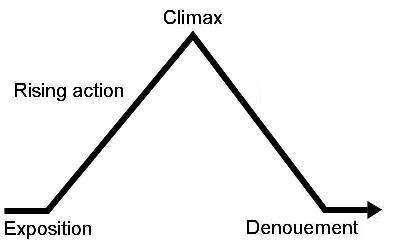
The exposition starts off with excitement over a wealthy young man (Charles Bingley) moving into the manor house of Netherfield Park. The Bennet family (including five, unmarried girls) were soon introduced. Charles Bingley, after hearing from Mr. Bennet about his daughters, is present at the ball - where he becomes attracted to Jane, the oldest of the five. After spending most of his night at the Ball enchanting Jane, it soon becomes a race to the alter. As Jane's relationship (friendship) with Mr. Bingley persists, she visits his mansion to call on his sisters. After travelling from her village in Longbourn to Netherfield - the location of the mansion - she gets sick, which forces her to stay there. Upon hearing about her sister's ailment - Elizabeth, Jane's younger sister, travels to Netherfield to tend to Jane.
The rising action in Pride and Prejudice is when Jane visits Mr. Bingley's manor house and gets sick during her stay. Elizabeth is already acquainted with Mr. Darcy and disproves of his character. Later, when the Bingleys leave the town, Elizabeth blames Mr. Darcy for the seperation of Jane and Mr. Bingley. When Mr. Whickham is introduced to Elizabeth she learns that he and Mr. Darcy have known each other for same time. After hearing some unsetlling rumours about Mr. Darcy, Elizabeth continues to make accusations about Mr. Darcy's character. The rising action takes us through a trip with Elizabeth to visit her best friend. While there, Mr. Darcy came to visit the high-class Ms. Catherine across the street. He and Elizabeth are thrown together a lot as they continue through their visits.
During the climax, Darcy overcomes alot of obstacles to get us to the point of the climax. During the climax, Darcy proposes to Elizabeth. This stuns her, but doesn't change her negative opinion of his character. She quickly rejects him, and is thrown into a bundle of turmoil that lasts over a month.
The denouement of the Pride and Prejudice was very full filling in some ways. Elizabeth was able to find it in her self to stand up for herself against Lady Catherine. This showed such strength in Elizabeth that I didn�t quite see before. It seems like Elizabeth�s love for Darcy gave her the strength she needed to actually dismiss Lady Catherine and finally get her point across. Though she (Elizabeth) was left in the dark about another proposal from Darcy, soon enough he did propose and that was what she
wanted. I thought Darcy�s character changed for the better, he wasn�t so pompous anymore and he let go of his pride and Elizabeth let go of her prejudices and it made for a good ending for this romantic novel.
Pride and Prejudice is an excellant book, both in it's written content, and the style it was written in. Jane Austen creates a masterpiece full of creative dialogue, in-depth and interesting characters, an amazing story line with a skill for twisting the plot unmatched by any other, and a creative wit. This book is written in third person limited, with the focus on Elizabeth. Jane Austen does an especially good job with describing how the characters would actually feel, and their different actions seem completely valid and natural. Another interesting point about this book, is that it conveys the idea that modesty, self-control, hope, and making wise choices is a good thing. Overall, Jane Austen wrote an absolutely amazing piece of literature that has stood the test of time, and will continue to do so.