
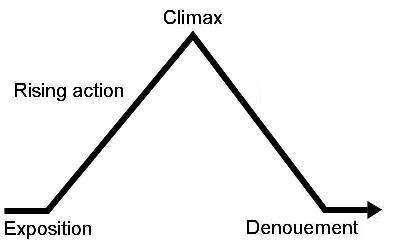
In the exposition of the story, Jonah is commanded by God to go to the city of Nineveh. He was to preach against the wickedness of the city, and their lack of concern for God. However, Jonah disobeyed God and ran away. He went down to the city of Joppa where he found a ship, paid the fare, and headed for Tarshish. Then the story takes a turn to Jonah's surprise.
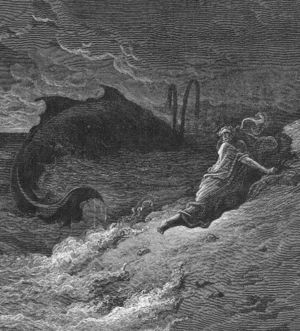
In the rising action of the story, the Lord causes a storm to come up on the seas while Jonah is asleep. All of the men on the boat call to their gods to save them, but nothing happens, and they wake Jonah up. Jonah soon confesses that he is the reason for the storm. Jonah tells them that if they throw him overboard, the seas will be calm. After trying many other methods of saving themselves, the men agree to do it and they toss him. The seas immediately become calm, and the men on the ship greatly feared the Lord. The Lord then provides a large fish to swallow Jonah. Although the writing does not explicitly say this, it seems that Jonah was drowning and crying out for help between the time he was thrown and the time the fish ate him. This is expressed in Chapter 2, when the story reverts to first person and praises for the God who saves those who call out to him. In this praise, Jonah expresses a theme of the story when he says: "Those who cling to worthless idols forfeit the grace that could be theirs".
Towards the end of the rising action, "The Lord commanded the fish, and it vomited Jonah onto dry land." (Page 1563). The Lord then commands Jonah to once again go the the city of Nineveh and proclaim His message.
During the climax of the book, Jonah actually goes through with his task and warns Nineveh of their coming destruction. The Ninevites are all remorseful for their actions, and their king issues a decree to all the Ninevite people demanding that they give up their sinful ways and follow God. The Ninevite people do, God has compassion on them, and does not bring them the threatened destruction.
During the resolution, we see a backlash in Jonah's behavior. He becomes angry with God because God had grace upon the city of Nineveh. Jonah felt that it was pointless to go to Nineveh because he knew God was slow to anger and would have grace and compassion upon the wicked people. God questioned Jonah about his reasons for anger, and Jonah proclaimed that he would rather die than remain living in his depression. Jonah removed himself to a place east of the city, to be in solitude. He was alone and God was still watching over him. God provided a great vine to shade Jonah's head from the sun and ease his discontentment. The very next day, the Lord allowed a worm to come up and suck the life out of the vine, and allowed the East wind to blow roughly and the sun to elevate to scorching heat. Jonah became overcome with more anger and God questioned Jonah once more as to why he was angry. God then patiently explained that he wanted to protect the city of Nineveh, and showed Jonah that the same grace covering the Ninevites was the grace covering him.
This book in the bible is an interesting one that explains God's grace. All throughout history, God has loved people, and given them multiple opportunities to come to him and love him back. In this book, he shows how he forgave and loved both Jonah and the Ninevites - Jonah followed God, but had his times of disbelief and disobedience, and the Ninevites entire lifestyle was seen as evil in God's sight. But God saved both of these parties, and was continuing to forgive and love them through the end of the story and beyond. This theme is a major one in the entire Bible, and is shown explicitly in Christ's death in the New Testament. God loves people, and is willing to forgive and unconditionally love those who ask for it.