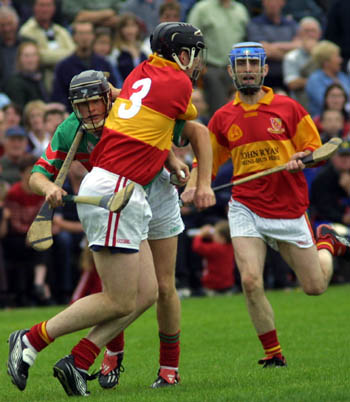
When the Celts came to Ireland as the last ice age was receding, they brought with them a unique culture, their own language, music, script and unique pastimes. One of these pastimes was a game now called hurling.
It features in Irish folklore to illustrate the deeds of heroic mystical figures such as Cuchullain, and was chronicled in writing as a distinct Irish pastime over 2,000 years ago.
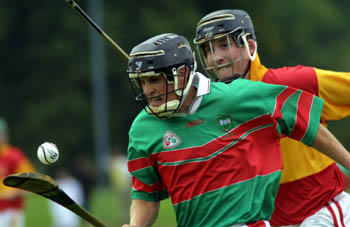
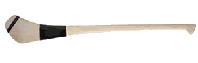
Today, hurling is Europe�s oldest field game, and the world�s fastest. Modern-day hurling involves using a curved wooden stick to propel a small ball on a grass pitch.

Both hurling and Gaelic Football are played on a pitch approximately 137m long and 82m wide. The goalposts are the same 'H' shape as on a rugby pitch, with the crossbar lower than in rugby, and slightly higher than in soccer, and a net in the lower section.
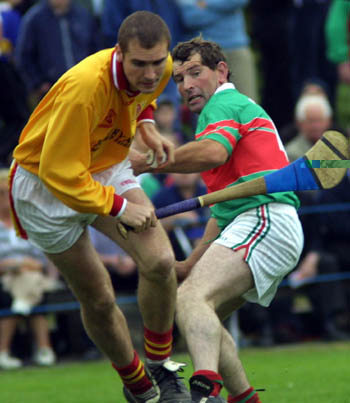
The ball may be struck with the stick on the ground or in the air. Unlike hockey, you may pick up the ball with your hurley (it may not be picked directly from the ground) and carry it for not more than four steps in the hand. After those steps you may bounce the ball on the hurley and back to the hand, but you are forbidden to catch the ball more than twice. To get around this, one of the skills is running with the ball balanced on the hurley.
The ball cannot be thrown, although a 'hand-pass' is permitted (see left photo), whereby the ball is struck with palm of the hand. The ball may also be kicked, although this is a rarely used technique. To score, you put the ball over the crossbar with the hurley to score one point, or under the crossbar and into the net for a goal, the latter being the equivalent of three points.
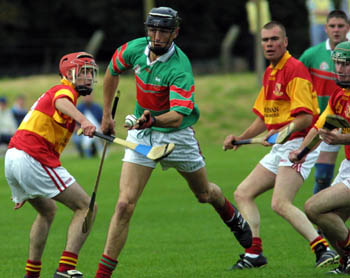
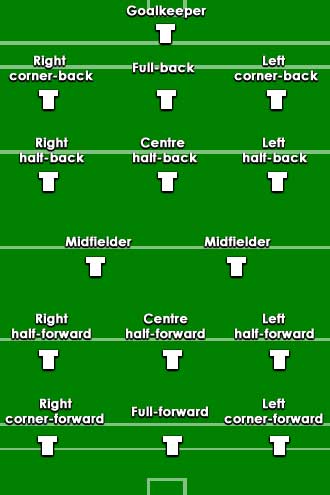
The teams line out in the same formation in both hurling and Gaelic ootball. Each team consists of fifteen players, lining out as follows: 1 goalkeeper, three full-backs, three half-backs, two midfielders, three half-forwards and three full-forwards. Players wear a jersey with their team colours and number on the back. Both teams must have different colour jerseys. The goalkeepers' jerseys must not be similar to the jersey of any other player. Referees normally tog out in black jerseys, socks and socks. Goalkeepers may not be physically challenged whilst inside their own small parallelogram, but players may harass them into playing a bad pass, or block an attempted pass. Players may switch positions on the field of play as much as they wish but this is usually on the instructions of team officials
Match officials for a game comprise of a referee, two linesmen (to indicate when the ball leaves the field of play at the side and to mark '65m' free kicks and 4 umpires (to signal scores, assist the referee in controlling the games, and to assist linesmen in positioning '65m' frees).