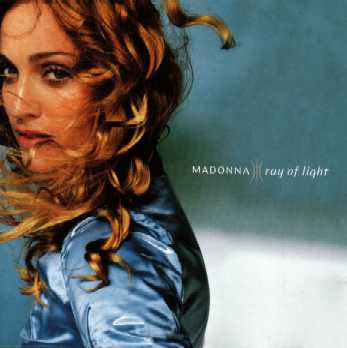
Released as another rebranding of Madonna, this cathartic album came out some four years after her last studio album 'Bedtime Stories'. But boy, was it worth waiting for! Heavily influenced by the birth and early life of Madonna's first child, Lourdes, and with a big liquid feel; melodies and rhythms wash and flow into each other. This, however, is not a current of water but of electricity: the album is propelled by synthesized sounds, electronic drumbeats and artificial noises. Madonna's collaboration with the British producer William Orbit has become a modern day legend.
Songs
- Drowned World/Substitute For Love*
- Swim*
- Ray Of Light*
- Candy Perfume Girl*
- Skin*
- Nothing Really Matters*
- Sky Fits Heaven*
- Shanti/Ashtangi*
- Frozen*
- Power Of Goodbye*
- To Have And Not To Hold
- Little Star*
- Mer Girl*
- (Has To Be)*
Drowned World/Substitute For Love is a hybrid of two component songs, and you can tell the difference between the two halves. But they have been welded together so seamlessly that it just seems like different phases of the same song. This is reputed to be Madonna's favourite song from this album, and even if one does not agree, one can certainly see why. It contains a poignant lyric which shows Madonna in the sudden realisation of how shallow fame can be. 'Drowned World' stays in the senses long after the final track has faded, such is its beauty and power. In a soundscape that sounds like a submarine trying to surface, the track shimmers into your senses for a full 6 minutes. The opening is spooky, all ethereal airs opening onto a gorgeous slow vocal before breaking into an equally slow beat that builds easily on a stuttering pattern before a guitar picks in 'Substitute For Love' which opens into a backbeat kicked dubby groove. There is even the hint of a jungle breakbeat, which is a piece of genius by producer William Orbit. Madonna's singing is extraordinary: beautifully phrased, no over-reaching, pure and emotive. Then, almost from nowhere, big, fat electric guitars drop into the mix and the whole thing metamorphoses into a rock song. In a video that was criticised as being too much like the plight of the late Diana, Princess of Wales, she flees from pursuing paparazzi, only to have her picture taken by hotel maids. Sporting a simple look in the video, Madonna creates a dreamy atmosphere and this is a worthy start to the album. The song is inspired by British author J.G. Ballard's apocalyptic 1962 novel 'The Drowned World', which is the first of four futuristic disaster novels by Ballard - each with their own theme of Air, Fire, Water, and Earth - in which the protagonist, at the end of a long journey through fire-engulfed and fantastic worlds, discovers the Truth. 'Drowned World/Substitute for Love,' draws the analogy between Ballard's ravaged landscapes and Madonna's former soul-killing obsession with success. Mature Madonna's 'truth' has turned out to be not showbiz but love, motherhood, and family. This is especially well expressed in two different ways by two parts of the song: in one part she sings "famous faces, far-off places, trinkets I can buy. No handsome stranger, heady danger, drug that I can try. No ferris wheel, no heart to steal, no laughter in the dark. No one-night stand, no far-off land, no fire that I can spark...", starting softly and increasing in volume and emotion until the end where her rage is something quite marvellous - one of the best parts of the entire album. The second is at the end, where she sings softly "and now, I find I've changed my mind. This is my religion.".
In Swim, Madonna tells of the evils of the world and comforts the listener. It is a very soothing and guitar-laden song, and the water theme is evident in the music and the flow of words. The gorgeous indie-rock guitar intro of this dubbed-rock song has been described by some as one of the best guitar intros of all time, and the pronounciation of the vocals are poignant because the day that Madonna sang them, she had a call on the way to the studio that her next door neighbour - Gianni Versace, the famous fashion designer - had been murdered. Though Madonna's lyrics skirt vaguely around the issue of the world's loss of spiritualism, she sounds 100% sincere and the track is over almost too quickly.
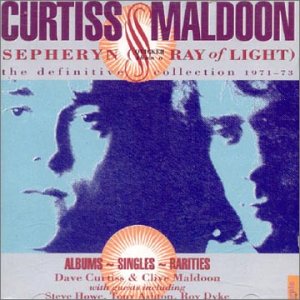
Title track Ray Of Light has a very different beat, with a strikingly distinctive guitar riff. Energetic, dynamic, pulsating and even operatic at times, the title track has been hailed as the best song by Madonna, by a lot of people. The video is unmissable for its speeded up effects, mirroring everyday life. What most people don't know is that this is a cover of a song by Curtiss & Maldoon in the 1970's. 'Sepheryn' was a song they had originally written and recorded (see thumbnail below which is of a retrospective 'best of' collection they released after Madonna's version became a hit) and it was reworked by a niece of one of the duo, Christina Leech for herself.
Neither of the previous versions however, was anywhere near as successful as this song, which benefits from 'orbitalisation' and Madonna's mastery of voice, gliding in and out of falsetto range, even tossing off a little Aretha-like growl and culminating in a shriek of sheer ecstacy - for the only time on the record, she breaking into wails, losing language altogether, before regaining it with "and I feel, and I feeeeel like I just got home" - which is remarkable in that it works in the context of the song, something that only true masters can achieve. The intro is like a rising sun after a nuclear holocaust and its a stunningly optimistic dance orientated track where Madonna voice soars way way above the fallout. The music bops from hypnotic disco to anthemic pop in a way that is simply remarkable. Sounding like Kate Bush on an E-pill, 'Ray Of Light' is the perfect antidote to the miserable lyric of all her female (and male) songwriting contemporaries. So proving that a great great song can still be a happy one. What exactly it is about, is a matter for debate. To me, it's about a journey through life to death, signified at the end by Madonna headbutting a glass pane and collapsing almost in ecstacy while the Earth spins on.
Candy Perfume Girl has a feel of rock, almost neo-punk in style and yet strangely ambient hip-hop at the same time. The lyrics are very wierd indeed (though at heart it is a simple song beckoning a lover onwards) as is the music (packed with beats, distorted sound and circus-like music breaks), but the overall effect is actually rather good. The androgeny theme of Madonna of yesteryear is revisited here with an improbable merging of sexes, "boy/girl, boy/girl, boy...", which perhaps is not about adrogeny after all, but pure and simply rather about sex! Only Madonna knows.
With Skin (originally and slightly pretentiously called 'The Flirtation Dance'), Madonna delves as deeply into the underground as she ever has. At the beginning of the song Madonna quavers "Put your hand on my skin," as if she were a tiny waif trapped inside an old transistor radio, even as a bone-shaking groove wells up and threatens to swallow her. Of course, she returns, full-size, and rises above the hurtling rhythms. With its arabic embellishments and hastening beats, 'Skin' manages to keep up the impossible standards set by the first three tracks. It has a very trancey feel at times, and though not instantly likeable in the way 'Ray Of Light' is, it grows on you, and it grows during the song as well, in a manner that reinforces the dreamy quality. Slowly building up, wave after wave, it has a more spicey and eastern feel to it than the previous songs. Very Eurodance-influenced, it's a complex dancefloor stomper twisted by Orbit from a Pat Leonard song, thus combining Orbit's technical wizardry (running vocals through hi-hats, thereby deconstructing the vocals and the music) with the proven genius of Leonard's songwriting.
Nothing Really Matters is a lively song telling how love (of her daughter Lourdes) overcame selfishness (of her previous materialistic, fame-hungry lifestyle). The video is memorable for the red kimono Madonna wears and for the 'Geisha' look she sported. This is possibly the closest Madonna gets to her old style of song, straightforward dance pop, floating by almost as if it's asleep, a knowing return to the disco diva-effortlessness of 'Vogue', but with Madonna free from the narcissistic outer-shell of old, free to announce: "I've realised, that nobody wins..."
Sky Fits Heaven is a glorious, heavy bass-led track peppered with mad drumming and eerie synth sounds - one that, in my opinion, should have been released as a single. It is very uplifting and perfect for playing in the car on a hot day on the highway ("travelling down, this road, watching the signs as I go, I think I'll follow, the sun..."). It continues the theme of the album, namely making your own life, and 'the sky is the limit'.
Shanti/Ashtangi is quite unlike any other song Madonna had ever sung, being almost tribal techno. Heavily influenced by India, there is not a single word of English as it is sung entirely in the ancient language of Sanskrit. The words are genuine mantras, and send a shiver down the spine with their authenticity, helped by capable pronounciation by Madonna. There is, however, a bit of humour there - for instance, some of the music in the middle sounds just out of Bollywood rather than out of Vedic Hindu scripture. I find a phrase from the song helps when you're nervous, e.g. before an exam. 'Om shanti' is a combination of the sacred hindu meditative syllable 'om' and 'shanti', which means 'peace'.
Frozen (another Orbit/Leonard collaboration) was the first single released from this album and is frankly, quite astonishing. Also influenced by India (evident from the mehindi figure of 'om' written on her palm in the spectacular video), this atmospheric beauty is haunting (especially the chorus), wierd and beautiful in equal measure. A magic spell seems to be cast on the listener, as Madonna beckons "give yourself to me", to the backdrop of windswept ambience and blunted beats which deepen the pathos of the song's lyrics. Time loses all meaning when listening to this song, and indeed it does seem to transcend time. It moves with an eerie, theatrical intensity, sheer simplicity is what makes it stick. Though it is a ballad (though it doesn't sound like a typical ballad), and though it is certainly slower than the preceding tracks, there is nothing boring about this track. It opens on strings before breaking into one of those glorious vocals that just oozes sensuality and atmosphere. The song folds back on itself with strong but random-sounding kettle drums echoing and a string-blissed centre which add to the grandeur of this majestic song, and Madonna's clear voice really adds the icing to this most delicious of cakes. Like 'Ray of Light', this is a clearly groundbreaking track.
Power Of Goodbye is another great song. The intro is incredibly cool and the blue-hued video sees Madonna looking simply stunning without any embellishment, healthy and shining. It is arguably the most compelling ballad of Madonna's career. Music-wise, acoustic guitar blends into keyboard reggae rhythms as Madonna bids farewell to a lover. Drawn from despair, it is an altogether beautiful ballad. In this song Madonna echoes what she first considered in her 'Promise To Try' back in her 'Like A Prayer' days, namely closure and the ability to move on - in this case the end of a relationship, rather than the loss of her mother in 'Promise To Try', perhaps talking about how she was finally over her ex-husband, Sean Penn. Madonna's voice is simply beautiful and radiant here.
To Have And Not To Hold is a very capable ballad - a delicate chant-like track in which Madonna's voice weaves through the melody - but it suffers through no fault of its own from following the previous few songs. The Indian theme is maintained, with the repetition of a Sanskrit phrase from Shanti/Ashtangi, and it is about how the relationship is there, but not complete. Some of lyrics are really good "like a moth to a flame, only I am to blame..."
Little Star is a pretty music box-lullaby of a song and is, quite clearly, about Madonna's daughter Lourdes. Charming and full of motherly love, the song gently instructs the baby to "never forget who you are, Little Star" and thanks God for the present. Touching, genuine, like all songs of this nature by acclaimed artists, this also has the virtue of being a good song (with good lyrics) too, which is something other artists, understandably perhaps blinded by parental love, often fail with when approaching this issue.
Mer Girl is the last song in the album and it is so wierd, it can put you off. There's always one, isn't there? Across a canvas of echoes and shades, Madonna intones a lyric that, if it were a poem, would puzzle thesis writers for years to come. It begins "I ran from my house that cannot contain me and a man that I cannot keep, from my mother who haunts me even though she's gone and my daughter that never sleeps", and then expands into a weird pastoral/feminist fantasy ending amid "burning flesh and crumbling tombstones". But stick at it, listen to it with your eyes closed and with no distractions, and you'll discover that it is actually really good. Built slowly around an engaged telephone tone and filled with spoken word, it draws you into its dreamworld and is depressing, haunting and downright bleak at points. Inspired by a family gathering where Madonna took cover from a downpour under a tree and watched rain falling on 'crumbling tombstones', it is a waking fever-dream flight from ghosts that can't be shaken ("I ran to the sky, out to the lake, into the rain that matted my hair and soaked my shoes and skin"). 'Mer Girl' is about everything that the rest of the album isn't, i.e. negativity and hopelessness - and the death of her mother when Madonna was a child. Or is it? Perhaps the very fact she has written about her nightmares has been a positive thing, perhaps it has helped achieve the 'closure' as advised in 'The Power of Goodbye'. Whichever way, 'Mer Girl' is disturbing but is further proof of the self-assuredness of this great songwriter. Another spine-chiller, though it doesn't try to frighten. A strange, but fitting end to this emotional, sometimes downbeat, sometimes vibrant and totally mad album.
Actually, there is a bonus song, available in some parts of the world - Has To Be. It is an evocative and moving song, where Madonna quietly sings 'I know there's someone out there, waiting for me, there must be someone out there, there just has to be." The haunting but familiar Orbit squeaks and bubbling sounds with delicate guitar strumming compliments the choiral backing to create a shimmering soundscape, by now familiar to anyone listening to this album. There is a hint of the East in the song, but not as much as in some of the other songs on the album. A wondrous song that European fans will have missed, unless they bought the import version.
RatingFour years since her last studio album, this was the longest gap in Madonna's recording career to date, despite the release of her greatest ballads collection 'Something to Remember' and her musical film 'Evita' in 1995-1996. While still managing rather stable sales figures of 6 or 7 million, Madonna had past her commercial peak. The success of 'Evita' could have managed to remove her from the pop career altogether but Madonna returned to the studio with a new confidence in her voice (thanks to Evita), and her life (thanks to the birth of Lourdes). In contemplative mood, she arrives back on the scene she once dominated, just as the era of dance had branched out into garage, techno, and trance music. With her own melodies, and the services of trance wizard William Orbit, Madonna came back with an album that re-established her role as the premiere female of pop/rock. In her absence had come a number of females who suddenly had become sexually awakened (Alanis Morrissette, Mariah Carey, Janet Jackson). Hell, even Icelandic banana-case Bjork was singing about cunnilingus and other sexual habits. Madonna, of course, had moved on. Motherhood seemed to have changed her perception of life and her won celebrity.
This album contains ethereal pop-styled melodies nourished with beautiful sunlit vocals - brainchildren of Madonna and such talented songwriters like Patrick Leonard, Rick Knowles and Babyface. Renowned dance producer William Orbit then came along and embedded wave after wave of sizzling funky rhthyms and state-of-the-moment techno soundscapes into these songs, turning them into breathtaking, adrenaline-charged tracks that sound like they have been derived from out of this world, yet earthly and human enough to remain in it.
In this most human of albums since the similarly cathartic 'Like A Prayer' of 1989, the sound of a numb Madonna - perhaps guilty in the past of projecting idealised, if self-empowering, images instead of her true self - trying to reconnect to her own emotions has poignancy akin to the Tin Man searching for a heart, or Spock struggling to come to terms with his human half. It is here that Madonna truly reaches the status of artist (rather than a mere pop singer, albeit the most famous one of all time) though there were hints of this in 'Like A Prayer'.
Whether it was the birth of her first child, or the singing lessons she received before 'Evita', or both, Madonna's voice has definitely grown and has acquired some new dimensions to it. Orbit's contribution cannot be overemphasised, but it is an equal partnership of invention (it is interesting, for instance, to note that this album is far deeper and more evocative than any of Orbit's own, admittedly very stylish, albums), and Orbit rates Madonna very highly as a producer. In my opinion, this is easily Madonna's best original album to date. A MASSIVE 10/10.
� Josh Deb Barman & Topman 2000