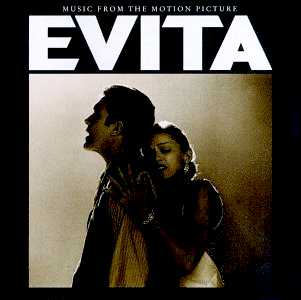
E V I T A
This is the best and most acclaimed film Madonna has ever starred in, winning her a Golden Globe. Award-winning songwriter Andrew Lloyd Webber and lyricist Tim Rice combine their talents with Madonna's superb voice, with excellent support from Antonio Banderas and Jonathan Pryce. The music is powerful and moving. An unmissable event!
Songs
- Requiem For Evita
- Oh What A Circus*
- On This Night Of A Thousand Stars*
- Eva And Magaldi/Eva Beware Of The City*
- Buenos Aires*
- Another Suitcase In Another Hall*
- Goodnight And Thank You*
- I'd Be Surprisingly Good For You*
- Peron's Latest Flame
- A New Argentina
- Don't Cry For Me Argentina*
- High Flying Adored*
- Rainbow High*
- And The Money Kept Rolling In (And Out)*
- She Is A Diamond*
- Waltz For Eva And Che*
- You Must Love Me*
- Eva's Final Broadcast
- Lament*
Requiem For Evita is, as the name suggests, a requiem, but its slow majesty is quite breathtaking. The interesting contrast between the rock guitar and the classical orchestral instrumentation & choir is jarring, but whether it works depends on personal preference. It is a mostly instrumental track, containing no main vocals.
Oh What A Circus is the first time we hear one of the characters singing and lifts the heavy mood set by the preceding track, with a bright set of Spanish guitars. It is performed by, Che the cynical commoner, played by Antonio Banderas, and it is basically a more upbeat version of 'Don't Cry For Me Argentina'. Che tells how the reaction to Evita's is overblown, considering what a person Eva Peron was, in his opinion. After a choiral section in the middle, there are dramatic changes in rhythm near the end, the song transforming into a rock song, with a few tumbling piano glissandos. The choir returns unaccompanied, the orchestra kicks back and then we get a first 'glimpse' of Madonna in this song, as the spirit of Eva.
On This Night Of A Thousand Stars is the first song in the chronology of the film, and is performed by Jimmy Nail, as Augustin Magaldi, the mediocre singer who first 'discovers' Eva Duarte, as she is then. Nail is a good singer, and better, a good actor, so he doesn't make the performance too good, as Magaldi is an indifferent singer at best and the song is deliberately cheesey.
Eva And Magaldi/Eva Beware Of The City is a duet between Nail and Madonna, with a rock backing. This is the proper entrance of Eva as a young, ambitious girl, who is determined to go with Magaldi to Buenos Aires...but he isn't so keen. A wonderful song built around an argument. The hook "I want to be a part of 'B' in Buenos Aires, Big Apple" is particularly effective, as is a tender little unaccompanied set of vocal lines by Madonna. Then the song changes tune, with another male singer with Nail. Then Madonna discordantly crashes the tune with a solo passage, before the 'Eva piano-backed Beware of The City' starts.
Buenos Aires is a real rocker of a song, where the energetic Eva succeeds in getting Magaldi to take her to Buenos Aires, and she is telling the City to look out for her talent, as she's determined to make it big time. Though written by Lloyd Webber and Rice, is this analogous to the young Madonna's journey from Bay City to New York? Maybe this is why she identifies with this song and performs it brilliantly.
Another Suitcase In Another Hall (originally recorded by Barbara Dickson in 1977) is a sadder song which is sung after Eva is effectively dumped by Magaldi and turned away from many jobs. It is a quite beautiful song carried by strings and subdued acoustic guitar, and Madonna does it great justice, singing in a gentle voice. A small snippet is sung later on in the film by a young Andrea Corr, whose character is displaced by Eva as Peron's new girlfriend. This was a big hit for Madonna in 1997, which is not surprising as this song is capable of standing alone from the film, as it has its own meaning - the urban rootlessness of modern society, objectified by a suitcase in a hall.
Goodnight And Thank You is mainly sung by Madonna and Banderas, and is a slightly humourous song detailing how Eva used a series of men to climb the social ladder. Bright and breezy, with trills of flute, as well as horns and strings as instrumentation - making it sound almost circus-like at points - and includes a bizarre but effective inclusion of a soap commercial fitted into the tune!
I'd Be Surprisingly Good For You is set at the turning point of the film, when Eva meets Colonel Juan Peron (played and sung by Jonathan Pryce) for the first time. It is love at first sight, and the song is equally beautiful - in my opinion, one of the most beautiful in the film. Although it's a duet, Madonna does most of the singing in this seductive song. Starting off as a recitation alternating between Madonna and Pryce, leading into a gentle ballad with flute, classical guitar, subdued strings and congas, as well as saxophone and bass to add smoochiness. This sexy shuffle has Madonna expressing herself (sorry!) beautifully with her voice, really getting into the theme of things. Banderas comes in with a few lines at the end, which is sudden. The most refreshing thing about this song is that the tune is different from the generic ones used throughout the rest of the soundtrack.
Peron's Latest Flame is a rambunctious song with a good rhythm which shows, however, that not everyone in Argentina approved of Peron's choice of girlfriend, calling her a slut and a bitch. A strong martial drumbeat and brass is complimented by tom-toms, prog-rock guitar and some synth solo, and there are a variety of voices used, male choir and mixed choir mostly, with Banderas at points. Madonna has a few lines justifying her position.
A New Argentina is a populist song demanding change for the people. It is not a very remarkable song (despite aspiring to Queen-like status with a rock stadium feel), but as it is sung by a crowd as almost an anthem, it's OK. Madonna sings aggressively with a growl in her voice as her character turns into something of a demogogue.
The most famous song in the film is, of course, Don't Cry For Me Argentina. A real musical classic, which Madonna does not disappoint with, with a performance worthy of Elaine Paige and Julie Covington (who took it to UK number 1 in 1977), previous incarnations of Evita. Evita appeals to the people for support after Peron becomes President with a vast dose of fake humility and popularism, and she is stunningly successful. The song starts with strings only, to which harp is added. The second verse sees the introduction of light percussion with acoustic guitar. A fine piece of drama it is, but perhaps a little overdone over the years and certainly within the film and soundtrack this tune rears its head more than once.
High Flying Adored is mostly sung by Banderas (but ended by Madonna), where Che tells how Eva Peron is now the darling of the people and is well loved by everyone except the elite. But Che's cynicism is evident and he says that it is too much too soon. The style is far less grandiose than the previous track, more resembling a pop song - perhaps even by Elton John! Nothing truly remarkable about this track however.
Rainbow High is a song that allows Madonna to use operatic vocals, and she does with ease, her singing lessons obviously proving their worth. Eva is beginning to enjoy her position as First Lady and is concerned with her image and spends a lot of money, because the people "need to adore me, so Christian Dior me, from my head to my toes". A wonderfully powerful song, instrumented with drums, horns, strings and electric guitar, and even featuring a small section of salsa near the end.
And The Money Kept Rolling In (And Out) and She Is A Diamond are more routine songs, necessary to tell the story of how Eva pleased the public (superficially, says Che) and how her star began to fade, though she kept Peron in power, respectively.
The Waltz For Evita And Che, however, is a classy, authentic duet where a clearly ill Eva is in a delirium and dreams a waltz with Che, who challenges her policies while she attempts to justify them. A really fabulous scene in the film, for the dreamlike dancing, pain and passion, it needs to be seen to be fully appreciated, though it is an effective enough tune if simply heard. The music itself is nothing special, being rather music-box in style with guitar and oompah brass and timpani in the louder parts.
You Must Love Me provided an accolade, a coveted Academy Award (Oscar) for Best Song from a Motion Picture as well as a hit single in 1996. It is a tear-jerker, where Eva, dying of ovarian cancer, tells Peron not to grieve too much and that he must love her. A really thoughtful piano ballad, it is however not in the same league as tear-jerkers of Madonna's past like 'Promise To Try'.
Eva's Final Broadcast is basically Don't Cry For Me Argentina all over again, but the emphasis is quite different. The original was 'don't cry for me though I am now not one of you', and this version is 'don't cry for me though I'm dying'. Packed full of emotion, with a voice made impressively flawed through sickness and sorrow, Madonna as Eva really gets into character. The instrumentation is woodwind and sombre horns in the intro and a passage sung by a choir in Spanish which is accompanied by rolling drums and strummed acoustic guitar with a rumble of piano at the end. Possibly one of the more interesting tracks, musically speaking.
Lament for Evita is started by Che but finished by Eva's spirit (with quavery vocals from Madonna), accompanied by guitar with the help of some magnificent but ever so slightly vulgur orchestrals (timpani thunder, brass rumbles etc), is a typically beautiful ending to an awe-inspiring musical film.
RatingCan you believe that this film was originally supposed to star Michelle Pffeifer or Meryl Streep? Despite Pffeifer's experience in 'Grease 2' and despite Streep's undoubted (and far superior) acting skills, it would certainly have flopped without a singer of Madonna's stature and presence. As it was it was more critically than commercially successful (it was only moderately high in the popular ratings). But critics mostly raved about Madonna's performance and the quality of the songs and directing. This film proved that Madonna could act, given the right setting and support. Some of the songs are magnificent, sometimes terrifying in their scale and at times quite awesome in their quality, and the music is lush. The big surprise is, however, Banderas's voice. He can sing, and it was not a case of Madonna holding him upright, and even Pryce did well. The album is well worth getting, but I would get or watch the film first, as the images do help to give the context, and this as well as the fact that it is not a 'Madonna' album in a stylistic sense that stops the album getting higher marks in my opinion. Only 'Another Suitcase In Another Hall', 'Don't Cry For Me Argentina' and possibly 'You Must Love Me' are effective enough on their own to stand alone from the film as tracks. Despite this, this film and soundtrack are important in Madonna's development, as her vocal training with renowned vocal coach Joan Lader in preparation helped Madonna develop the refined voice she displayed during Evita and post-Evita with her own material. A timeless 8/10.
� Josh Deb Barman, Topman, Rikky Rooksby 2000