Nov 8 Chapter
9 Patterns of Inheritance (continued)
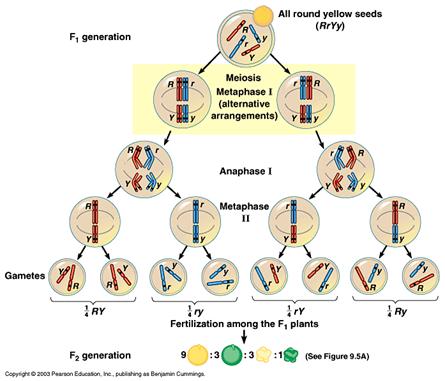
3) Mendel’s principle of independent assortment
(Mendel’s second law of inheritance)
dihybridcross – Cross of parents differ in two
traits.
“Each
pair of alleles segregates independently during gamete formation.”
True
for traits that resides in different chromosomes.
<Example>
Two traits
in pea Seed shape:
round (R), winkled (r)
Seed
colour: yellow (Y), green (y)
Parents’
traits (genotype): round and yellow (RRYY) x
winkled and green (rryy)
Genotypes of
gametes: RY ry
F1
generation (genotype): All round
and yellow ( RrYy)
Genotypes of
gametes: RY, Ry, rY or ry
F2
generation
|
|
RY |
Ry |
rY |
ry |
|
RY |
|
|
|
|
|
Ry |
|
|
|
|
|
rY |
|
|
|
|
|
ry |
|
|
|
|
Genotype
ratio RRYY : RrYY : RRYy : RrYy : RRyy
: Rryy : rrYY : rrYy : rryy=
Phenotype
ratio
Round and
Yellow: Round and Green : Winkled and Yellow : Winkled and Green =
Chromosome
basis of inheritance
4) Variation in Mendel’s principle
a. incomplete dominance
-Heterozygotes
exhibit intermediate phenotype.
example 1. colour of snapdragon flower
red
flower: RR
white
flower: rr
pink
flower: Rr
Monohybrid
cross of red and white flower parents
P
generation RR x rr
F1
generation Rr (pink)
F2
generation
|
|
R |
r |
|
R |
|
|
|
r |
|
|
genotypic
ratio
phenotypic
ratio: red flower: pink flower:
white flower =
example
2
hypercholesterolemia
Fig 9.12, p168
b. multiple alleles
-Many genes have more than two alleles in the
population.
Example: ABO
blood type
- Blood type is determined by presence and absence of
specific sugar chains on the surface of red blood cells.
- Two types of sugar chains: A and B chains
- Alleles that express A and B chains are represented
by IA and IB,
respectively.
- The recessive allele i represents inability to
produce neither A or B chains.
- A person may have
|
sugar
chains |
blood type |
genotype |
|
neither A
or B |
O |
ii |
|
only A |
A |
|
|
only B |
B |
|
|
both A and
B |
AB |
|
Codominance
– expression of two alleles in heterozygotes
(Note the difference between incomplete dominance and
codominance.
incomplete dominance – intermediate phenotype in
heterozygotes)
IA
and IB alleles are codominant.
ABO blood type (continued)
-
Human bodies produce antibodies
against molecules foreign to themselves.
|
sugar
chains |
blood type |
antibodies
against |
can
receive blood |
|
neither A
or B |
O |
|
|
|
only A |
A |
B chain |
A or O |
|
only B |
B |
|
|
|
both A and
B |
AB |
|
|
-
This limits types of blood a person
can receive through blood transfusion.
-
Receiving
wrong blood can be fatal!
-
Blood type can be used for paternity
analysis.
c. pleiotropic effects
A single gene
can affect many characteristics.
example 1 sickle-cell disease (Fig 9.14,
p170)
example 2 Hungtington’s disease
example 3 albino
d. polygenic inheritance
-
A single characteristics can be
influenced by multiple genes.
-
additive effects
ex. height, skin colour
e. inheritance of linked genes
i) linked
genes
- Genes on
the same chromosome tend to be inherited together.
- They do
not follow Mendel’s principle of independent assortment.
ex. sweet
pea
Purple
flower: P, red flower: p
Long pollen: L, round
pollen: l
The P and L
genes are on the same chromosomes. If
there is no crossing over, they will always segregate together. P and
L genes are linked.
dihybrid
cross: purple flower, long pollen x red flower, round pollen
genotypes of
parents: PPLL x ppll
genotypes of
gametes: PL pl
F1
generation: All
PpLl (purple flower, long pollen)
genotypes of
F1 gametes: PL, pl
F2
generation
|
|
|
|
|
|
|
|
|
|
|
|
Genotypic
ratio:
Phenotypic
ratio:
ii) genetic
recombination
In reality, F2 generation always contains a small
proportion of recombinant phenotypes due
to crossing over.
Crossing over produces new combinations of alleles
(Fig 9.19A, p175).
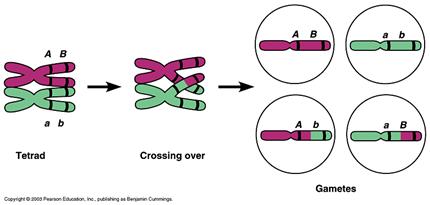
In
the example of sweet pea plants, crossing over would produce gamete genotypes
such as Pl and pL.
As
a result, about 10 % of F2 generation shows recombinant phenotype (Fig 9.18,
p174).
Can
you identify recombinant phenotypes in the Fig 9.18?
iii)
recombination frequency vs. genetic map
Recombination frequency -
the percentage of recombinants in offspring.
Recombination
frequency (%) =
(number
of recombinant / total number of offspring) x 100
ex. Fig 9.18
number of recombinant 21 + 21= 42
total number of offspring 284+21+21+55= 381
recombination frequency 42 / 381 = 11 %
-
Recombinant frequency is higher between genes located further apart in the
chromosome.
-
Physical distances between gene loci can be estimated via recombination
frequency (Fig 9.20, p176) ® Genetic
map
Example:
If recombination frequencies between three genetic
loci A, B and C are
A and B 20 %
B and C 15 %
C and A 5 %
Genetic map of
loci A, B and C would be:
The Nov 13
class will deal with some issues concerning the genetic testing. Please read the following paragraphs before
next class and think of what you would do if you were placed in these
situations. There is no right or wrong
answers to these issues. It is up to you
to make decisions.
(These
paragraphs are taken from “Your Genes, Your Choices.” by Catherine Baker issued by American
Association for the Advancement of Science (AAAS). You can access the book from the web site http://ehrweb.aaas.org/ehr/books/
.)
Priya
Should Find Out She Inherited a Fatal Disease (or should she?)
Priya has just lost her mother to an illness called Huntington’s disease.
It was hard for Priya to watch her mother die. First her mother had strange
changes of mood. Then her arms and legs began twitching. Soon she couldn’t talk
or control her movements. In the end, she was totally bedridden and could
barely get food down without choking. Priya knows that Huntington’s disease
usually strikes people in middle age. It is always fatal, and there is no
treatment. She also knows that since the disease is inherited, she has a strong
chance of getting it herself. Priya just learned about a test she can take. The
test will tell if she carries the gene for Huntington’s disease. She is tempted
to take the test. She thinks that if she could find out once and for all
whether she will get the disease, she could plan for her future. On the other
hand, she wonders if it is better not knowing. At least then Priya would still
have some hope. If you were Priya, what would you do?
Carlos
and Mollie Can Have a Perfectly Healthy Baby (or can they?)
Carlos and Mollie want to have children. However, they haven’t tried to
start a family yet because they disagree on something important. Carlos wants
Mollie to get tested to see if she is a carrier for cystic fibrosis (CF).
Mollie doesn’t want to do it. People with CF have mutations in one or more
genes. These mutated genes give faulty instructions for the production of proteins
that help move salt in the body. One result is that the lungs become clogged
with mucus, making it hard to breathe. Another result is that the body has a
hard time digesting food. The disease can be painful and lead to an early
death. Carlos had a brother with CF. He hated seeing his brother suffer so
much. His parents struggled with the hardship and expense of caring for a sick
child who never made it to adulthood. Carlos doesn’t want to repeat that
experience in his own life. That’s why he had himself tested for CF.
Unfortunately, he found out that he is a carrier. CF is a recessive disorder.
That means his children will have the disease only if they inherit the mutated
gene from both parents. Mollie can get tested to see if she carries the CF
mutation. If she does, then when she gets pregnant they can have the fetus
tested to make sure it does not have two CF genes and is therefore free of the
disease. Mollie would prefer simply not knowing what the risks are. She figures
that once a baby is in their arms, they will be glad they had it, no matter
what. If you were Mollie or Carlos, what would you do?
Howard’s
Health Is Up to Him (or is it?)
Howard will turn 50 soon, and it worries him. His grandfather died of a
heart attack in his fifties, and so did his father and uncle. Several years
ago, a doctor told Howard that he was at high risk for heart disease because of
his family history. But the doctor said that Howard could improve his chances
if he lost some weight, stopped smoking, and exercised. The doctor also told
Howard to come back every year for a checkup. Howard hasn’t gone on a diet, and
he hasn’t given up his cigarettes or taken up exercise. He also hasn’t been
back to the doctor. He’s afraid of what the doctor might find. Howard can’t
make up his mind. Sometimes he thinks he should try to take better care of his
health. Other times, he thinks that he should just accept the fact that he
won’t live much longer and should get as much fun out of life while he can. If
you were Howard, what would you do?