Nov 6 Chapter
9 Patterns of Inheritance (continued)
Genetics of autosomal dominant traits
-
They don’t skip generation.
-
If one parent is homozygous for a
dominant trait, the probability of their child getting the same trait is 100%.
Parents’ genotypes: AA x AA
AA x Aa
AA x aa
-
If both parents are heterozygous for
a dominant trait, the probability of their child getting the same trait is 75 %.
Parents’ genotypes: Aa x Aa
|
|
A |
a |
|
A |
AA |
Aa |
|
a |
Aa |
aa |
genotypic ratio AA
: Aa : aa = 1 : 2 : 1
phenotypic ratio dominant
: recessive = 3 : 1
-
If one parent is heterozygous for a
dominant trait and the other parent don’t have the trait, the probability of
their child getting the same trait is _______.
Parents’ genotypes Aa x aa
|
|
|
|
|
|
|
|
|
|
|
|
genotypic ratio
phenotypic ratio dominant
: recessive =
Genetics of autosomal recessive traits
-
They can skip generation.
-
Carriers
– Individuals who do not show
the recessive traits, but carry recessive allele (gene). They are heterozygous.
Example - The child of a health couple has cystic
fibrosis because the parents are carriers
of cystic fibrosis allele.
-
If one parent is heterozygous for a
recessive trait and the other parent is homozygous for a recessive trait, the
probability of their child getting the recessive trait is __________.
Parents’ genotypes: Aa x aa
|
|
|
|
|
|
|
|
|
|
|
|
genotypic
ratio
phenotypic
ratio dominant : recessive =
-
If both parents are homozygous for a
recessive trait, the probability of their child getting the same trait is
_______.
Parents’ genotypes: aa x aa
-
If both parents are carriers of a
recessive trait, the probability of their child getting the recessive trait is
_______.
Parents’ genotypes: Aa x Aa
|
|
|
|
|
|
|
|
|
|
|
|
genotypic
ratio
phenotypic
ratio dominant : recessive =
Human
genetic disorders
-
Most human genetic disorders are recessive.
-
Marriage
between close relatives increases the probability of
producing children with harmful recessive traits.
Example 1.
High frequency of deafness in Martha’s Vineyard is the result of frequent
marriage between close relatives.
Example 2. High frequency of hemophiliacs (sex-linked recessive disorder) among royal
families in Europe.
-
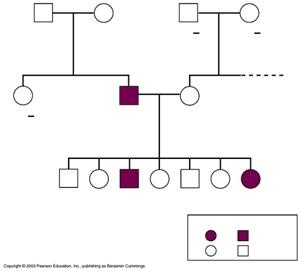
Pedigree
(family tree) helps to keep track of family history for the trait.
Example: Inheritance of the deafness gene
-
The frequencies of genetic disorders
differ in different regions and different population.
Example 1 Frequency of cystic
fibrosis
1/17,000
African American
1/90,000 Asian American
1/1,800 Caucasian American
Example 2 Andermann's
Syndrome (Read the CBC news article shown in the last page of this lecture
note.)
Example problems
1.
Dwarfism is a dominant trait. If one parent is dwarf and the other parent
is normal height, the probability of their child being dwarf is ________ .
Dwarf allele: DW
normal
allele: dw
Note:
The dwarf parent is heterozygous for the dwarfism trait. Homozygous genotype is fatal.
Parents’ genotypes: x
|
|
|
|
|
|
|
|
|
|
|
|
Genotypic ratio:
Phenotypic
ratio: dwarf : normal =
2.
Deafness is a recessive trait. One parent is deaf and the other parent is
normal. If their first child is deaf,
what is the probability of the next child being deaf.
Deaf allele: d
normal
allele: D
Parents’ genotypes: x
|
|
|
|
|
|
|
|
|
|
|
|
Genotypic ratio:
Phenotypic ratio: deaf :
normal =
3.
Cystic fibrosis is a recessive
trait. Neither parents have cystic
fibrosis but their child has cystic fibrosis.
What are the genotypes of the parents?
Use lowercase letter c for the cystic fibrosis allele and uppercase
letter C for normal allele. What is the
probability of the next child having cystic fibrosis?
Parents
genotypes: x
|
|
|
|
|
|
|
|
|
|
|
|
Genotypic ratio:
Phenotypic ratio: cystic fibrosis
: normal =
4.
Huntington’s disease is a dominant trait. One grandmother had Huntington’s disease but
neither parents had Huntington’s disease.
What is the probability of the child having the disease?
3) Mendel’s principle of independent
assortment (Mendel’s second law of inheritance)
dihybridcross – Cross of
parents differ in two traits.
“Each
pair of alleles segregates independently during gamete formation.”
True for traits that resides in different chromosomes.
<Example>
Two traits
in pea Seed shape:
round (R), winkled (r)
Seed
colour: yellow (Y), green (y)
Parents’
traits (genotype): round and yellow (RRYY) x winkled and green (rryy)
Genotypes of
gametes: RY ry
F1
generation (genotype): All round
and yellow ( RrYy)
Genotypes of
gametes: RY, Ry, rY or ry
F2
generation
|
|
|
|
|
|
|
|
|
|
|
|
|
|
|
|
|
|
|
|
|
|
|
|
|
|
|
|
|
|
Genotype
ratio RRYY :
RrYY : RRYy : RrYy : RRyy : Rryy
: rrYY : rrYy : rryy=
Phenotype
ratio
Round and
Yellow: Round and Green : Winkled and Yellow : Winkled
and Green =
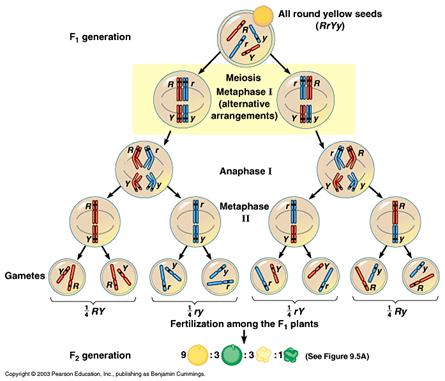
Chromosome
basis of inheritance
4) Variation in Mendel’s principle
a. incomplete dominance
-Heterozygotes exhibit intermediate phenotype.
ex. colour of snapdragon
flower
red flower: RR
white flower: rr
pink flower: Rr
Monohybrid cross of red and
white flower parents
P
generation
F1
generation
F2
generation
|
|
|
|
|
|
|
|
|
|
|
|
genotypic
ratio
phenotypic
ratio: red flower: pink flower:
white flower =
CBC News:
Quebec researchers find gene for brain disease
http://cbc.ca/storyview/CBC/2002/10/08/neuro_gene021008
Quebec
researchers find gene for brain disease
Last Updated Tue Oct 8 19:12:57 2002
MONTREAL--
Neurologists at McGill University have identified a defective gene that has
left hundreds of Quebec children in wheelchairs with a degenerative disorder.
The children suffer from Andermann's Syndrome,
which results from a mutation that inactivates a gene critical to the
development of the nervous system.
The gene is associated with the development of a part of the brain that bridges
the left and right hemispheres and allows the two sides to communicate. Without
it, the developing child will be unable to walk, will spend adolescence in a
wheel chair, his mind and body will deteriorate and he will likely die by age
30.
"This
is a gene that's not working," said Dr.Guy Rouleau of McGill University's Health Centre Research
Institute. "To replace the function of a gene is not an easy thing to
do." Most of those afflicted with the disease live in the Saguenay-Lac-St-Jean region north
of Quebec City, where one in 2,100
children is born with it, Rouleau said Tuesday.
Others cases have been identified in those with Quebec roots in Western Canada,
and the disease has also been found in Italy, Turkey,
South Africa and Brazil. One in 22 Saguenay residents thought to be a carrier. Researchers
believe some of the settlers who colonized the region had the defective gene.
Rouleau, who is
credited with the discovery, said parents will now be able to undertake a
simple test to determine if they are carriers of the defective gene. If two people who are carriers conceive a
child, there's a 25-per-cent chance the child will have the disorder. Since
the test of amniotic fluid can be done early in pregnancy, parents may decide
to end the pregnancy. Alain Coude's twin daughters,
Valerie and Alexandra, suffer from peripheral neuropathy because they inherited
the defective gene. He said he hopes the discovery might someday save other
families from going through what his family has.
Doctors
say the discovery is also significant because it yields important information
about the development of the brain and nervous system. The researchers say the
publication of their results in the November issue of the journal Nature
Genetics may rekindle interest in the area of genetic neuroscience worldwide.
Researchers analysed DNA from 191 French Canadian families, including 81 with
the disease, before finding the defective gene.
Written
by CBC News Online staff
Copyright
© 2002 Canadian Broadcasting Corporation - All Rights Reserved